Tien Chiu

  • Home
  • About Tien
  • C.V.
  • Online Teaching
  • Works
  • Essays
  • Travels
  • Book
  • Blog
  • Dye samples
You are here: Home / Archives for velvet

December 10, 2023 by Tien Chiu 8 Comments

Velvet doodles

The velvet warp is now dyed and in the Eternal Rinse Cycle. I say “eternal” because I’ve been soaking/rinsing it for two and a half days now and small amounts of color are STILL coming out. Really dark blues are prone to bleeding, and this is an extremely dark blue, but still, this is ridiculous. I am considering boiling it with detergent as a “Take THAT!” measure, because I am eager to get on with putting on the warp.

Normally I wouldn’t worry about a teeny-tiny bit of bleeding (it generally doesn’t stick), but there’s some chance I might decide to use white for the pile, in which case even a little bleeding will be disastrous. And velvet is VERY time-consuming to weave, so weaving an entire piece and then discovering bleeding would be, well, tragic. I could always try weaving a sample to find out, but better to avoid bleeding entirely.

I am not, however, planning on using white, at least right now. I spent the morning playing with potential color combinations. With a two-color polychrome velvet warp, I get three warp colors: the foundation warp, pile warp #1, and pile warp #2. I also get all the mixes of any two warps, with the caveat that the blends will generally not be smooth.

Because I am constitutionally incapable of doing anything simple, I’ve been messing around with gradients in both polychrome warps. I spent the morning doodling up possible designs with different gradient combinations, and have settled on these two gradients for the pile:


yellow to red color gradient
blue to green to blue symmetric gradient

The foundation warp, of course, is already decided (mottled dark blue, black, and purple) and will look like this:

mottled blue-black-purple background

(That looks like pure black, especially on a white background, but it’s not. It has very subtle color changes.)

I can choose any one of these color sets, or mixes of each of them, to work with in my design.

Here are a few of my doodles:

orange and yellow phoenix on blue-green background
"sunset" on an alien blue-green sky with mottled black liquid splashing upwards
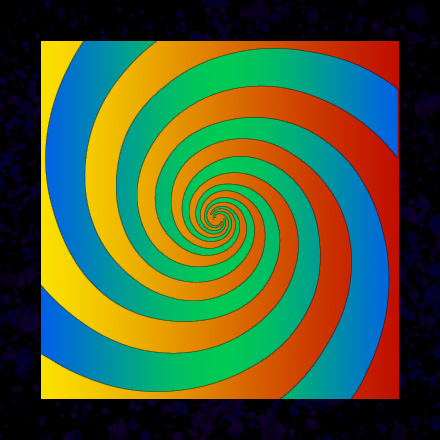
red-yellow and blue-green double spiral
red-yellow spiral

and my favorite:

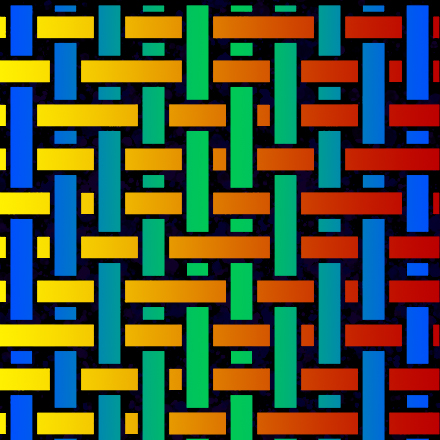
"woven cloth" in a double color gradient

The combination of an asymmetric gradient and a symmetric one produces a far more interesting result than two symmetric or two asymmetric gradients. That was a surprise, but I’m really liking it.

These are just doodles, not serious work. I’m exploring the space of possible designs with these color combinations so I can choose colors. I haven’t yet figured out how to create those gradients, how many threads to wind together, or any of a host of other things. And when I start, I’ll likely start with a series of samples to fine-tune my setup before progressing on to actual designs.

But I’m really excited by the possibilities so far.

Some people, on the other hand, are upset about my dereliction of duty as I play around with possibilities. Clearly it is time to stop playing with velvet and do my One Job – catering to feline whims.
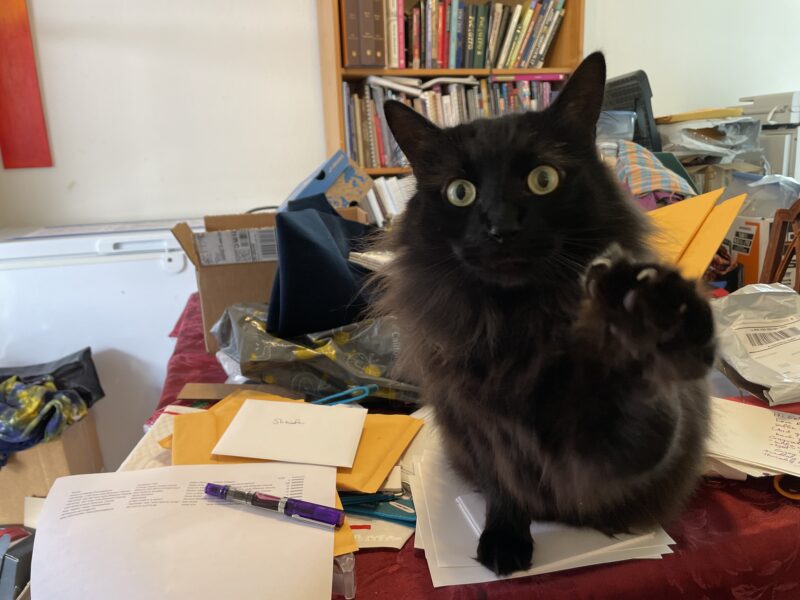
Fritz pawing at me, claws out.

Filed Under: All blog posts, textiles, weaving Tagged With: gradient colors, velvet

December 7, 2023 by Tien Chiu 8 Comments

Velvet progress, a new knotting tool, and autumn beauty

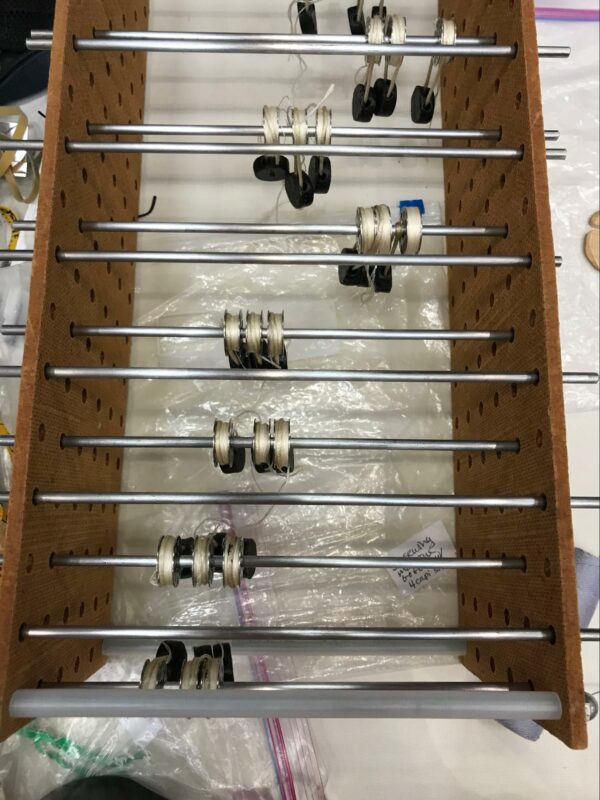
The last week has shown some progress on the velvet project. I met with Chris, my friend who is doing the cantra design (and probably most of the build), and we talked about the design. He thinks we can do better than the traditional cantra design, which involves a bunch of spools on a rod suspended in the frame. (For the curious, Peggy Osterkamp has some great photos of velvet looms on her blog.)

Here’s a photo I took of one of Barbara Setsu-Pickett’s velvet cantras (which is designed to break down neatly and fit into a suitcase). It’s only partially populated with bobbins, but you get the idea. A full cantra would be packed with bobbins edge to edge.

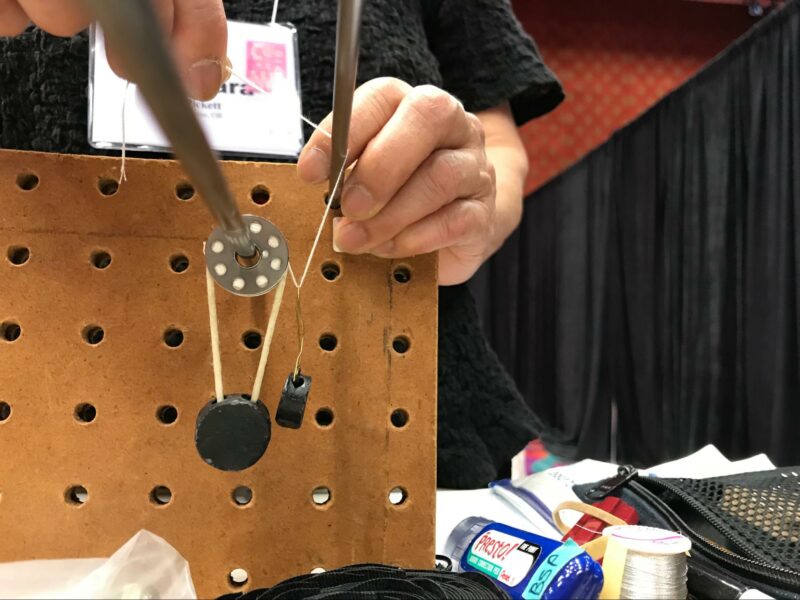
A weight hung over each spool acts as a brake, and another weight tensions the design. Here’s a pic I took of an individual weighted spool in the same cantra:

With 440 threads to warp, and two weights for each thread, that means managing 880 weights. Oy.

Excitingly, the only way to remove a spool from the center of the rack is to pull out the rod until you get to the spool you want to change. Simultaneously, you insert another rod from the other side to hold the spools on the other side. This obviously requires significant dexterity. It also has obvious potential for hilarity, should you lose your grip on the rod. Bobbins on the floor everywhere!

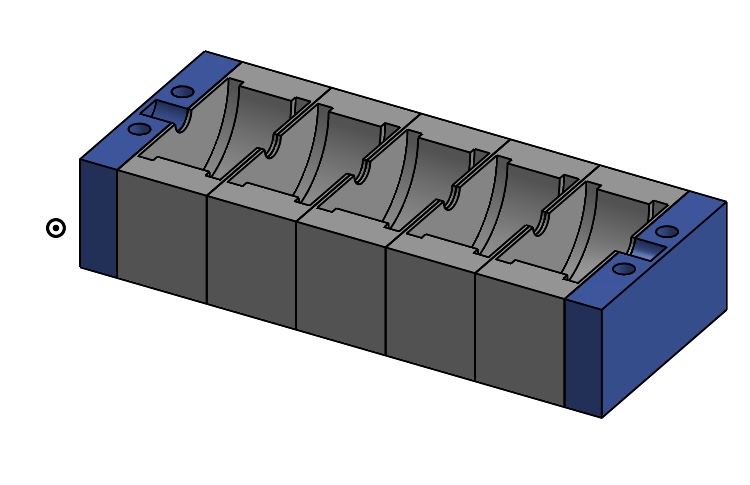
Chris has proposed a simple design modification to remedy both of those issues. Simply put a tray under each rack, lined or coated with something that adds a little friction. Each bobbin fits into a slot in the tray, and a rod runs through the bobbins. Here’s his schematic of the tray:

When you want to change out the spools/bobbins, simply remove the rod. The tray holds the bobbins while you swap out the one you’d like to change. No risk of bobbin hijinks.

The tray also allows us to replace the brake weight with friction against the tray, most likely by lining it with something that will add drag. (I’m thinking some of that rubber coating that is used on tools, but we’ll have to experiment.)

Obviously this is not something to be constructed by hand, but fortunately Chris has a 3D printer, which we can use to print the trays.

This is of course all experimental at this point, but at least it gives us a place to begin! Chris is working on a small prototype tray now, so we can see whether the idea works. If it does, then it’ll be on to the larger design.

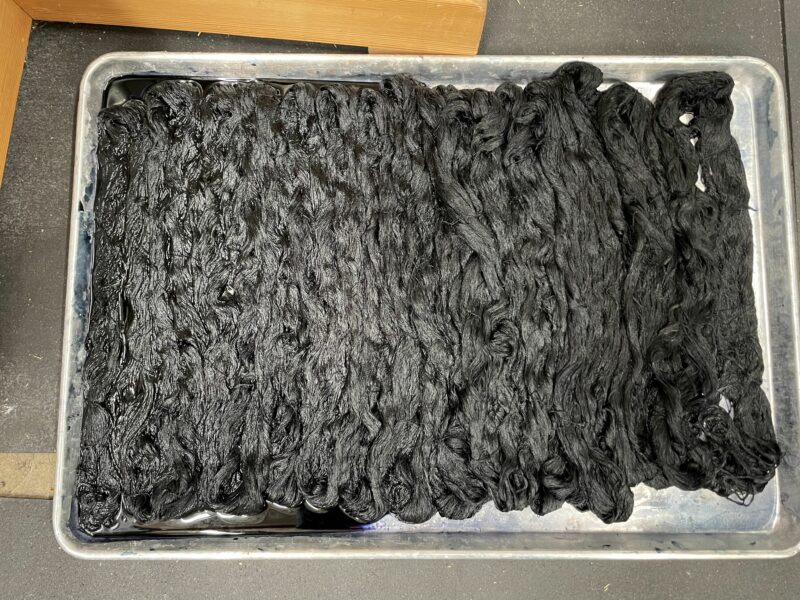
Meanwhile, I have wound the foundation warp and dyed it. I used deep indigo blue, dark purple, and black for the dye colors, scattering them about at random and squishing to make sure the dye got into all parts of the warp. It appears solid black in the photo below, but after 24 hours of curing and another 24 or so hours of rinsing out, some blues and purples are starting to emerge. I was aiming for a variegated black or super dark blue, so I think I’ve succeeded. Another day or two of rinsing, then another day or two of drying, and I’ll be done.

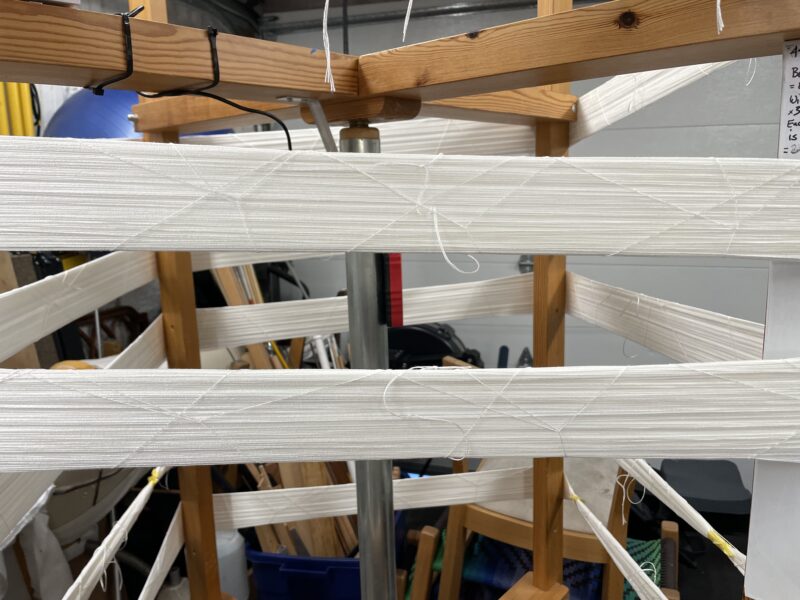
I tried a new thing with this warp. Waaaaay back when, someone (Debbie Kaplan, I think) had told me about protecting fine-thread skeins from tangling by “crocheting” a thread around the skein to help keep it together without compressing it. Since tangling can be a problem with warps that need a lot of rinsing, I tried that on this warp. Here’s a pic of what I did:

So far it seems to be working, holding the warp together without unduly squishing it. I’ll find out if it was effective when I actually put the warp onto the loom.

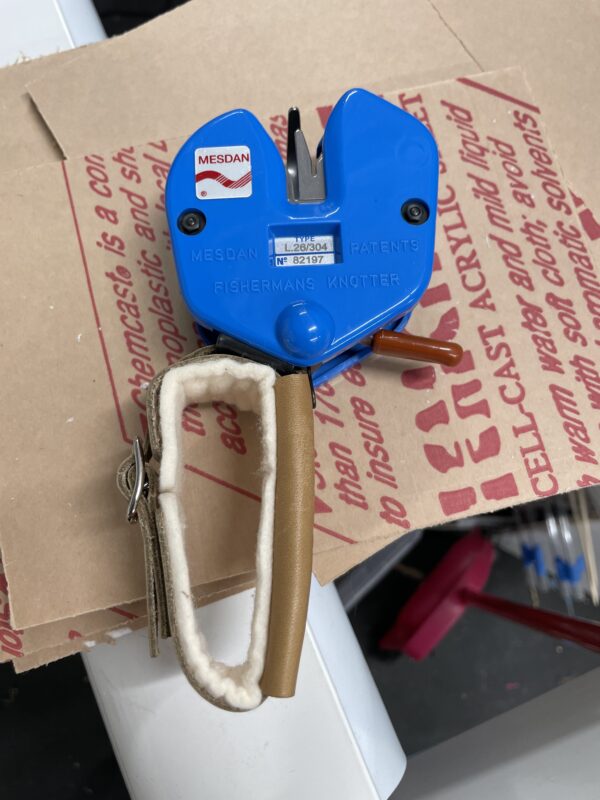
Since I will have to tie 2,200 knots to get the velvet warp and the painted warps samples onto the loom (yes – I am gasping for breath too), I decided to get a new tool: the Mesdan Fisherman’s Knotter. You lay two threads in it, under slight tension, pull the trigger, and presto! It knots the threads together and clips the ends.

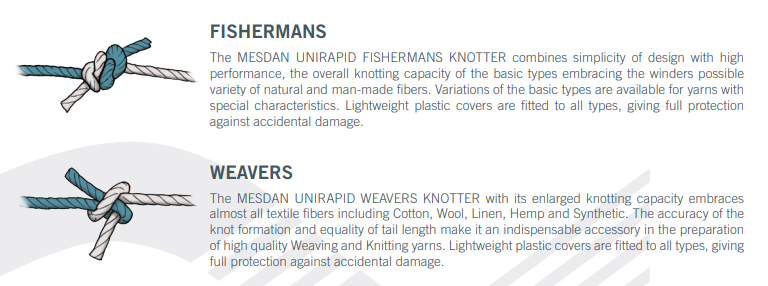
It’s not entirely unlike the Boyce Weaver’s Knotters that show up periodically on eBay. Except that this one isn’t a worn-out antique, but a new one. It also ties a much more robust knot – here’s a pic from the Mesdan catalog that shows the knots tied by the Fisherman’s and Weaver’s Knotters:

I was going to buy the Weavers Knotter, but the technician at AB Carter (where I bought it) told me the fisherman’s knotter would be much better for slippery fine fibers, such as my beloved 60/2 silk, or like the rayon embroidery thread I’m planning to use in the velvet warp. He also said he thought the ergonomics of the Fisherman’s Knotter would be better.

Here’s a YouTube demonstration of the Mesdan Fisherman’s Knotter in action:

I’m still not entirely sure how helpful it will be. I worry about repetitive stress thumb injuries with the knotter – so will have to test it and also take frequent breaks. I expect it will be faster and more secure than tying knots by hand, though!

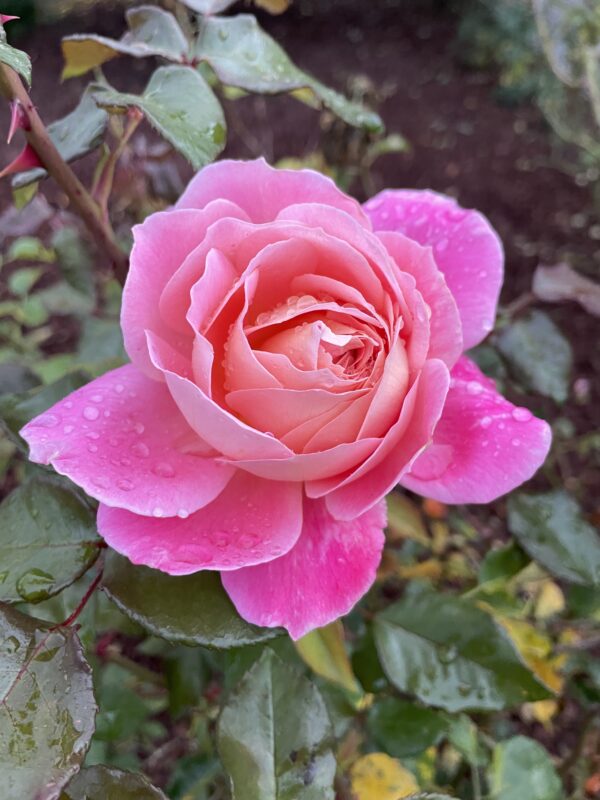
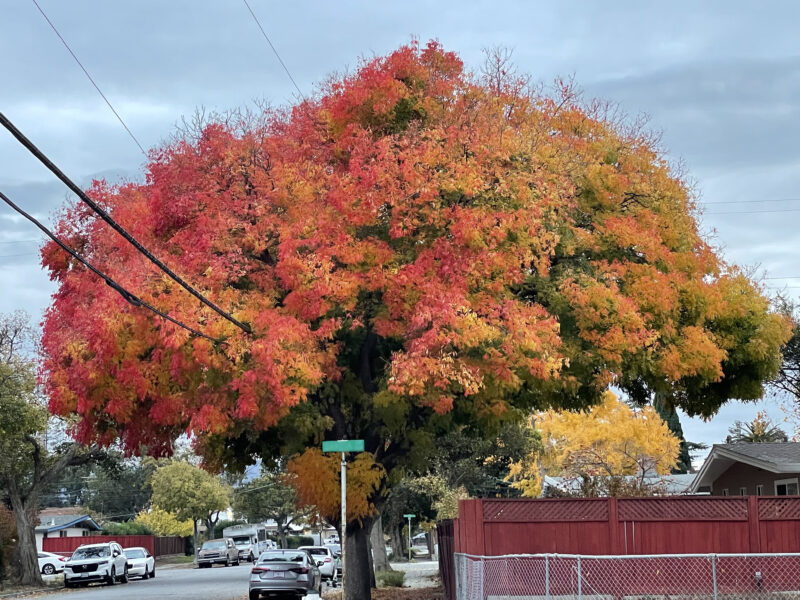
I’ll leave you with a lovely rose (yes, ours are STILL blooming!), and a gorgeous autumn tree (autumn starts in late November here!).

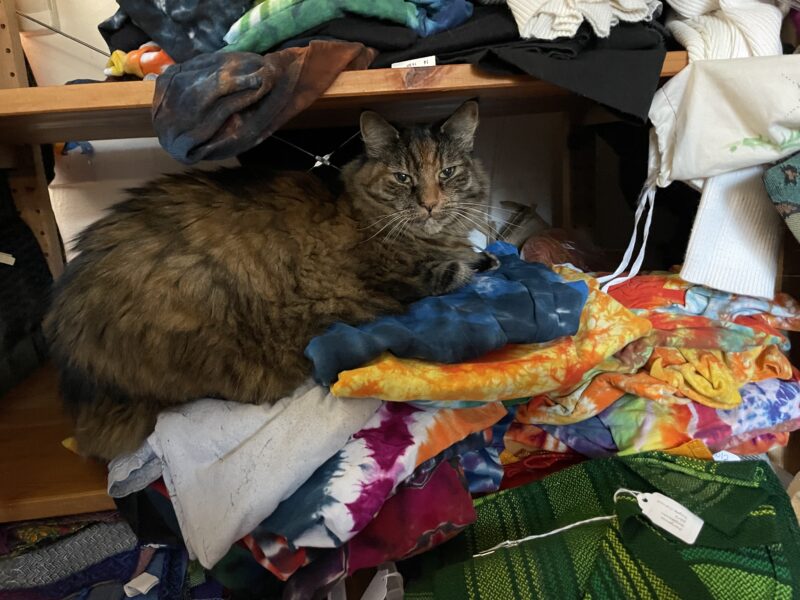
And, of course, the inevitable cat. Here’s Tigress on her favorite shelf, generously distributing cat hair over all my clean clothes. (I love her anyway.)

Filed Under: All blog posts, dyeing, textiles, weaving Tagged With: velvet

December 2, 2023 by Tien Chiu 3 Comments

Winding and painting the velvet warp

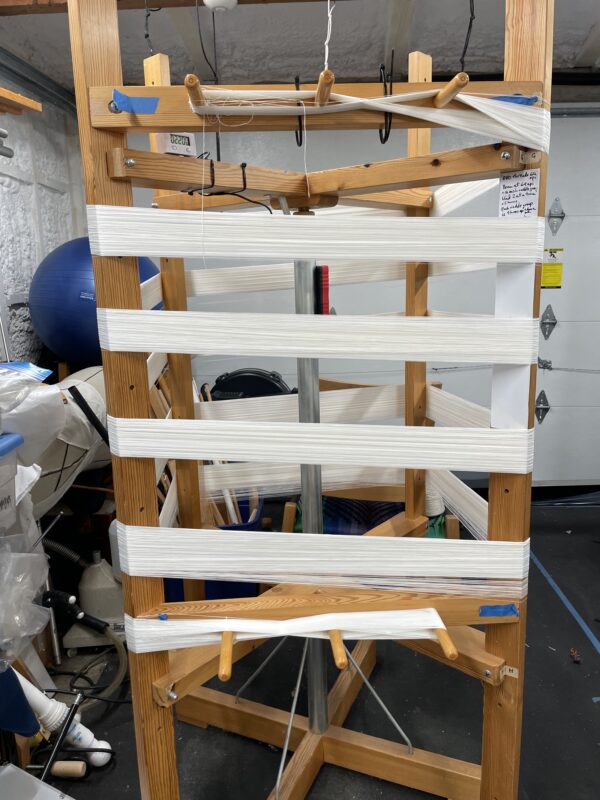
I’ve now fully wound the velvet foundation warp:

It’s 18 yards long, which is pretty close to “infinite” for velvet, because weaving velvet is verrrrrrry slow. On the other hand, tying on 1,320 threads is not something you want to do often, so I’m cool with having an infinite warp. When I get tired of those colors I will cut it off, but it leaves me lots of room for experimentation.

After much thought, I’ve decided to paint this warp. I was having a really hard time deciding between black and white. Black is MUCH harder to see, but I wasn’t thrilled with white, either. I seesawed back and forth for several days before deciding that a painted warp would be more interesting than either black or white. I’m going to paint it in shades of deep indigo blue, eggplant (dark purple), and (possibly) black.

I’m not going to paint it the conventional way, though, with stripes of color over the warp. Instead, I’m going to randomly dye it, scattering blue, purple, and black over it in small patches. This will produce patches of color that will have blurry edges and lots of color variation. I’m keeping the colors dark and low-saturation so it will make a good background – it won’t distract from the velvet pile if it shows.

I haven’t quite decided what to do about the pile warp yet. There are SO many options! I love gradients, so I was thinking about one symmetric gradient, going from purple to yellow and back to purple, in one warp color, and a solid colored warp.

Then it occurred to me that if I did TWO gradient warps, I could create the illusion of a bazillion colors by creating patches of each gradient in different colors, and using the dark background for background, like this:

I’m not sure how good that would look, though, as voided areas, where the foundation shows through, will show some pile warp and thus be less attractive than in the image.

As you can see, my visions are getting more and more complicated. I need to be careful to make sure that my initial designs aren’t too complex for me to handle. There’s always the next one.

I have time to noodle on that, though, as the velvet cantra is still in the prototyping stages. My friend Chris came by earlier this week to help out with the design, and suggested some improvements that will make it much easier to manage. He’s working on prototyping those improvements and will come back next week sometime with the prototype so we can test it out.

Meanwhile, I am also winding the warp for samples for the painted warps class I’m releasing with the Handweaving Academy in January. I’ve plotted out 27 samples and am winding two 440-thread warps 17 yards long, which will go on simultaneously as a double weave warp. I’m not actually going to weave double weave – instead, I’ll use it for weaving stripes of painted warp alternating with a solid color.

Once I get those warps wound, I’ll do a painting session and dye all three warps at once. I may throw in a few T-shirts, too, if I have time after painting everything. (One can never have too many tie-dyed T-shirts!)

To help with the knot-tying (1,320 knots in the velvet warp and 880 in the painted-warp-sample warp = 2,200 knots total), I’ve ordered a Mesdan fisherman’s knotter. This is a hand tool that (hopefully) makes tying on much faster – lay two tails of yarn into the knotter, squeeze, and presto! A secure knot.

I think, though, that before I can use it effectively, I’ll have to build some sort of jig to suspend it across the warp so I can have both hands free to select and lay in threads. Hopefully that should be quick and easy. I think four rods and some blue tape might be sufficient – we’ll see once it arrives, early next week.

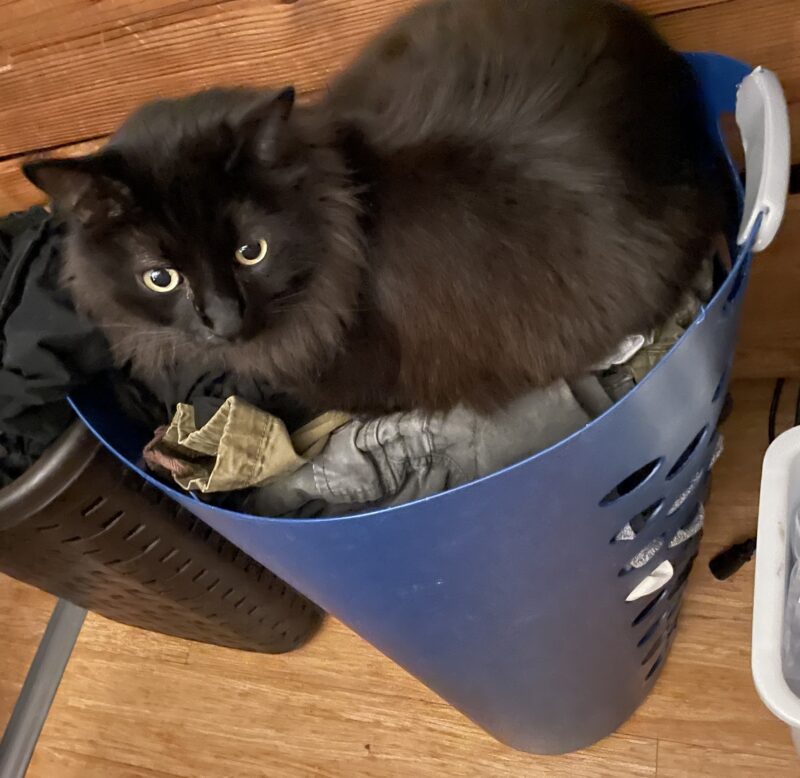
Meanwhile, Fritz would like to remind you that having a cat means never lacking for a laundry topper. Very considerate of him; as my friend Janet says, “You just can’t get the same quality and coverage of cat fur from a dryer.”

(Besides, wouldn’t ANYONE want such a handsome and friendly laundry topper?)

Filed Under: All blog posts, textiles, weaving Tagged With: velvet

November 25, 2023 by Tien Chiu 5 Comments

Adventures in velvet weaving

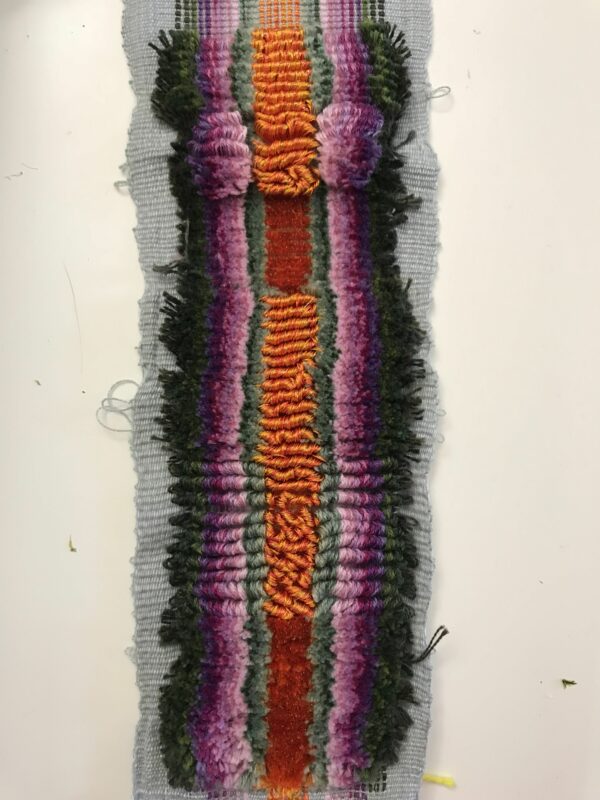
I’ve wanted to weave velvet for years. I fell in love with it when I took Barbara Setsu-Pickett’s velvet class at Convergence, back in 2018, where I wove this spiffy sample:

The sample shows a few of the things that can be done with velvet: cut loops, uncut loops, tall pile, short pile, different fibers (orange rayon embroidery thread center, cotton in the purple and green sections), etc. (It was also a ton of fun to weave!)

However, on my return home, I was daunted by the equipment requirements, especially for the number of velvet pile warps needed for weaving on the jacquard loom. I also emphatically did not have space for a velvet cantra (the frame that holds the bobbins for the pile warps) in the garage. Nor did I have the time to study velvet or set up the loom.

But times change. This time the catalyst was selling Maryam. Yep, I’m down to “just” one TC-2. I hadn’t used Maryam pretty much since I got her, and she was taking up a LOT of space in the garage. I had bought her because I thought you could only do one project at a time on the jacquard loom, in which case two looms made sense so I could weave samples on one loom and a personal project on the other.

However, I discovered that you can have multiple projects on one TC-2! You can’t do that on a wooden loom (because the wood will flex, you always want to center your warp), but the TC-2 has steel beams that won’t deflect at all if the warp is beamed to one side. Since my loom is three modules wide, that means I can potentially have three different projects on the same loom, as long as I don’t mind weaving relatively narrow (14.5 inch in the reed) projects (and purchasing some extra warp beams).

That means I can weave velvet, samples, and another personal project and switch between them, quickly and easily, on just one jacquard loom.

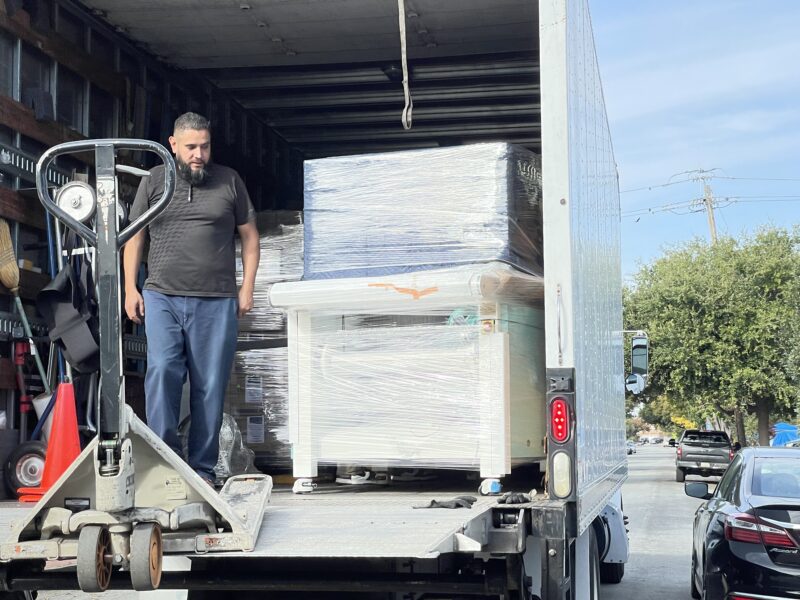
So I had been considering selling Maryam for a while, but wasn’t willing to put forth the effort to make it happen. Then I was contacted by a textiles professor at University of Georgia who was seeking a used TC-2 for his lab. We struck a deal, and Maryam left for her new home three days ago. Here’s a pic of her as she was loaded into the truck, headed for her new home:

I’m pretty sure she’ll be well-treated there. The plan is to use her to weave electronic textiles, which sounds much more interesting for her than sitting around in my garage.

Anyway, Maryam’s departure freed up a tremendous amount of space in the garage, including space for that velvet cantra.

So I’m back to working on velvet. The design possibilities are AMAZING. Even with solid velvet in a single color (which can be woven on a 4-shaft loom!), there are so many design choices:

  • cut vs. uncut loops – the uncut loops are typically much lighter and more lustrous than cut ends, though it depends on the fiber
  • Pile fiber (silk is shiny where it’s uncut, but is much darker and plush when cut; linen produces a stiff pile; unmercerized cotton produces a matte pile)
  • height of pile – shorter pile tends to produce a plusher result, while taller pile stands, well, taller; you can outline tall pile with a border of shorter pile, etc.

You can also do velvet where the pile appears in some places but not others, creating figured or voided velvet. You can cover the “blank” (non-pile) areas with brocading weft or another layer of cloth in a different weave structure.

And then if you want to get even fancier, you can do polychrome velvet, and have two or more pile warps going simultaneously. Then you have four options for design: no pile warp up, Color A up, Color B up, and both Colors A and Color B up. This allows you to do designs in Color A, Color B, AND the blends between them. The possibilities are endless.

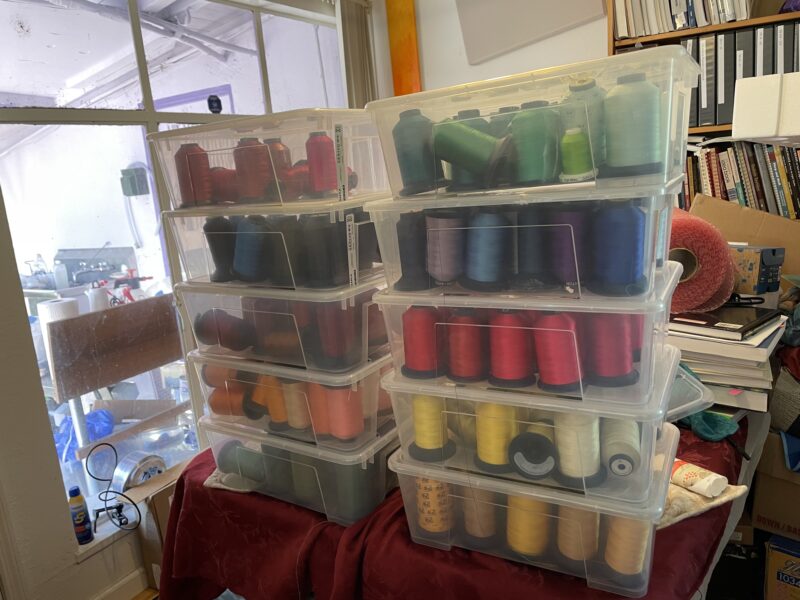
I was fortunate enough to chat with Wendy Landry yesterday. She wrote the definitive book on velvet, Velvet on My Mind, Velvet on my Loom – and patiently answered all of my zillion questions. I have another friend who’s good at woodworking, and who will help me build the velvet cantra. I am also armed and dangerous with five hundred Style M bobbins (meant for sewing machines, but good for velvet pile, too), an automatic sewing-machine-bobbin winder, and one hundred sixty-two 5500-yard cones of rayon embroidery thread (mostly full) in 97 colors. This is going to be FUN!

The current plan is to weave velvet at a density of 90 ends per inch, using 20/2 mercerized cotton for the foundation warp, and putting on a polychrome (two sets of colors) pile warp. One of the polychrome pile warps will be solid black, 60/2 silk; the other will be a symmetric color gradient in shimmering rayon machine embroidery thread. That should allow me to create a nearly infinite array of designs.

Because I’m weaving only 14.5 inches wide, I’ll have to put on “only” 1,320 warp threads. That’s a lot, but not infeasible. I’m really looking forward to this project, and have already started winding the warp for the foundation cloth.

WHEE!!

Meanwhile, I have been keeping up with the powerlifting. We recently tested my max lifts, and I’m pleased to say that I can now:

squat 305 pounds:

deadlift 315 pounds:

and bench press 155 pounds (sorry – forgot to video that one!)

That totals 775 pounds. I only need 703 pounds to qualify for USPA Nationals next June, so my goal is to do a meet in January to get an “official” number, and register for the national-level competition as soon as possible afterwards. I’m crossing my fingers and hoping that it doesn’t fill up before I can register.

Because, as you know…

Filed Under: All blog posts, powerlifting, textiles, weaving Tagged With: velvet

December 7, 2019 by Tien Chiu Leave a Comment

Learning CAD design!

I’m off on a little vacation right now, visiting family for a couple days in Maryland before looping up to New York City to visit my old friend Edouard for a few days. It’s a bit of a working vacation, but I’m also using some of the time for personal projects that I wouldn’t have time or focus for if I were at home, distracted by a zillion other things. One of them is (finally!) learning CAD design so I can create models for 3D printing!

The driver for this project is velvet weaving. My design-genius friend Dave came up with a design for a better velvet-weaving spool rack and tensioning system, but it requires some parts that are probably best 3D-printed. My esteemed spouse is currently busy doing other things, so I’ve decided to learn how to do my own designs for 3D printed objects. After all, how else am I supposed to design a 3D-printed flamethrower with which to take over the world? (Don’t worry, you can 3D-print in metal. I wouldn’t try to print a plastic flamethrower!)

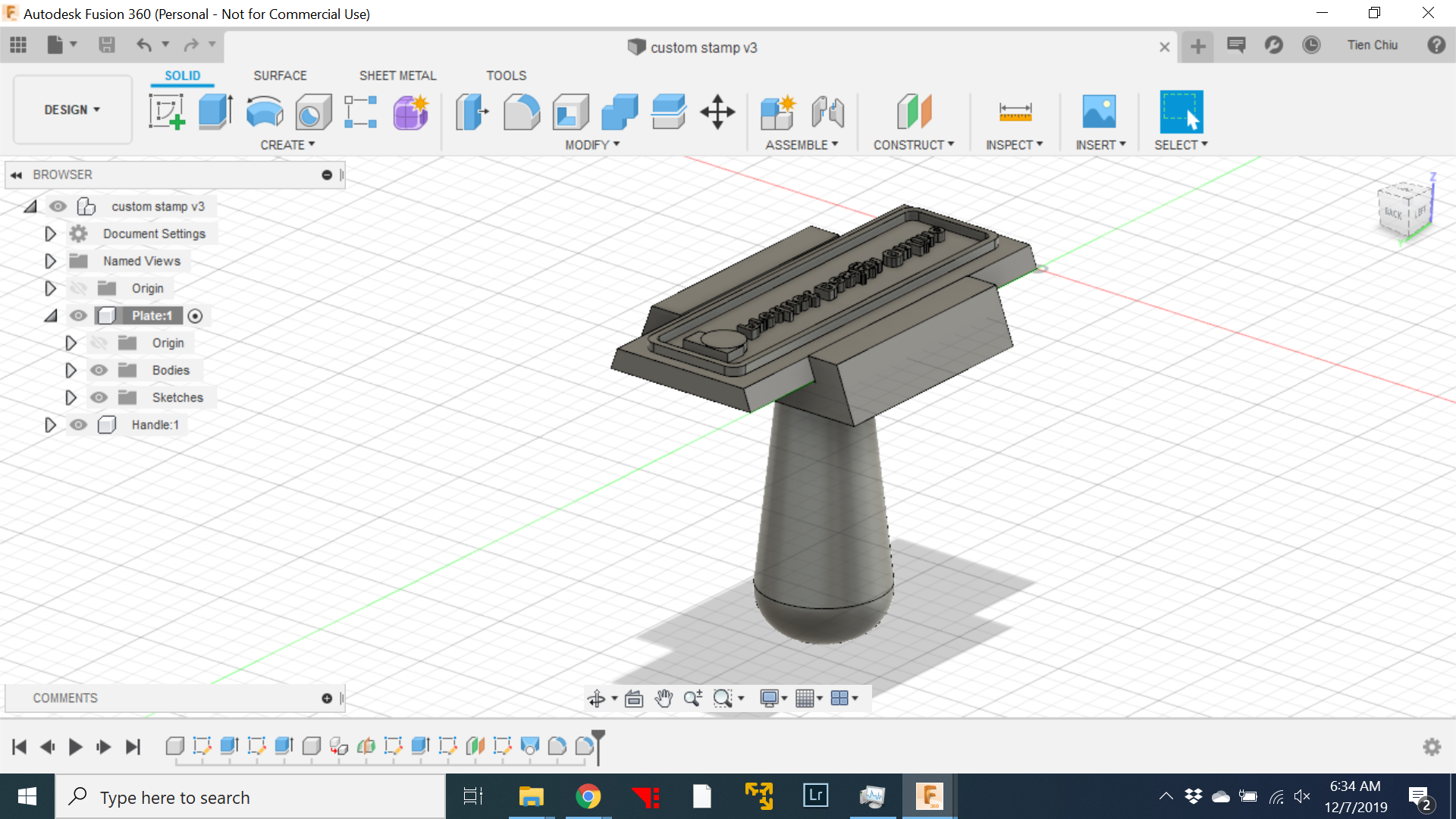
Alas, the learning curve for CAD design software is as steep as the learning curve for Photoshop, so while at home I never had the peace, quiet, and free time to sit down and figure it out. While visiting family, though, I’ve got a lot more free time, so I spent about two hours this morning working my way through this excellent tutorial, and have now created this lovely stamp:

Fusion 360 screenshot
Fusion 360 stamp model

It was both far easier and far more complicated than I thought! I’m giving the knowledge a couple hours to settle into my head before tackling the next lesson. The author has a series, Learn Fusion 360 in 30 Days, on YouTube – I’m going to get through as many of the lessons as I can in the week that I’m traveling. I don’t need to become an expert in order to do the few simple projects I have in mind, but knowledge is never wasted!

Meanwhile, work on “Seasons of Creativity” continues. I think I’ve figured out how to do it with three painted-gradient wefts and one solid black weft. I may throw in some iridescent wefts for the butterflies and have ordered some wefts from Giovanna Imperia Designs. I’m currently working on designing the leaves, and will work on the butterflies next. I expect progress on that to be slow as working with Photoshop on a laptop screen is cramped and difficult – but, well, we’ll see. More photos once I get further along in my sketches!

Filed Under: All blog posts, textiles, weaving Tagged With: seasons of creativity, velvet

  • « Previous Page
  • 1
  • 2
  • 3
  • Next Page »

Archives

Tags

aids lifecycle outfits autumn splendor book cashmere coat cats celtic braid coat color study cross dyeing design design class devore doubleweave doubleweave shawls drawing dye samples dye study group gradient colors house infinite warp jacquard loom katazome knitted blanks kodachrome jacket ma's memorial mohair coat network drafted jacket/shawl project network drafting painted warp phoenix rising phoenix rising dress phoenix rising kimono phoenix rising reloaded pre-weavolution project sea turtles taquete tie-dye tied weaves tomatoes velvet weaving drafts web design website redesign wedding wedding dress woven shibori

Categories

  • Africa
  • aids lifecycle
  • All blog posts
  • All travel posts
  • Asia
  • Bangkok
  • Belize
  • Cambodia
  • Central America
  • Chai Ya (Wat Suon Mok)
  • Chiang Mai
  • Chiang Rai (Akha)
  • China
  • chocolate
  • computer stuff
  • creating craft
  • Creative works
  • cycling
  • Delhi
  • Dharamsala
  • drawing
  • dyeing
  • Fiber Arts
  • finished
  • food
  • garden
  • Ghana
  • Guatemala
  • Hanoi
  • Ho Chi Minh City
  • Hoi An
  • India
  • Khao Lak
  • knitting
  • Knitting
  • Ko Chang
  • Laos
  • Luang Namtha
  • Luang Prabang
  • markleeville death ride
  • meditations on craft
  • mental illness
  • musings
  • Phnom Penh
  • powerlifting
  • Rewalsar (Tso Pema)
  • sewing
  • Siem Reap (Angkor Wat)
  • Southeast Asia
  • surface design
  • textiles
  • Thailand
  • travel
  • Vangvieng
  • Vientiane
  • Vietnam
  • Warp & Weave
  • weaving
  • Weaving
  • weavolution
  • writing

© Copyright 2025 Tien Chiu · All Rights Reserved ·

Loading Comments...