Tien Chiu

  • Home
  • About Tien
  • C.V.
  • Online Teaching
  • Works
  • Essays
  • Travels
  • Book
  • Blog
  • Dye samples
You are here: Home / Archives for diversified plain weave

December 17, 2010 by Tien Chiu 1 Comment

Woven sample and trapeze warp

By working diligently (okay, obsessively) after B. got up, and a little bit at lunchtime, I got the warp set up and this sample woven:

Woven sample, cherry blossoms in diversified plain weave

Aside from a few skips where shaft #24 was acting up, it looks GREAT! and I think I will most likely use it for my bathrobe.  I still need to weave a couple more samples, both to test how it looks after dyeing and to see how well rayon and cotton chenille stand up to multiple machine washes (on delicate) and tumble drying.  This sample has a rayon chenille weft (two strands of 3000 ypp rayon chenille), I want to do another sample with 1450 ypp cotton chenille weft, and see how they differ once wet-finished and washed/dried a couple times.

I want to use rayon chenille for the weft if possible, because I think the luster of the rayon chenille will really “pop” the cherry blossoms once dyed in bright gold/red/oranges.  But I want to try cotton chenille as well.

And I am pleased to say that the trapeze method for the second warp works perfectly:
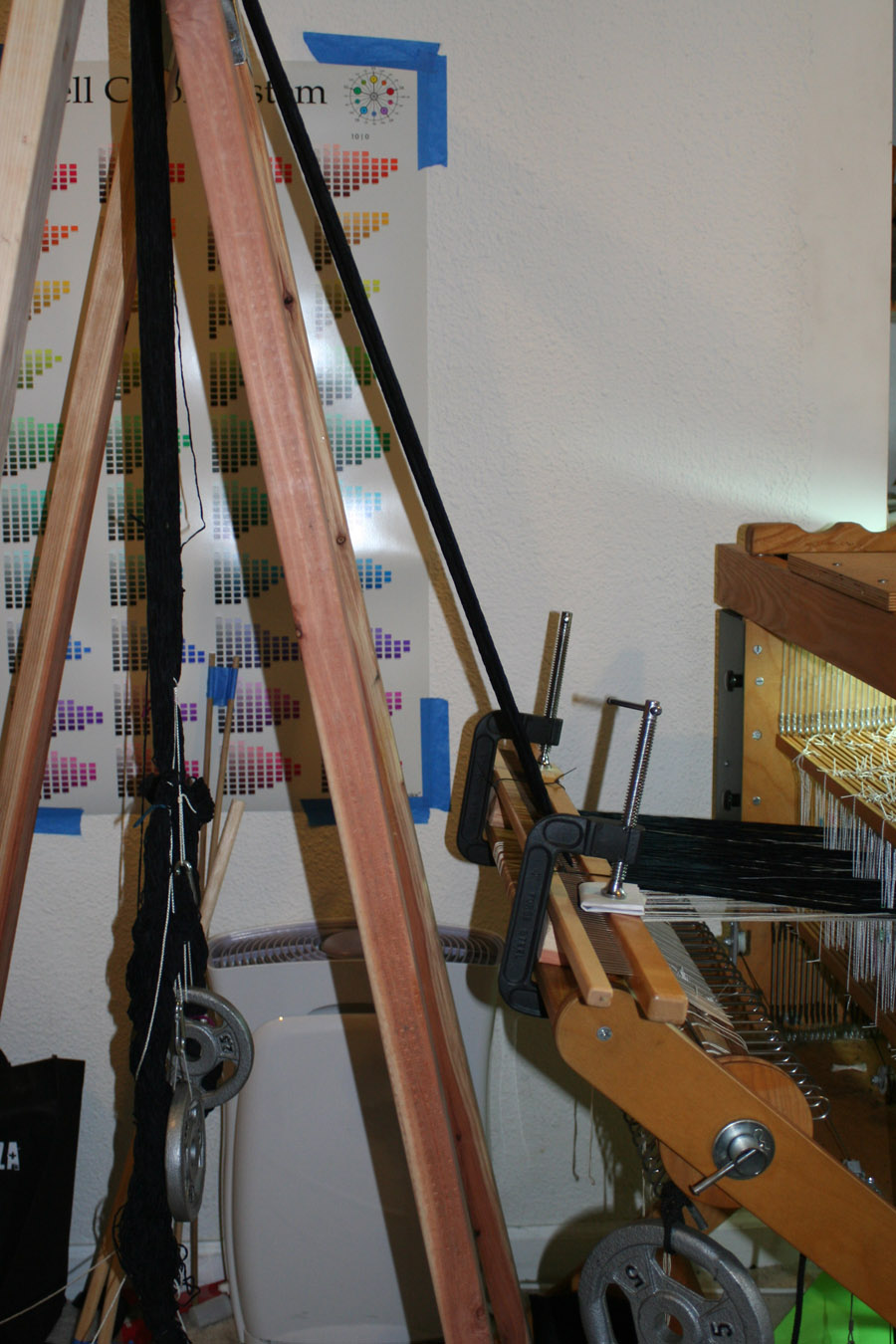
2nd warp, hung on trapeze

The black (cotton chenille) warp passes through the heddles and through a raddle clamped onto the back beam of the loom (with wooden spacers under the raddle to keep it from interfering with the 1st warp).  From the raddle, it goes up and over my free-standing trapeze, which is made with two sawhorse brackets and 5 pieces of 2×4 – quick, easy, and cheap.  I used two chains for a 12″ warp and weighted each chain with a 2.5-lb weight that I had sitting around.

And it works great!  I can hardly wait to get the cotton chenille sample woven, so I can cut off and dye the samples.
Filed Under: All blog posts, textiles, weaving Tagged With: bathrobe, diversified plain weave, trapeze, two warps

December 17, 2010 by Tien Chiu Leave a Comment

A tale of two warps

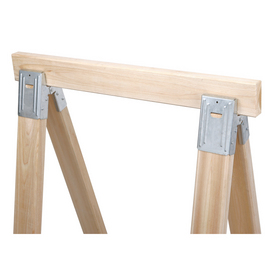
By being my usual cheerfully obsessive self, I got the rayon chenille warp wound and both warps threaded and sleyed yesterday.  (Lest you be impressed, there were only 360 ends in this particular sample, as it’s only 12″ wide.)  I also finished making my free-standing trapeze, which is basically an oversized sawhorse.  I put 5’8″ legs into a pair of cheap sawhorse brackets ($7.58 a pair at Lowe’s Hardware) and stuck a 2×4 in between.  Here’s the stock photo of how the sawhorse brackets work:

Sawhorse brackets
Sawhorse brackets

I’ve basically done the same thing but with much longer legs than a conventional sawhorse.  I’m also leaving the top loose to make the sawhorse easier to break down; I’ll screw  it down temporarily while using it, then remove the screws later.

I worry a bit about the trapeze tipping over, but if it looks like that might happen, I’ll follow B.’s advice and run a big bolt through the back legs a foot or two from the floor, and hang some weightlifting plates from the bolt.  I already have them for my live-warp tension system, so I won’t have to buy anything new.

Also, I plan to fix a raddle onto the back beam of the loom, like so:

second warp, passing through raddle, which will be clamped to the back beam with a wooden-block separator to keep it from catching the first warp (wound onto the back beam)
second warp, passing through raddle, which will be clamped to the back beam with a wooden-block separator to keep it from catching the first warp (wound onto the warp beam)

The idea is that the warp passes over the trapeze and through the raddle on the back beam, spreading the warp out and bringing it level to the heddles.  (All sorts of unintentional hilarity would ensue if the warp came in directly off the top of the trapeze!)  A useful side effect is that it ensures that most of the pull on the trapeze is  vertical rather than horizontal, reducing the odds of tipping over.

I had a lot of trouble getting the tension even on both warps while tying on, and finally decided to tie on the two warps separately.  I had trouble getting the rayon chenille warp tensioned correctly, with the ends even, because it was not tied to the back beam.  Finally I hung the chains off the back of the loom, weighted them with a couple of C clamps, and used that light tension to pull against, to get the ends even.

And voila:

Two warps, lashed on separately

I am a bit worried that the two lashings-on will interfere with each other, preventing  equalizing of tension, but I think I can manually adjust the tension on the strings if necessary.

On the whole, handling two separate warps, one wound on the back beam and one not, was a royal pain.  For my next sample, I will try winding two warps together onto the back beam and using the weighted-rod method to make sure the looser warp gets tensioned correctly.  I had been worried that the weighted rod would hit the floor before the end of a 15-yard warp, but Jean from Weavetech offered the brilliant idea of throwing the weight for the weighted rod over the top of a trapeze, thus allowing a lot more space for the rod to “drop” before it hit the floor.

The only possible problem with winding two warps together on the back beam is capacity – I want to put on a 15-18 yard warp, and I’m not sure I can fit a 15-yard warp in 1450 ypp rayon chenille onto my warp beam.  Hanging a second warp from the trapeze would solve this problem neatly.  The only way to find out whether it will work is to try, of course, and I plan to do so.

Anyway, I am now threaded, sleyed, and lashed-on.  The only things left to do are to set up the trapeze, clamp down the raddle, toss the rayon chenille warp over the trapeze and weight it, and then – WEAVE!

None of which can be done  until B. gets up (in about an hour), so meanwhile, I’ll catch up on my reading.  I finally got a copy of Doramay Keasbey’s Designing with Blocks, and it is fantastic.  I also intend to play some more with WeavePoint, which B. bought me as an early Christmas gift.

And, of course, there is always the Black Sheep presentation to work on.  I have the basic framework in place and am now struggling to make it visually interesting, instead of a series of boring bullet points.  I think I’ll be able to finish it before the deadline in January.

Filed Under: All blog posts, textiles, weaving Tagged With: bathrobe, diversified plain weave, two warps

December 15, 2010 by Tien Chiu 1 Comment

Blossoms of fire

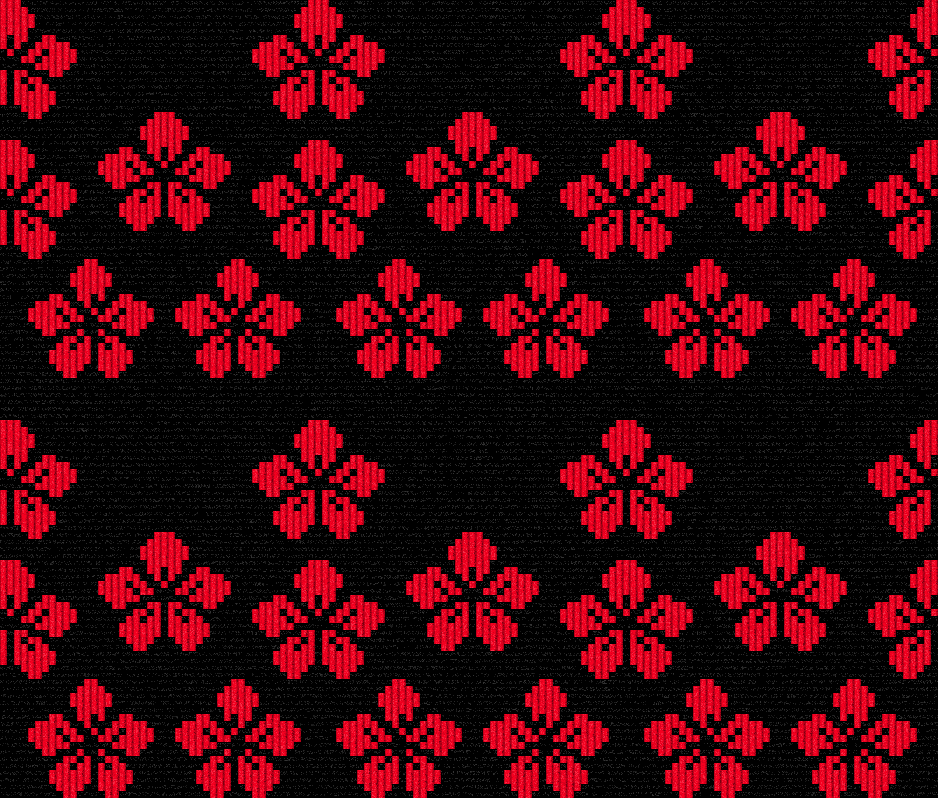
I was doodling along last night, making a cherry blossom motif, and almost by accident found a pentagonal arrangement of the cherry blossoms that is quite pretty:

cherry blossom, pentagonal arrangement

In this particular draft, the cherry blossoms would come out about 2″ wide – big enough to be seen, but not big enough to dominate.  So I like this.

The actual draft is different, of course.  I was just doodling, so this is a 24 block profile draft, and I can only get 22 blocks in diversified plain weave.  Nonetheless, I find this pleasing and will probably work a variation up as a sample.  (The final fabric will be in mottled flame colors, of course, after I scrunch-dye the fabric.)

The cotton chenille yarn should be dry tonight or tomorrow morning, which will allow me to wind the rest of the warp and start threading.  I’ve decided to try two types of weft: 1450 ypp cotton chenille, and a doubled strand of 3000 ypp rayon chenille.  I’d like to use the rayon chenille for the weft, because it’s glossier and will really make the cherry blossoms “pop”, but this bathrobe has to be able to stand up to occasional machine washing and tumble-drying (on “delicate” and “low”, of course), and I’m not sure whether rayon chenille will do that, even with a cotton chenille warp to help lock things down.  The fine weft will be 60/2 silk in either case.  I’m a little worried about differential shrinkage (cotton/rayon will shrink, silk won’t) but we’ll just have to see how the sample turns out after wet-finishing.

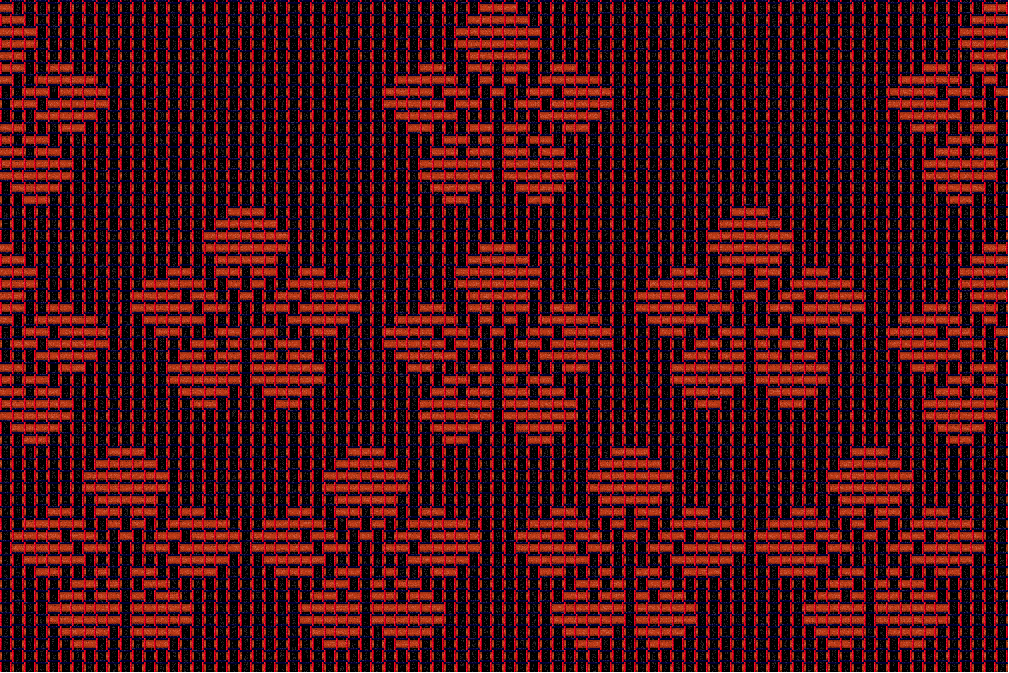
Update: I just finished doing up the draft in diversified plain weave.  Here’s a simulation of the fabric:

Pentagonal cherry blossom design, in diversified plain weave on 24 shafts

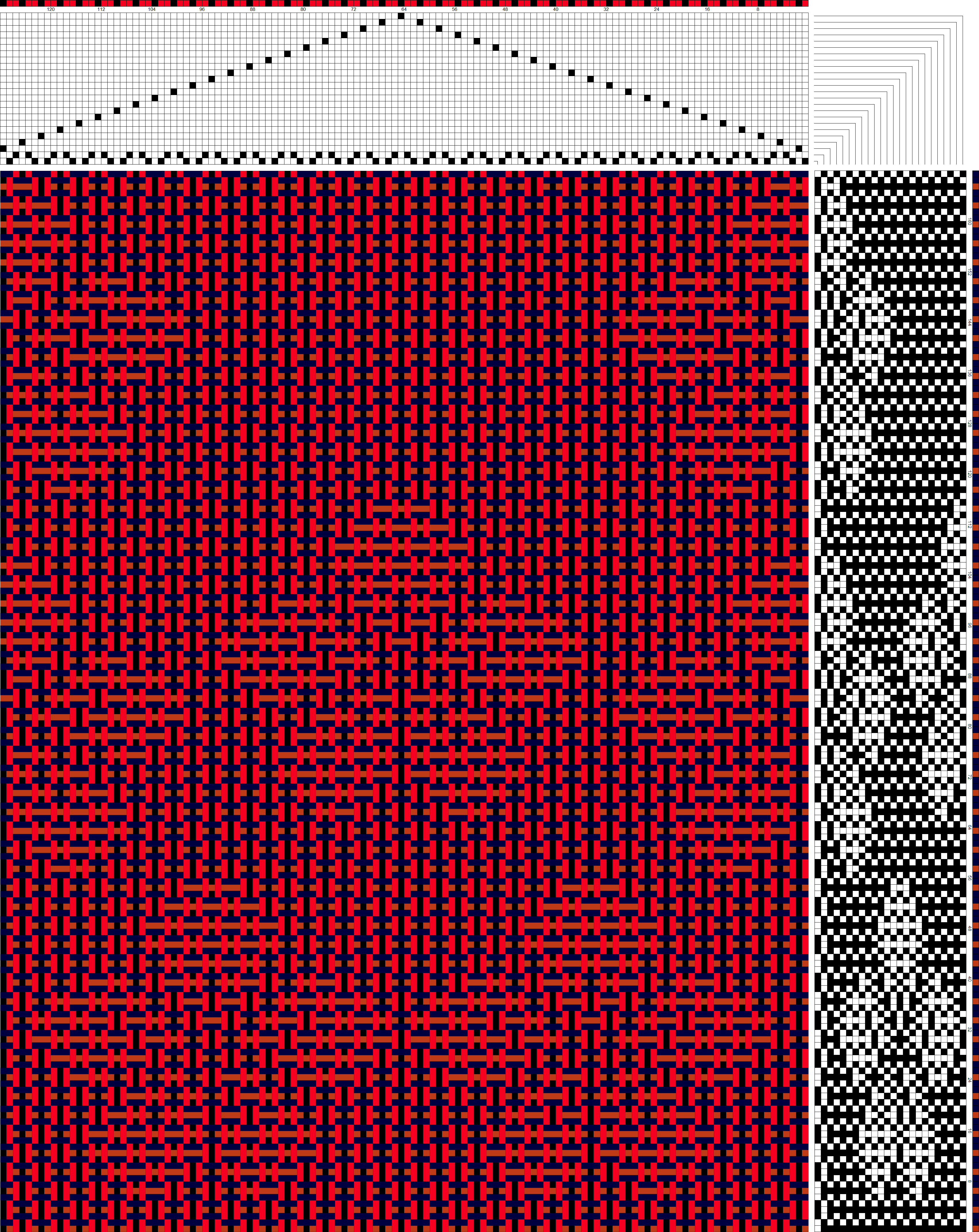
And here is the draft (click to view the full size version)

Draft for diversified plain weave cherry blossoms on 24 shafts

I think I have the draft right, but will have to check against my references.  And then weave it up, of course!

Filed Under: All blog posts, textiles, weaving Tagged With: bathrobe, diversified plain weave

December 14, 2010 by Tien Chiu 2 Comments

Change in pattern

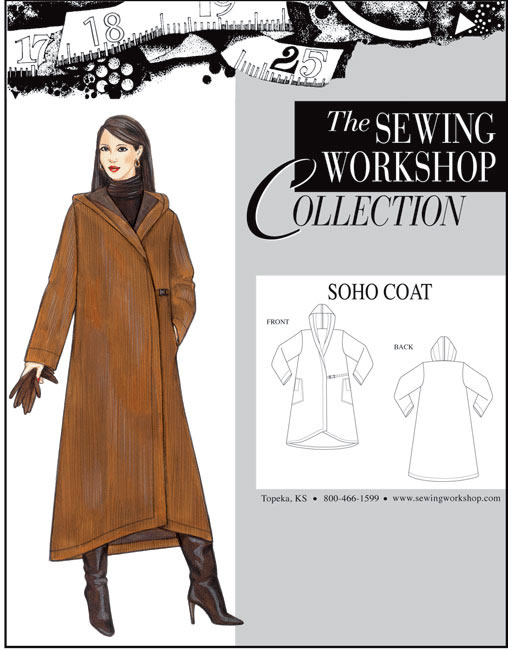
Yesterday I remembered a wonderful site that has reviews of sewing patterns.  So I went to check out the patterns I’d been looking at.  The first coat pattern looked atrocious (I thought) when actually sewn; the second one has too much flare at the hips, I think.  However, I did stumble across this wonderful-looking pattern from The Sewing Workshop:

Soho coat pattern from The Sewing Workshop

I don’t know that I’d go for the hood, but the rest of it looks really elegant, and the photos in the pattern reviews look just as good!  And the pattern is designed for 45″ fabric, so will be much easier to cut from 22″ handwoven yardage.  So I’ve ordered a copy of the pattern.

I dyed the black 1450 ypp cotton chenille yesterday, which was a disastrous exercise in things you shouldn’t do.  All of which boils down to, “Never try to dye outdoors when it’s almost too dark to see, you’re tired, and you’ve never attempted this dyeing procedure before.”  I managed to spill the soda ash, cut a hole in my glove (I now have one black finger!), get the dye powder almost hopelessly clumped, and get a huge pile of undissolved salt at the bottom of the dyeing pan, but – thank goodness – I was dyeing the yarn black, so I don’t think most of those errors will show.  It’s currently rinsing out in cold water, and I’ll try drying it this evening.

I’ve also realized that 24 epi will not work gracefully as a sett.  For diversified plain weave, the best way to sett the yarn is three ends to a dent, with the thick yarn and the two thin yarns flanking it sleyed as a single unit.  That works great for 24 epi – IF you have an 8-dent reed, which I don’t.  I do have a 10-dent reed, so I am going to try setting up at 30 epi, using 1450 ypp cotton chenille and 60/2 silk for the fine threads.  (Because I am practically swimming in 60/2 silk, and it’s stronger than 40/2 cotton.)  I also have some 2000 ypp cotton chenille on its way, in case the 1450 is too heavy.

So the next few days will be all about sampling…and then dyeing the samples!  I think the dyeing part will be loads of fun, I’m going to scrunch-dye it in yellow, orange, and red, to produce a flame-colored pattern on a black background.

Filed Under: All blog posts, dyeing, textiles, weaving Tagged With: bathrobe, diversified plain weave

December 11, 2010 by Tien Chiu 3 Comments

…to meet the Queen

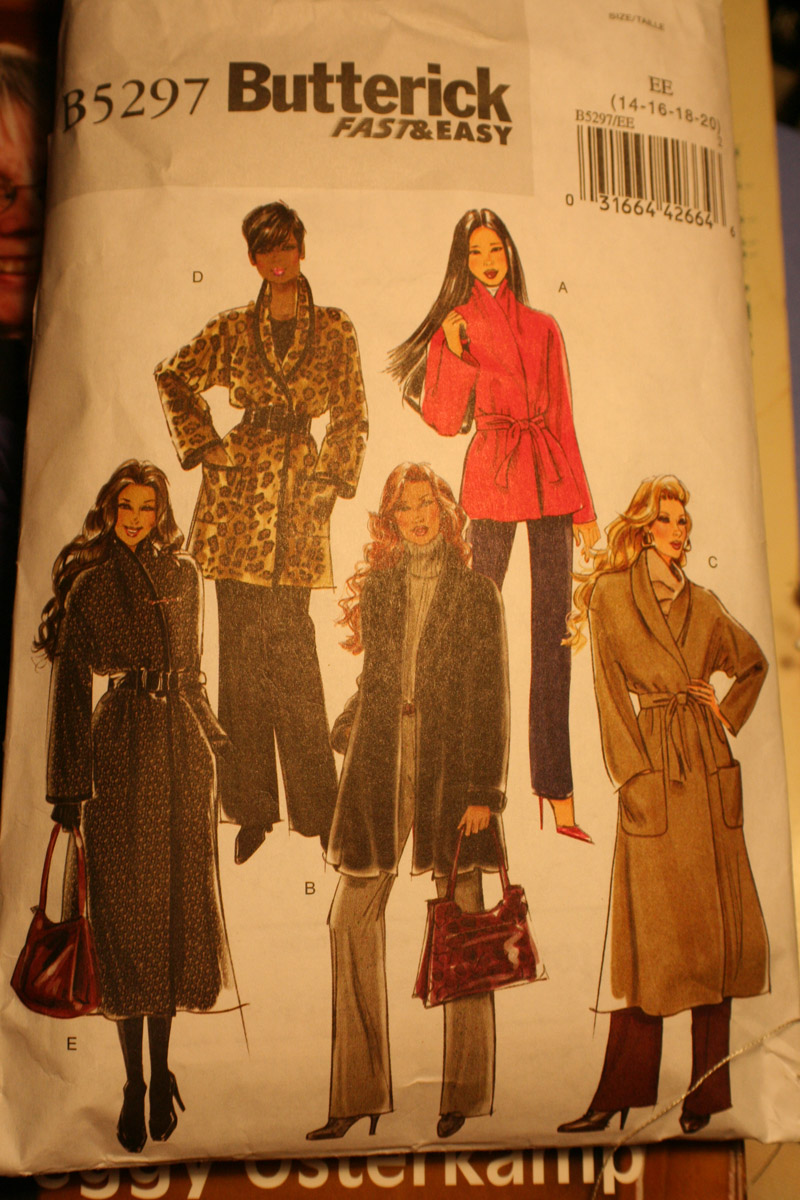
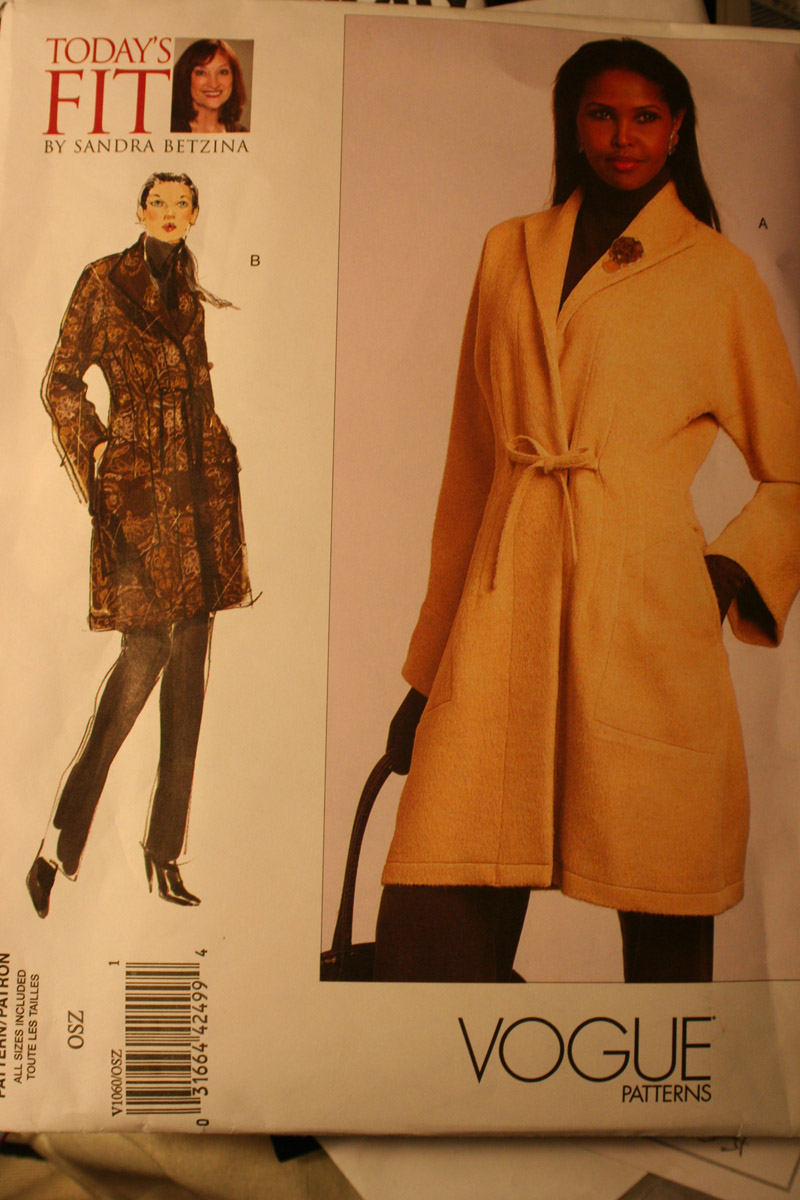
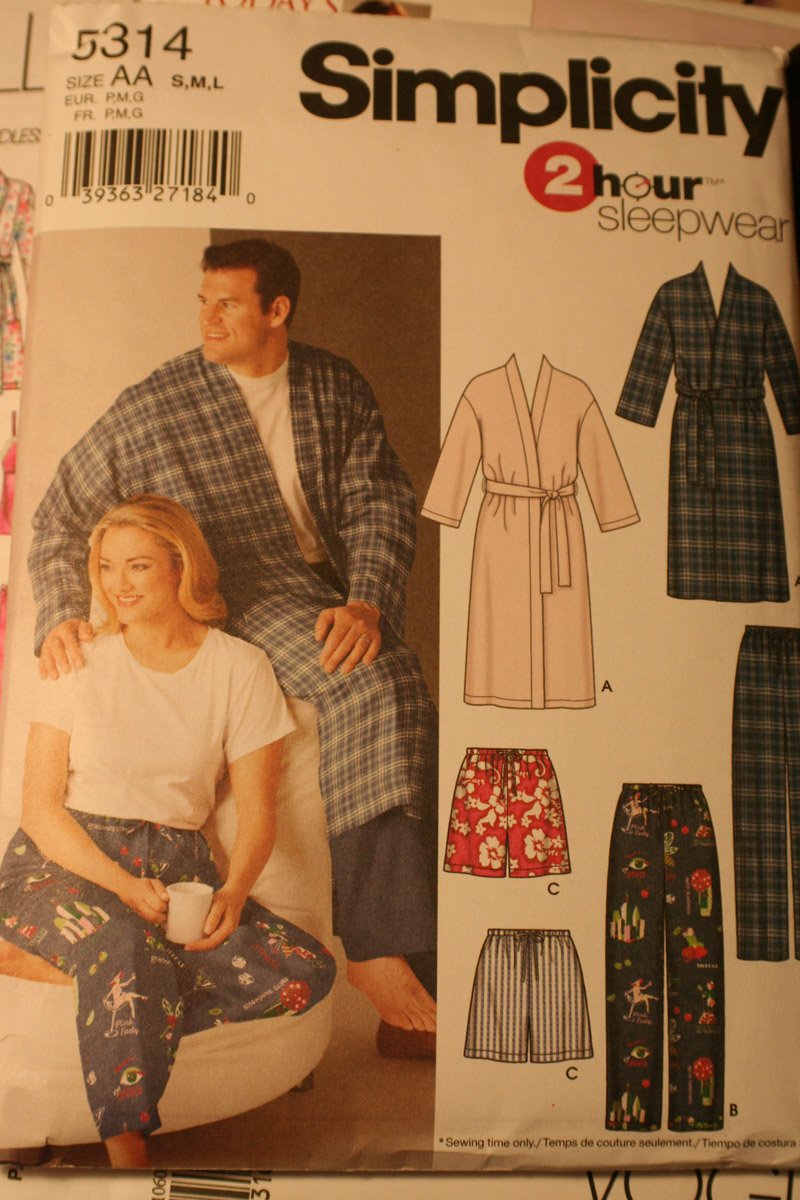
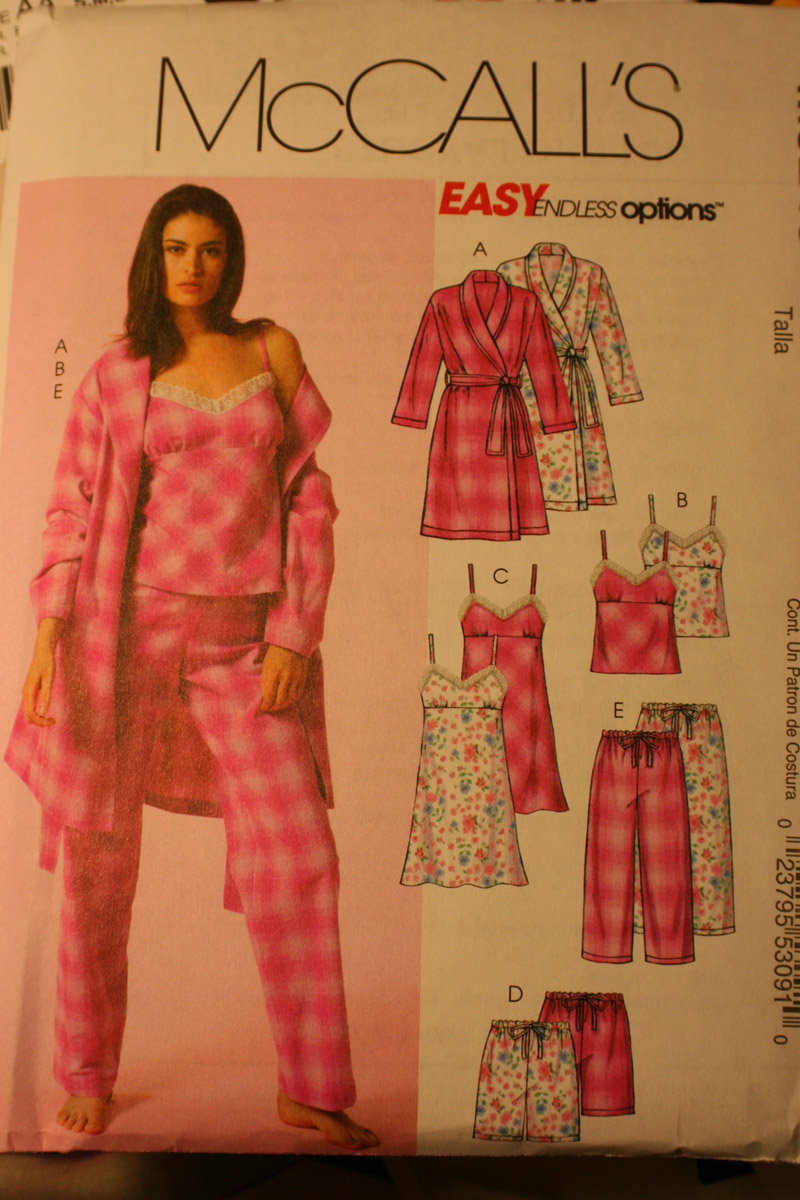
After spending some time yesterday scoping out bathrobe patterns, I’ve changed my mind: I do in fact want a bathrobe “to meet the Queen”.  My reasoning is pretty simple: bathrobe patterns are simple and boring, and I am constitutionally incapable of doing anything boring!  Also, it would be fun to enter the bathrobe into various weaving shows, and if so, it should be a svelte, graceful, knock-your-socks-off bleeding-edge-of-hot-fashion bathrobe.  I mean, imagine the fun if a bathrobe won a fashion show?

Umm, yeah.  Actually these are the patterns I’ve been considering:

An elegant, knock-your-socks-off, classic coat, I mean bathrobe, pattern
A somewhat less elegant coat pattern
A clearly not-fancy-enough bathrobe pattern
Another unexciting bathrobe pattern

The one problem with the two coat patterns is that they call for 60″ fabric, and I only have a 24″ loom.  I figure I can piece together three lengths of fabric into a 60″ fabric, but that does limit my options for imagery: if I do motifs, I have to beat super-consistently so the motifs match along the sides, which is unlikely, so I’ll need to do some sort of continuous pattern like the Celtic braid.  I think I would also line the coat/bathrobe, on the grounds that a handwoven anything should really be lined, and the coat doesn’t currently have a lining in the pattern.  So I’d have to construct my own lining pattern.

I am currently considering my draft for the bathrobe.  I’ve just realized that diversified plain weave has very few pattern threads compared to the thin threads.  If I use 16/2 cotton as the thin yarn and 1450 ypp cotton as the thick weft, and sett it at 24 epi as Laura recommended, that only gives me 8 pattern wefts per inch!  Which, if you use 24 shafts threaded up with the pattern shafts ascending in a straight line, means that my pattern repeat would be three inches wide!  That’s HUGE!!  I’m having a hard time wrapping my head around using such big repeats.  I’m used to repeats of half an inch to an inch in the warp, because I tend to work in fine threads on straight draw.

As a result of stepping outside my habitual designs, I’m a bit at a loss for patterns to weave.  So I’m putting that question on the back burner and will start the other pre-work, like sewing muslins and dyeing the cotton chenille yarn, later today.  (I’ve decided to ditch the Christmas cards, as you may have guessed.  It sounds kinda interesting, but after the chocolates and the book, I’ve had enough of working under tight deadlines for awhile.)  I also need to weave and wet-finish quite a few samples before I really understand either diversified plain weave of cotton chenille, so there is a good bit of work involved before I start doing up my final draft!  Fortunately, because of the structure of DPW, it doesn’t really matter what pattern of colors I finally choose, it won’t change the drape or behavior of the fabric much (I think).  So I can start experimenting with sett, fine threads, etc. without worrying too much.

Today I will also run up to the KPFA craft show in San Francisco, partly to see Sandra Rude and partly to get some Xmas shopping done!  Despite sending out chocolates to all and sundry, I’d still like to get presents for my immediate family, which means doing a little bit of shopping.

Filed Under: All blog posts, textiles, weaving Tagged With: bathrobe, diversified plain weave

  • « Previous Page
  • 1
  • 2
  • 3
  • Next Page »

Archives

Tags

aids lifecycle outfits autumn splendor book cashmere coat cats celtic braid coat color study cross dyeing design design class devore doubleweave doubleweave shawls drawing dye samples dye study group gradient colors house infinite warp jacquard loom katazome knitted blanks kodachrome jacket ma's memorial mohair coat network drafted jacket/shawl project network drafting painted warp phoenix rising phoenix rising dress phoenix rising kimono phoenix rising reloaded pre-weavolution project sea turtles taquete tie-dye tied weaves tomatoes velvet weaving drafts web design website redesign wedding wedding dress woven shibori

Categories

  • Africa
  • aids lifecycle
  • All blog posts
  • All travel posts
  • Asia
  • Bangkok
  • Belize
  • Cambodia
  • Central America
  • Chai Ya (Wat Suon Mok)
  • Chiang Mai
  • Chiang Rai (Akha)
  • China
  • chocolate
  • computer stuff
  • creating craft
  • Creative works
  • cycling
  • Delhi
  • Dharamsala
  • drawing
  • dyeing
  • Fiber Arts
  • finished
  • food
  • garden
  • Ghana
  • Guatemala
  • Hanoi
  • Ho Chi Minh City
  • Hoi An
  • India
  • Khao Lak
  • Knitting
  • knitting
  • Ko Chang
  • Laos
  • Luang Namtha
  • Luang Prabang
  • markleeville death ride
  • meditations on craft
  • mental illness
  • musings
  • Phnom Penh
  • powerlifting
  • Rewalsar (Tso Pema)
  • sewing
  • Siem Reap (Angkor Wat)
  • Southeast Asia
  • surface design
  • textiles
  • Thailand
  • travel
  • Vangvieng
  • Vientiane
  • Vietnam
  • Warp & Weave
  • Weaving
  • weaving
  • weavolution
  • writing

© Copyright 2025 Tien Chiu · All Rights Reserved ·

Loading Comments...