Tien Chiu

  • Home
  • About Tien
  • C.V.
  • Online Teaching
  • Works
  • Essays
  • Travels
  • Book
  • Blog
  • Dye samples
You are here: Home / Archives for velvet

March 7, 2019 by Tien Chiu 1 Comment

Reorganizing the rainbow

I’m currently suffering from the double whammy of an eyelid infection and a cold. Antibiotic ointment is helping with the eyelid infection and Sudafed is fending off the worst of the cold, but I’m still not seeing very well and my brain is DOA. However, I do have some energy, so yesterday I decided to reorganize my rayon machine embroidery stash.

A few years ago, in an impulse buy, I had ordered OVER 1 MILLION YARDS, 220 MOSTLY FULL LARGE SPOOLS (so said the eBay ad) of rayon machine embroidery thread. (Presumably from some kind of factory that went out of business, though I didn’t ask.)

The thread arrived in two big boxes weighing 65 pounds, and got tumbled randomly into two giant plastic tubs. But it was hard to figure out what colors I had, so I sorted them roughly by color into big plastic bags. Still too disorganized.

Yesterday I sorted them all into smaller boxes. Much tidier now:
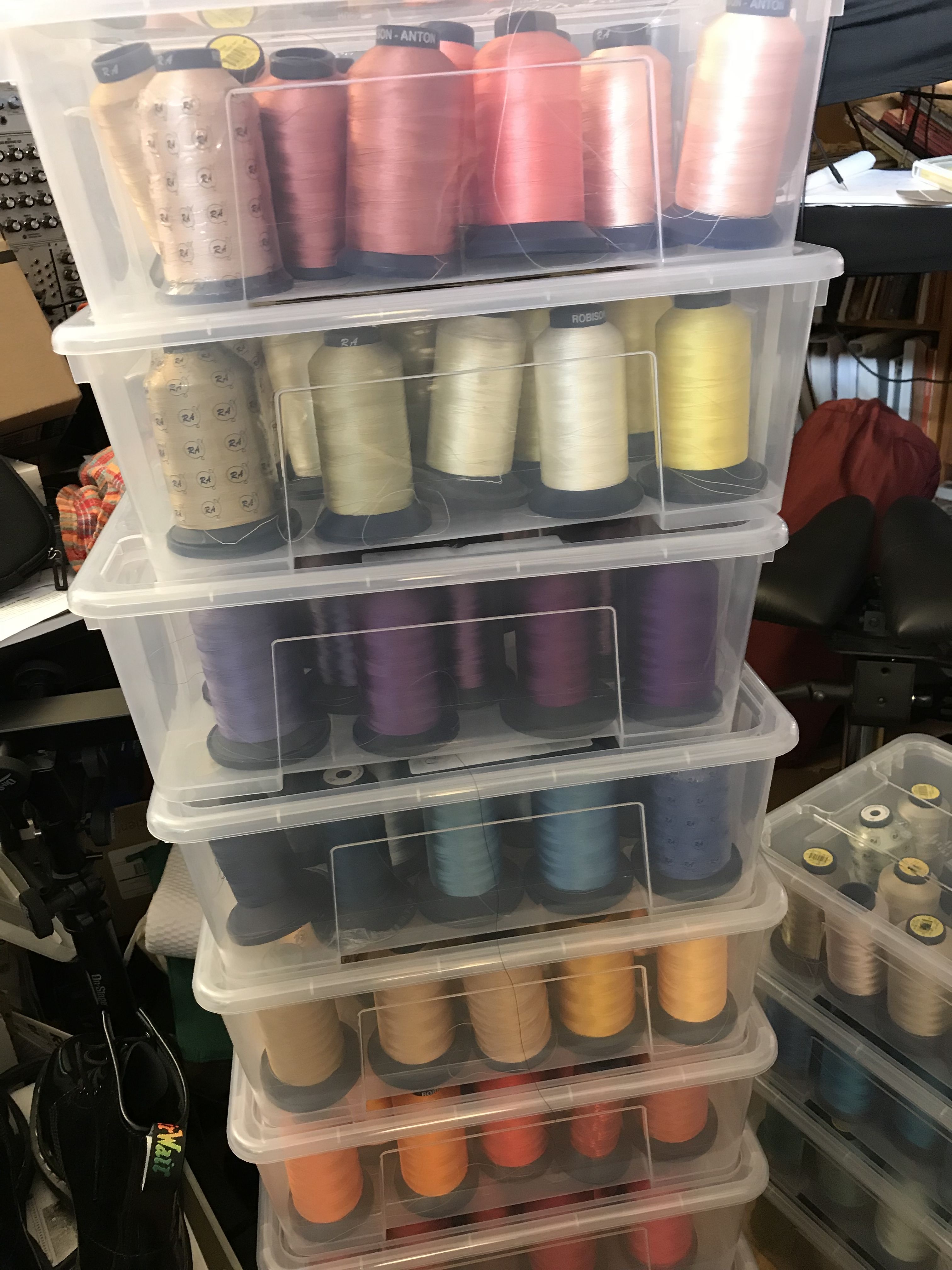
Boxes of rayon machine embroidery thread

Each spool is 5500 yards when full (some are partially used). A box holds 16-18 spools:

box of rayon machine embroidery thread
A box of rayon machine embroidery thread – about 70,000-80,000 yards!

And here’s a pic of the entire collection. (Photobomber cat added for scale.)
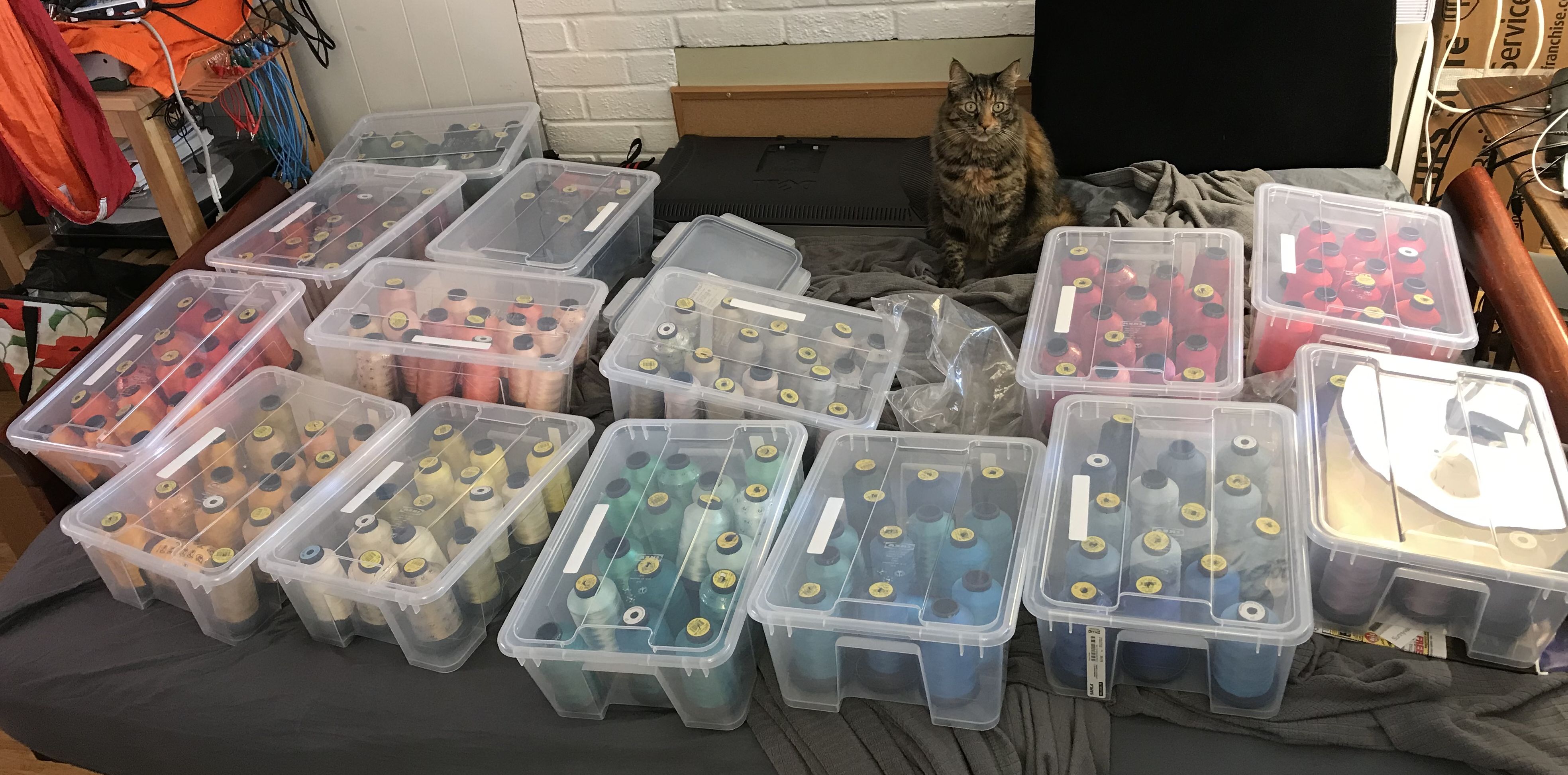
Full collection of rayon machine embroidery threads. (With cat.)
My lovely Tigress, center of the universe.
Oh yeah – and over 1 million yards of rayon machine embroidery thread!

Believe it or not, I’m actually short a few colors of a full rainbow set – I don’t have any yellow-greens, red-purples, or blue-purples. Fortunately my friend Alison just asked me what she should get me for a combined birthday/Christmas gift from last year…hee!

In case you’re wondering what I plan to do with the stuff – two words: velvet pile!

Given the glacial pace at which velvet is woven, I think I can safely be said to have a lifetime supply. (And then some.) But hey – at least I won’t run out!
Filed Under: All blog posts, textiles, weaving Tagged With: velvet

February 26, 2019 by Tien Chiu 4 Comments

Prototyping velvet

I spent an hour threading Grace yesterday, and am now almost halfway done:

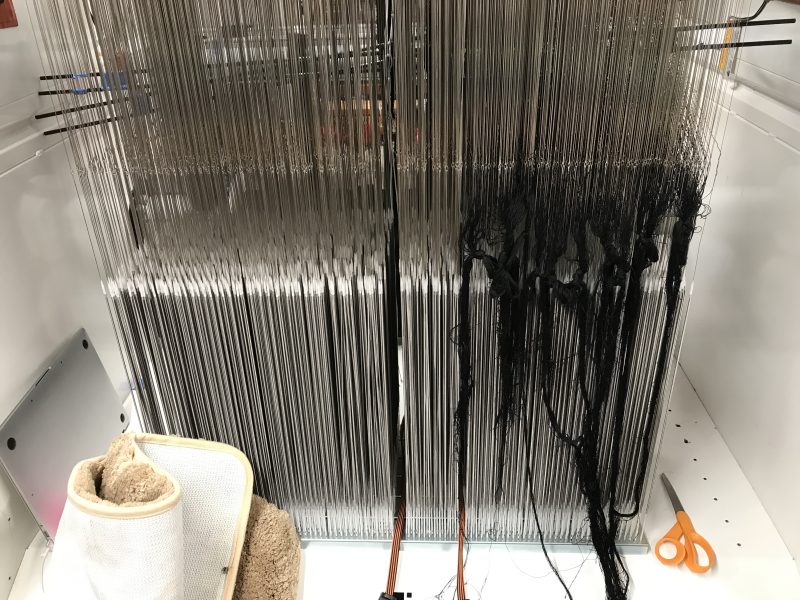
Amazing Grace, my TC-2 jacquard loom, almost 1/2 of the way through threading

Ricki is coming over next week and hopefully will be able to make even more progress. Between the two of us, I want to get Grace threaded and sleyed by the end of March. Of course, then there is the debugging of threading and sleying errors – another Eternal Slog…but fortunately it only needs to be done once, then I can tie on and pull through forevermore.

After that, there will be a ton of prototyping before I can weave velvet on Grace. B. and I will have to design and refine a lot of velvet-weaving equipment first, which will take months. Discouraging, no?

However, this morning it finally occurred to me (genius that I am) that I don’t have to wait until Grace is ready. I have two looms! Fancy that! And I can do a lot of the prototyping on Lady Ada.

Here’s what B. and I need to figure out:

  1. How to tension the velvet warp threads individually, so I can weave figured velvet. The take-up will be different on each thread, so they need to either be on individual weighted spools in a spool rack, or they need to be weighted separately to take up the extra slack between the warp beam and the fell (edge of the woven cloth). Bonus: I need to figure out how to make all that work with the automatic tensioning system of the TC-2.
  2. If I use the individual weighted spools in a spool rack (which seems likely), design the spool rack, and design the spools to fit the spool rack. 3D-print the spools. Did I mention that I will need 440 spools?
  3. How dense should I make the pile warps relative to the 20/2 cotton I’m using for the ground warp? What yarn should I use for the pile warps? If I use the rayon machine embroidery thread that I’m currently planning to use, how many strands?
  4. What size monofilament should I use as velvet rods for the pile warp, once I figure out the right density? What if I want shorter or taller pile? Or a mix of cut or uncut velvet?
  5. What size velvet knives would I need for each diameter of monofilament? (Bonus: 3D-print each knife handle in a different color, with the size of monofilament and the number of strands of weft thread printed on the handle so I don’t get confused.)
  6. Is the rayon embroidery thread suitable for my purposes? Some rayon embroidery threads are not washfast or lightfast. So I want to embroider swatches of each color and then test for both.

As you can see, there are just a few variables involved, and I was not looking forward to the 3-4 months it would take me to sort all that out after preparing Grace. However, most of that can be figured out by putting a 14.5″ warp onto Lady Ada, my 8-shaft Baby Wolf, in the same yarn and at the same density as the warp going onto Grace. So that’s what I plan to do.

The other thing I’ve realized is that the reason I was making no progress on any personal art projects was that I was trying to fit in my personal projects in after the business stuff was done. Since there is more than enough business stuff to fill 3x the time and energy that I actually have, I never got to the fun stuff!

I’m now reaching the point where not not every business thing is screamingly urgent all the time, so I think I’m going to start injecting a fun goal into each day’s work, in addition to taking weekends (mostly) off.

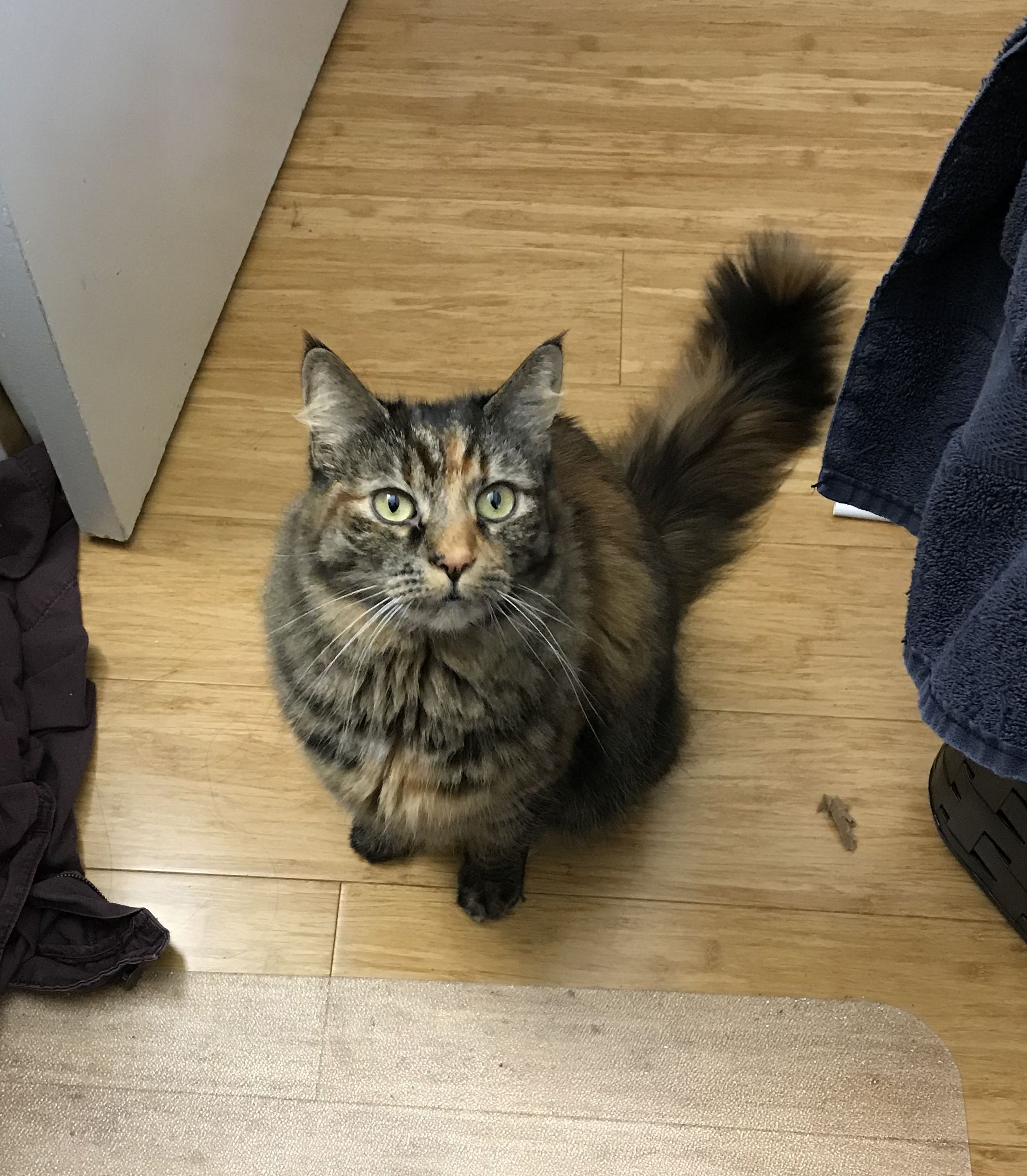
Meanwhile, since some people have said they’re suffering from Fritz-and-Tigress withdrawal, here is what Tigress is up to right now: demanding that I do my One Job. (Which, in this case, is playing with her and/or giving her cat treats. Never mind that I did both just half an hour ago. What have I done for her lately??)

My cat Tigress, demanding I do my One Job.
One Job! One Job!

Filed Under: All blog posts, textiles, weaving Tagged With: velvet

February 5, 2019 by Tien Chiu 3 Comments

Velvet beginnings

Today is the Lunar New Year, a day of new beginnings. An auspicious day on which to share velvet beginnings with you!

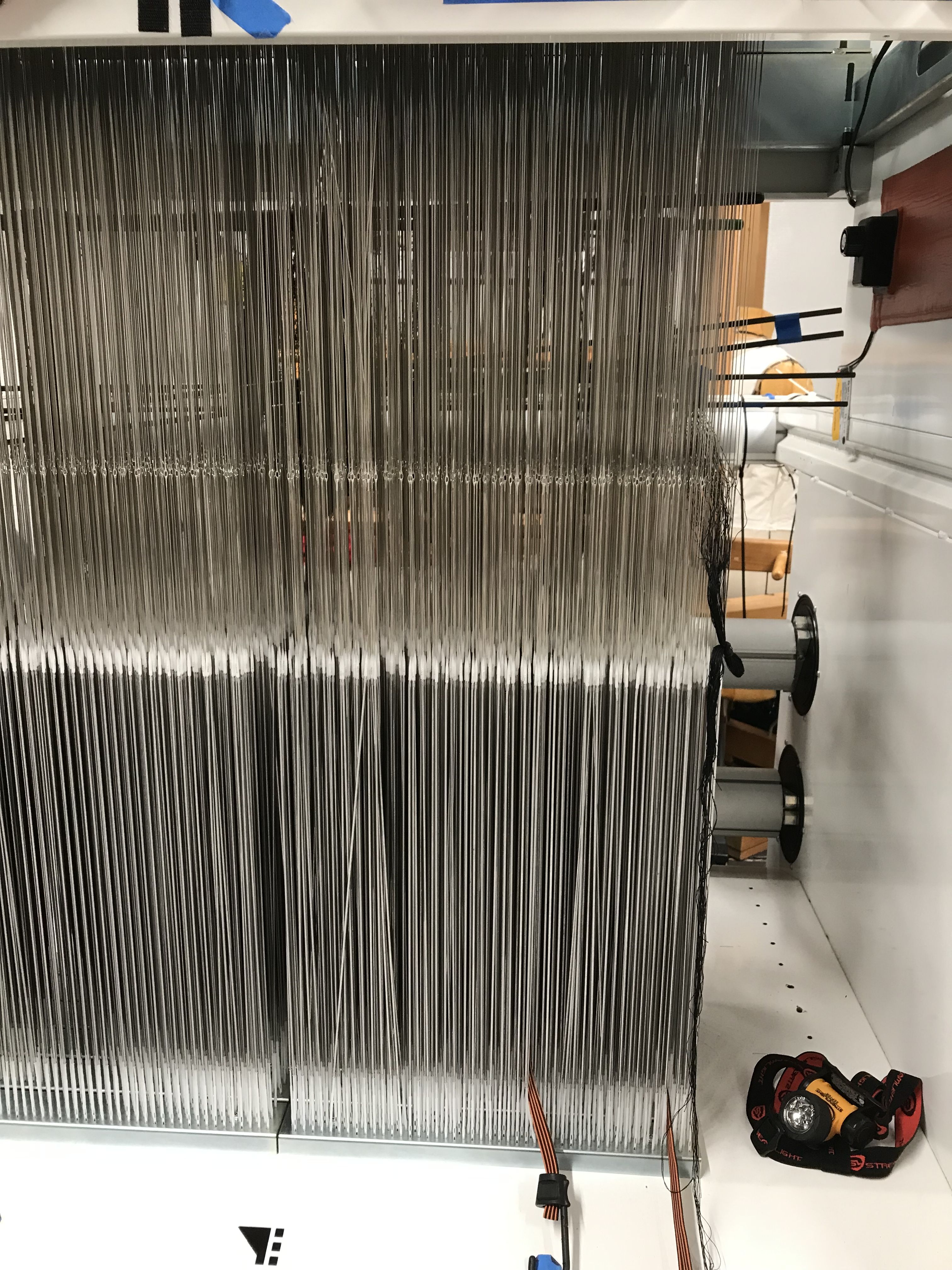
First, there’s the loom. With heroic effort, Ricki and I (mostly Ricki!) have gotten the warp wound and beamed, rearranged the modules, and have started threading. Here’s what Amazing Grace (my TC-2 jacquard loom) looks like now:

A TC-2 jacquard loom with a few heddles threaded

As they say, a journey of 2,760 threads starts with a single heddle.

Ricki has been doing most of the work so far, but I’m planning to do a lot more threading soon. Ricki graduates in May, and most likely will leave the Bay Area shortly thereafter, so if I’m to uphold my side of the bargain and show Ricki how to weave a project on Grace, she needs to be fully threaded by mid to late April. Ricki’s not going to have time to do all that threading solo, so I’m going to pitch in and help. Done a little bit at a time, it shouldn’t be that onerous, and I’m confident that, with Ricki’s help, I can finish in time for Ricki to weave something on the loom.

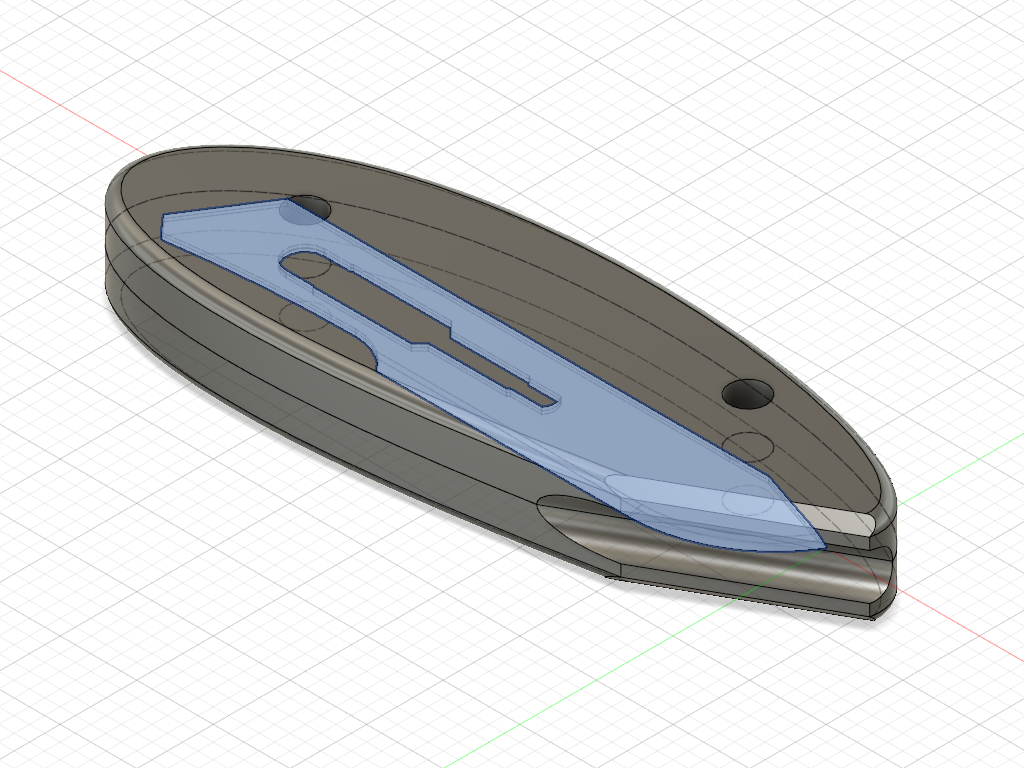
I am grateful to Ricki for giving me the kick in the pants I needed to get started with Grace again. I have plans for some fabulous velvet weaving. B. designed and 3D-printed me a velvet knife that would work with round velvet rods – it has a round channel with a scalpel blade centered in the channel. The round channel runs along the rod and holds the scalpel blade centered over the rod, so you can cut down the middle of the rod and the blade doesn’t roll off.

That’s probably hard to visualize, so here’s a schematic of the knife:

schematic of velvet knife

Instead of traditional velvet rods, I plan to use nylon monofilament – 150, 200, or 300 pound-test fishing line, straightened out in hot water. John Marshall put me on to that idea – apparently Japanese velvet weavers have largely switched to monofilament – and I’m eager to give it a try.

For ground warp, I’m using black 20/2 cotton from Lunatic Fringe Yarns. For the pile warp, I’m using rayon machine embroidery thread. I had impulsively bought a giant lot of it on eBay several years back – “giant” meaning over 220 king-size (5500 yard) spools that arrived in two huge boxes weighing over 65 pounds – so I have a more or less infinite supply, and a huge collection of colors. I haven’t tested them for lightfastness and washfastness yet, but the brand has an excellent reputation, and I’m only weaving samples at the moment, so I’m just “winging it” for now.

The plan is to use a black ground warp and my usual brilliant yellow/orange/red colors, perhaps with a hint of blue/purple to provide hue contrast, to create interesting velvet designs. I haven’t any concrete designs in mind, only exploration. I do, however, have a few interesting ideas I want to play with.

The first idea comes from a fabulous Japanese velvet that John Marshall showed me. It is a velvet woven with real gold thread – that is, precious metal thread made from real gold. Because the Japanese are, well, Japanese, though, the gold thread is placed in the ground cloth – behind the velvet pile. So it doesn’t show unless the cloth moves or is draped over something, spreading the pile threads apart and allowing the precious gold to glimmer through. (Not being modest to the point of stupidity, however, they do make the pile sparser than usual, so the gold becomes easier to see.)

Here’s one of the precious metal velvets that John showed me. See how the gold shines through the velvet pile as the fabric turns around the fold:

Photo of Japanese velvet woven with real gold thread in the ground cloth
Photo of Japanese velvet woven with precious metal thread (gold) in the ground cloth

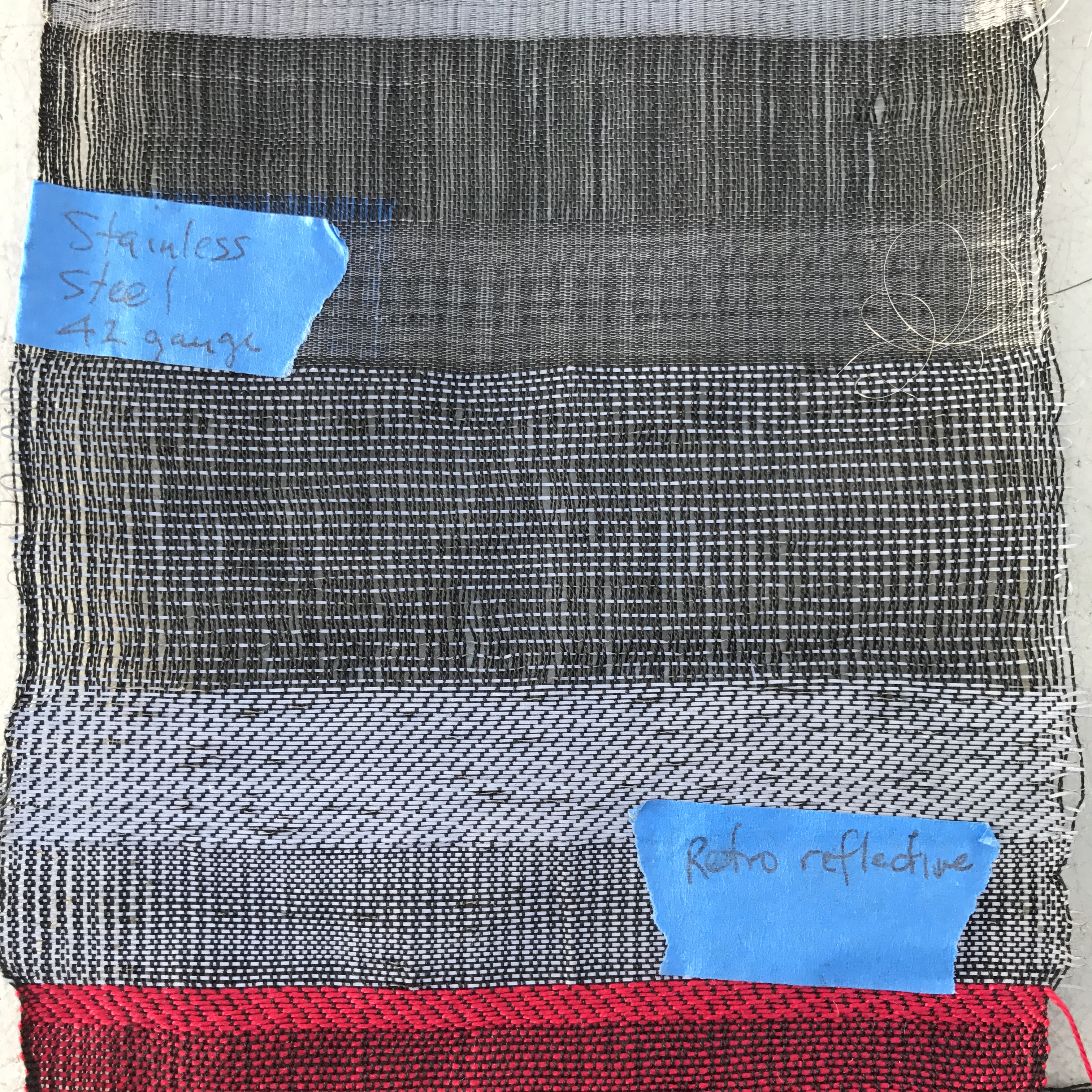
Well, one of the more interesting yarns in my collection is retro-reflective thread. It’s the stuff they put on running shoes and safety vests, and it lives a double life: Boring gray by normal light, but blindingly bright when viewed in a focused, head-on beam of light, e.g. headlights.

Here are two photos of a sample I wove with the retro reflective thread. The first shows it in normal light. The second shows it with a flashlight directed straight at the sample. See how it glows in the second photo?

sample woven with retro reflective thread, in normal light
handwoven cloth sample woven with retro reflective thread, illuminated with direct lighting

So…now I’m thinking that putting retro-reflective thread in the ground cloth, behind a somewhat-sparse velvet pile, could produce some really beautiful cloth. Because its base colors are gray and silver, though, it would probably work better with blues, greens, and grays than with the fiery colors that I prefer…but there is plenty of time to experiment with the possibilities!

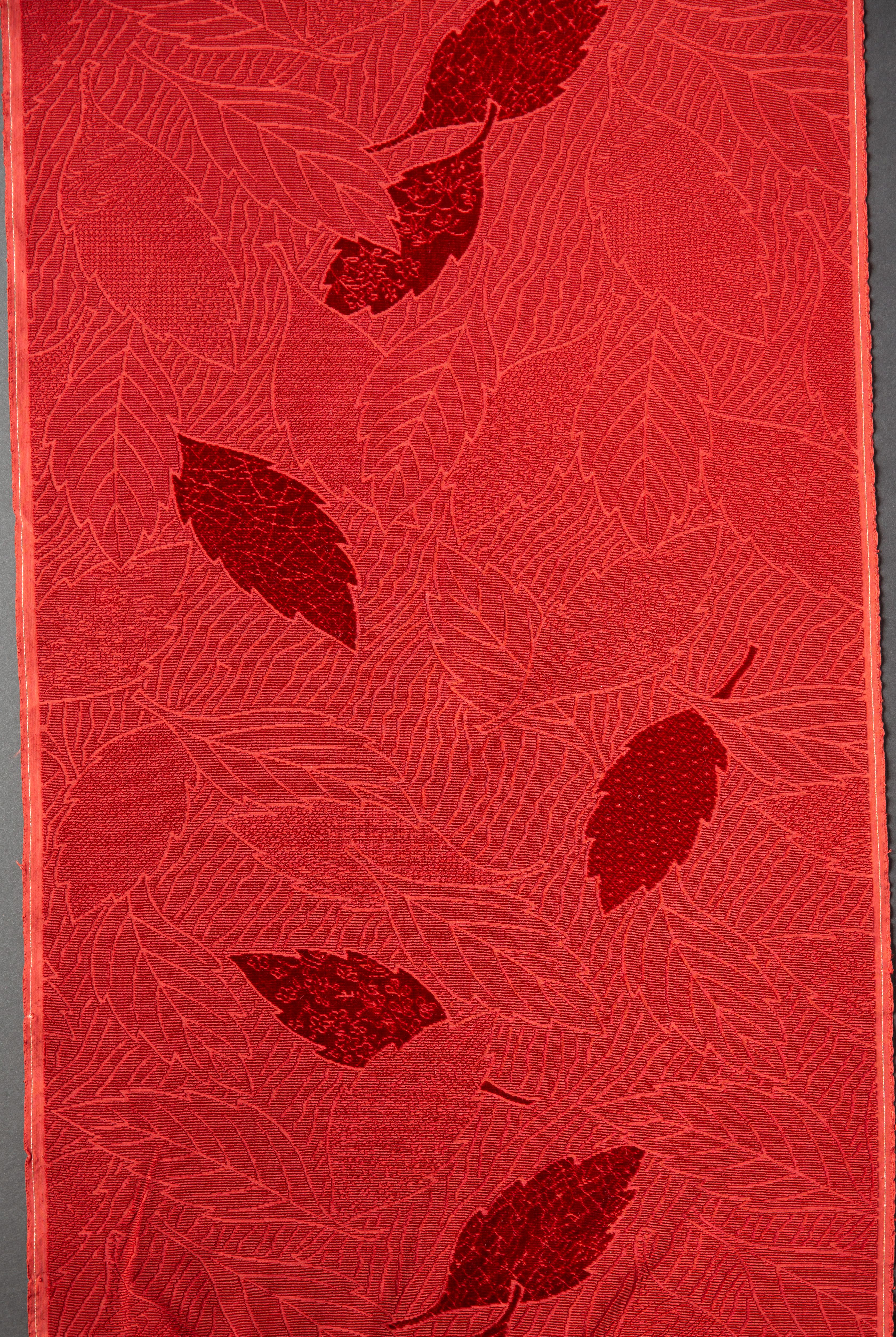
My other ideas are not nearly so concrete. I take a lot of inspiration from the Japanese velvet weavers’ design aesthetic. John Marshall very generously loaned me a large number of Japanese velvets, and my expert-photographer friend Lieven just as generously photographed them for me in meticulous detail. Here’s one that shows the power and simplicity I aspire to:

Japanese velvet piece showing red cut-velvet leaf design against uncut and voided velvet patterning

I love the understated elegance of this piece, and the virtuoso skill that lies under it. The red is cut velvet, the rest is uncut velvet. What I love is the restraint on the cut portions: only a few portions of the velvet are cut, with great precision, to create emphasis on the relevant design elements and create a sense of movement through the piece. The design looks simple, but if you look close up, you can see the complex patterning in the leaves – both the cut and uncut velvet leaves – and in the background.

(Do click on the image to see the full-size photo of the cloth, but only if you have a fast connection – Lieven’s photo is about 28 MB. But worth it – you can make out every detail of the velvet patterning, right down to the individual loops. Exquisite!)

Anyway, I don’t yet know enough about velvet to know what is and is possible, so my first plan is simply to explore the possibilities. B. and I are going to have to figure out how to create the required velvet equipment ourselves, so part of the adventure will be figuring out how to create the weighted velvet spools, and the spool rack to hold them. B. has 3D-printed some test spools for me already, and I have sketched out some ideas for a modular spool rack that would make it easy to switch out spools if I want to change colors, break a thread, double the number of threads in a pile unit, and so on. I expect a ton of technical experimenting will be needed before I can really start thinking about design – and I am looking forward to every moment of it!

Happy Chinese New Year to you all! May the coming year bring new beginnings to everyone, in all your ventures.

Filed Under: All blog posts, textiles, weaving Tagged With: velvet

December 23, 2018 by Tien Chiu 1 Comment

Back to weaving soon!

Spoiler: Velvet coming to these pages soon!!

You may have noticed that there’s been no weaving content in quite awhile. This is partly because I’ve been crazy busy with developing and launching Color Courage for Weavers – working 12-14 hours a day for the last 2-3 months leaves little time for anything else. But it’s also because the warp that’s on Grace (my TC-2 jacquard loom) is incredibly persnickety and no fun to weave.

At the same time, rethreading a jacquard loom is not something one approaches lightly (read: without chugging a fifth of whiskey first), and since I just haven’t had the mental or emotional energy to deal with it, Grace has been sitting around moping for the better part of two years.

Hopefully, that’s about to change.

Out of the blue, I got an inquiry from an MFA student, Ricki, who wanted to trade studio assistance for training in how to use a TC-2. Now, I get this kind of request on a fairly regular basis, and I generally say no, because typically the person asking doesn’t have enough experience to make it worthwhile. However, Ricki is an MFA student with considerable weaving experience. They’ve been offered a jacquard residency at CCA, but CCA won’t teach them how to learn how to use the TC-2, so they have to learn how to use it first. Ricki sent an email to my weaving guild asking if anyone knew someone who owned a TC-2, and thus wound up on my doorstep.

This sounds like a wonderful trade to me. I still don’t have time or energy to rethread Grace, so having someone willing to spend the 20-30 hours needed to wind a 10-20 yard, 2,640-thread warp, beam it onto two warp beams (beaming a warp onto Grace bears a certain resemblance to watching grass grow), and then thread all her teeny-tiny heddle eyes, is manna from heaven. (Plus, Ricki is still young enough to chug that fifth of whiskey without regretting it for months afterwards.) And teaching someone how to design for and use a TC-2 sounds WAY more fun than sitting there doing endless threading.

From Ricki’s perspective, of course, it’s also a great deal, because TC-2s are rare, and getting a chance to learn all the aspects of how to use one, including threading one, is a pretty unusual opportunity. And I told Ricki that I’d be happy to let them weave on it as much as they wanted, if I weren’t in the middle of a project at the time – which is a VERY rare opportunity indeed. So it’s a good trade all around.

Now, what am I planning to weave? VELVET!!

I’ve gotten obsessed with velvet since my trip to John Marshall’s place. His collection of Japanese velvets is amazing. I’m going to rhapsodize over a few examples in my next blog post, and then obsess over a lot more examples in another blog post a couple days from now. They are gorgeous, demand virtuoso skills, and are also technically intricate – exactly the kind of work I live for.

Because I can’t wait that long to tell you about my new obsession, here is one small example:

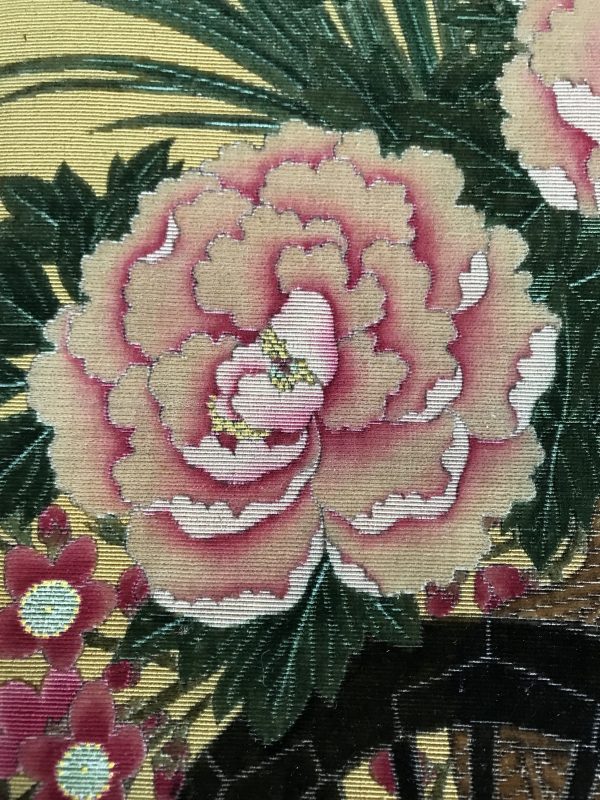
Japanese velvet - Peony - cut vs. uncut velvet
Japanese velvet -peony

This is a lovely velvet that has been painted with dye after weaving. Looks nice, right? But look at the white bits, the highlights on the peony. That’s not paint. That’s areas where the loops of velvet pile have been left uncut. (If you click on the image to get the big image, and zoom in, you’ll see little loops in the white areas.) The artisan used the fact that uncut loops of thread are more reflective than cut ends to create the highlights – not just in the big white areas but also in tiny little sections around the edges of each petal. Some of those areas are only a thread or two wide. Similarly, the veins in the leaves are created not with dye, but with uncut loops of thread. Cutting almost all of an area, but leaving 1-2 threads intact, requires amazing control over the velvet knife. Hats off to the artisan!!

And there is plenty of other virtuoso work in the Japanese velvets, but if I got started on them in this blog post, I’d never finish it. More in the next post, I promise!

I don’t plan to do anything that complicated, at least not initially. But I do plan to do some interesting experiments with velvet. This involves quite a bit of custom equipment, which is why most weavers don’t weave velvet. But B. and I are hoping to change that. B. is designing and printing velvet-weaving equipment for me using CAD software and his 3-D printer. Once he has the design down, and we’ve gotten them to the point where I’m happily weaving on them, we’re planning to publish the designs. That way any weaver can download them, have them 3-D printed, and start weaving velvet, too!

More in my next post…

Filed Under: All blog posts, textiles, weaving Tagged With: velvet

July 16, 2018 by Tien Chiu 5 Comments

Wow, was THAT a party!!

I left for Convergence on Thursday, July 5, and returned the following Thursday, totally exhausted of seven days of nonstop partying with 1,500 fellow weavers.

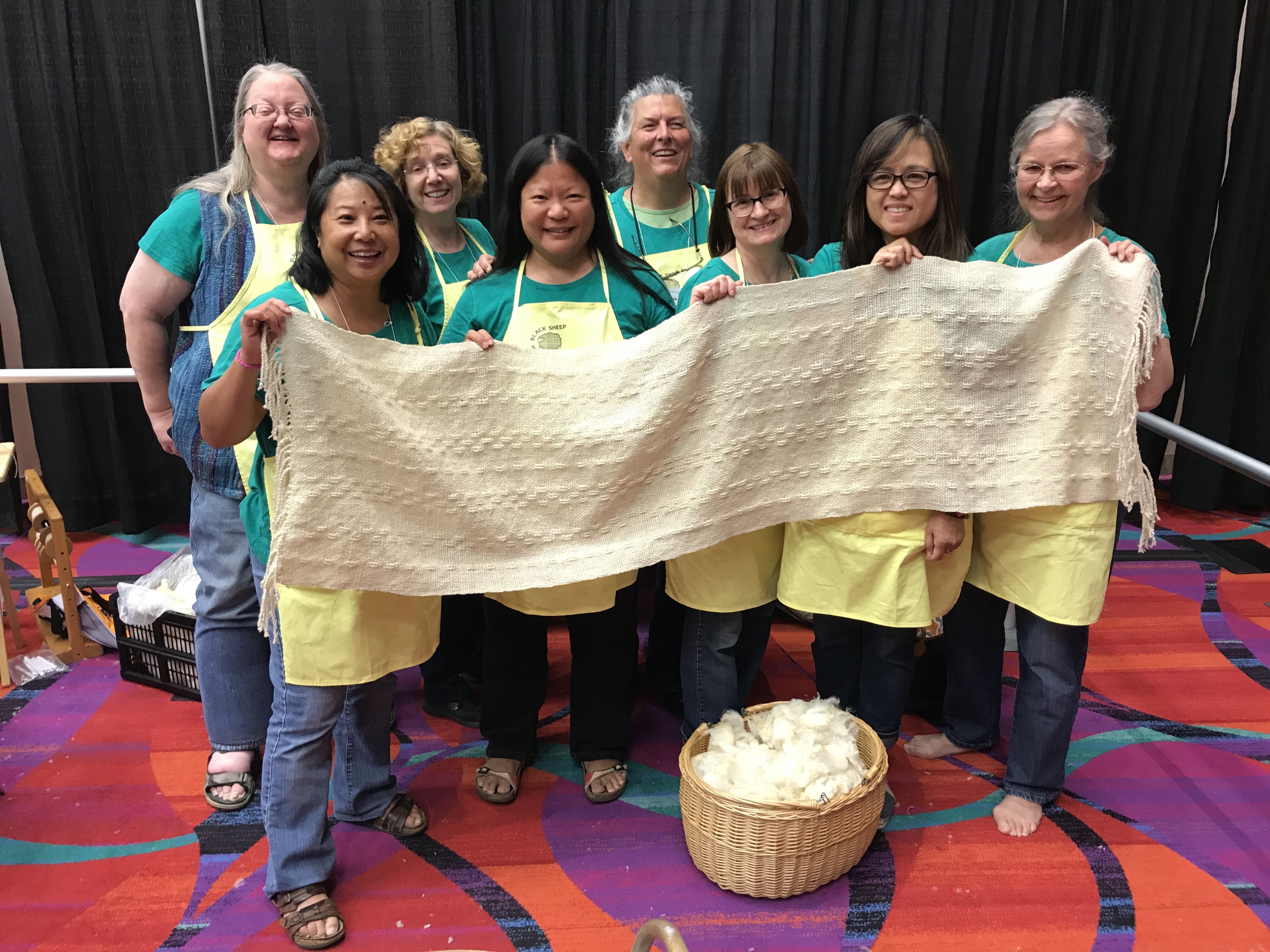
I started with the Sheep to Shawl on Saturday, as part of the Black Sheep Handweavers Guild (one of my two weaving guilds). Five spinners, a carder, and me (the weaver) – plus an educator to talk to passersby so the team didn’t get distracted. We had a lot of fun, and finished our shawl well within the 4-hour time limit:

sheep to shawl contest - Black Sheep Handweavers Guild
sheep to shawl contest – Black Sheep Handweavers Guild

For the unfamiliar, sheep to shawl contests originated when a medieval English lord bet one of his friends that the workers on his estate could shear a sheep at dawn, then wash the fleece, card, spin, dye, weave, and sew it into a jacket for him to wear to dinner. The workers succeeded (which still flabbergasts me!). But remember, these were trained professionals, kids – do not try this at home!

Ah, who am I kidding?? Bring on the sheep to shawl contests!

Modern day sheep to shawl contests aren’t nearly as strenuous. Typically each team starts with a washed fleece, then cards, spins, and plies it into yarn. The team gets to warp the loom before the contest, either with handspun or commercial yarn – so all that needs to be done during the contest is weave the shawl and finish the ends. There are variations on the rules, but the basic idea is to get from a fleece to a shawl within a time limit.

I had some funny conversations about the contest, like this one:

“I thought they were going to start with a sheep!”

“Nah, the conference venue wouldn’t let them have sheep.”

“Couldn’t we have told them they were comfort sheep?”

The day after the Sheep to Shawl, I taught my 90 minute seminar about critique. I’m pretty sure most of the students were expecting me to say something totally different – mostly because we have such terrible misconceptions about critique. The three-bullet summary of my 90-minute seminar:

  • Critique is about evaluating your work in order to make it stronger.
  • You get WAY more improvement out of taking good ideas and making them spectacular than you do from fixing flaws.
  • So in critique, you want to focus on finding the things you like, the things that are working, so you can figure out how to make them amazing. NEVER focus on finding flaws.

There was a lot more to the seminar, of course – I’m thinking of recording it and putting it on YouTube, actually, because I got a LOT of positive feedback on it afterwards. In my copious free time, of course.

(As soon as I find out where I stashed all that free time…let’s see…could I have left it in the studio? Hey, what’s this black hole doing here…?)

Monday I took two classes from Mickey Stam – one about “Weaving Your Passion” and the other about “Opening Your Weaving to New Possibilities”. She had a really interesting approach to brainstorming new areas for exploration and some very practical advice on how to move forward with making, exhibiting, and selling textile art.

And Tuesday night started Barbara Setsu Pickett’s class on velvet weaving! I had been looking forward to this class for months – after Wendy Landry’s lectures at Complex Weavers Seminars 2016, I really wanted to try velvet weaving.

Velvet weaving is not for the timid. You weave velvet with two warps: the ground cloth warp, which weaves the backing, and the pile warp, which produces all those lovely fluffy cut ends. 

Here’s how it works:

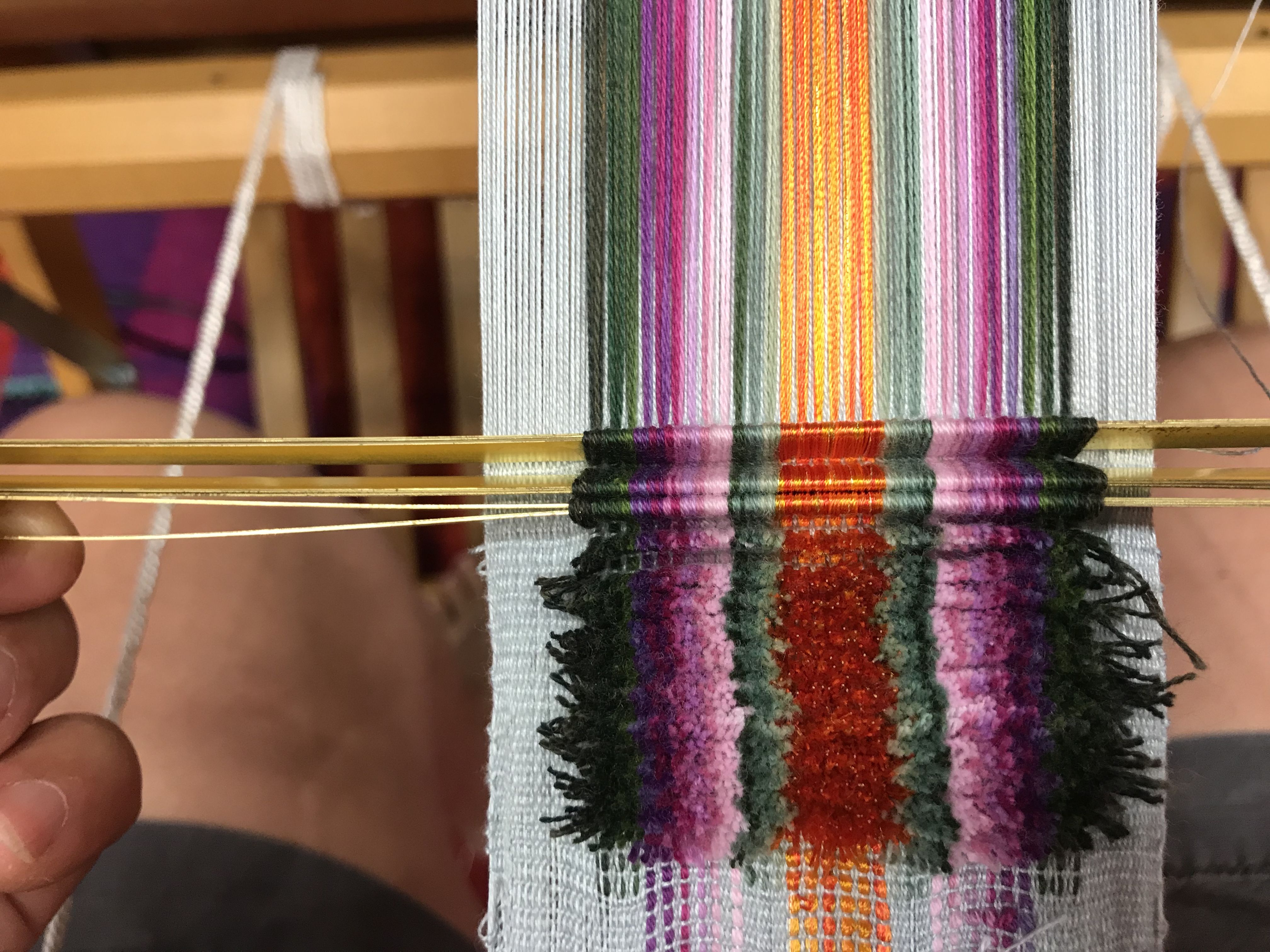
Weave a header of ground cloth. Then lift whatever pile warps you want to show, and insert a grooved rod. Weave a few more picks of ground cloth (to hold the pile), then insert another rod. After placing three rods, run a razor-sharp blade through the groove in the rearmost rod to cut the pile, remove the rod, and insert it in the next pile-warp shed. The five or six picks of ground-cloth/binder weft will (at least in theory) be tight enough to hold the pile warp in place.

It looks like this:

weaving velvet: velvet rods at work

And here’s a short video of me cutting the pile (with a scalpel taped to a depth where it will cut the pile but – in theory – not your cloth):

Swiping razor blades down a thin groove right next to cloth! Relying on just eight picks of weft to hold your entire pile warp in place! What could go wrong??

But wait! There’s more!

If you want to weave figured velvet – and let’s face it, haven’t we all desperately wanted to weave figured velvet at least once in our lives? – every single one of those pile warp ends needs to be tensioned separately. That’s because figured velvet requires having pile in some places but not others, like this sample Barbara showed us:

Figured velvet
Figured velvet

Looping a strand of pile warp over a rod takes a lot more thread than just weaving it into the ground cloth. So if you are weaving pile in some areas but not others, your pile warp threads will take up at vastly different rates. So the only way to get even tension is to tension every pile thread all by itself.

At the Lisio Foundation, and other velvet weaving studios, they have huge racks that sit behind the looms. Each rack is full of individually weighted spools. Each spool contains (more or less) one pile warp. Multiply by a couple hundred pile warps, and what do you get?

…a ton of spaghetti (and an entire week of rethreading) if you accidentally cut the cloth, or if you haven’t beaten tightly enough to hold in the pile warp ends when you start cutting the pile.

Whee! Velvet is easy!! No problem!! What could go wrong??

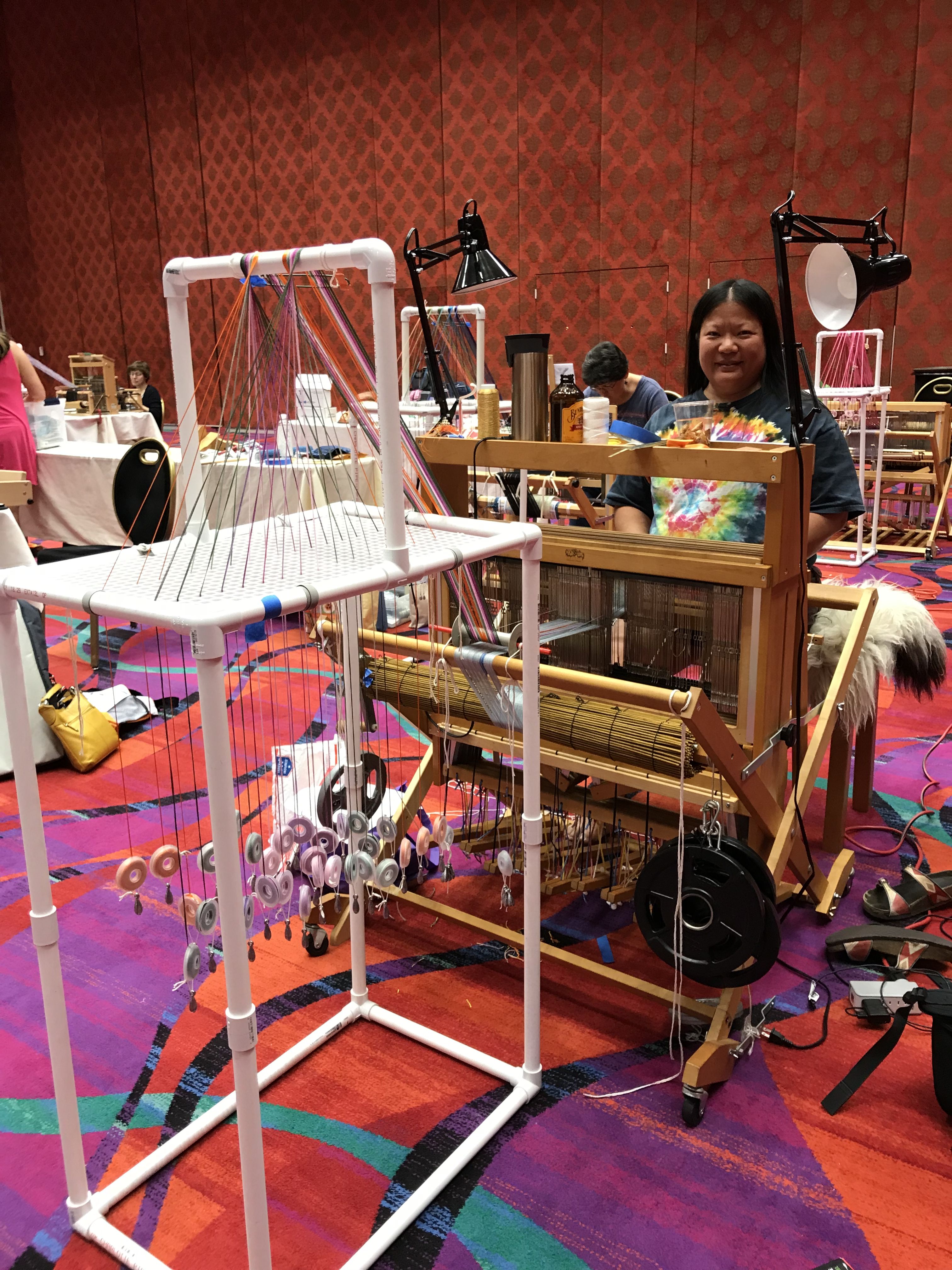
Since we didn’t have giant racks, and some of us (including Barbara) flew in, we used an ingenious device (called a cantra) that Barbara designed for her classes. Here’s what my setup looked like:

Velvet loom setup
Velvet loom setup

In the top of the cantra is a piece of egg crate (you can get it in your local hardware store; it’s used as a diffuser for fluorescent lighting). The pile thread warps go up from their weighted bobbins through the egg crate dividers, up and over, through a little cross at the top, and then down to a stick held over the back beam. And from there to the rest of the loom.

The cantra is about three feet tall – which means you can weave three feet of pile warp before having to stop and unwind all the bobbins. And there are a LOT of bobbins. I wove a finer velvet than the rest of my classmates, so I had 15 pile warps per inch. So all the bobbins you see dangling there were required for weaving a two-inch-wide strip of velvet! For a wider warp that would mean unwinding bobbins for approximately all eternity, every time you need to advance. Better make that cantra tall.

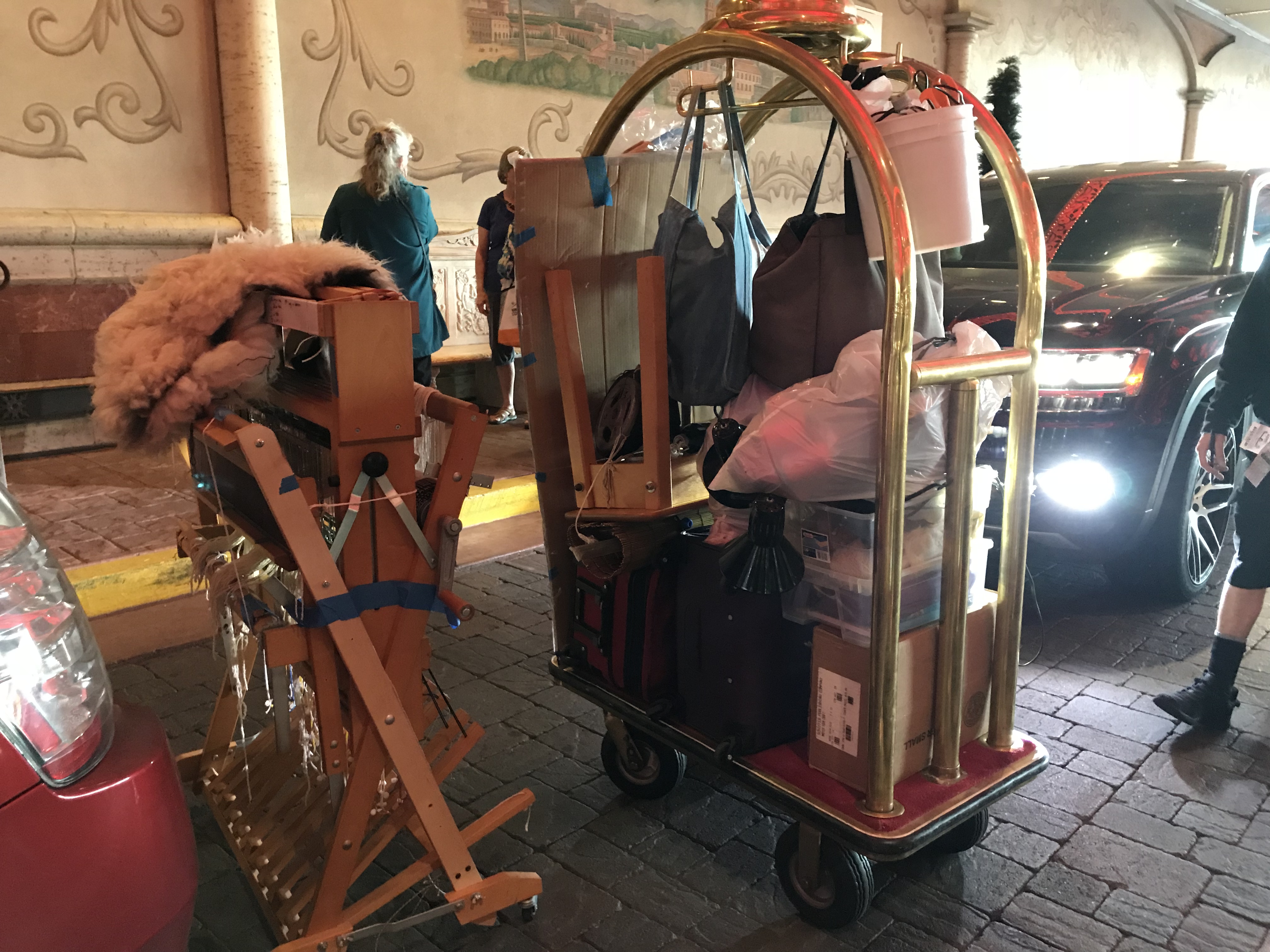
You may have noticed that there appears to be quite a bit of stuff in that photo. I actually had a LOT more stuff than that, since I had to come prepared for the Sheep to Shawl and my own lecture, too. Plus, in a burst of generosity, I volunteered to bring an entire suitcase worth of rayon machine embroidery thread for my classmates to use, since I was driving anyway.

This led to a new linguistic discovery when I arrived. I now know that the sweetest words a bellhop can say, in any language, are “Don’t worry, we’ll deliver everything to your room. Have a nice stay.”

unloading the car
unloading the car

(I was AMAZED that he fit all that stuff on the cart. I later discovered that they take classes on how to load these!)

The bellhop who delivered the loom to my room, however, was apparently traumatized by the experience. He kept saying, “I’ve never had to move anything this big and this delicate before!” I didn’t have the heart to tell him what the rest of his week was going to be like. 🙂 (Though I did tip him $5 to help him get over the trauma.)

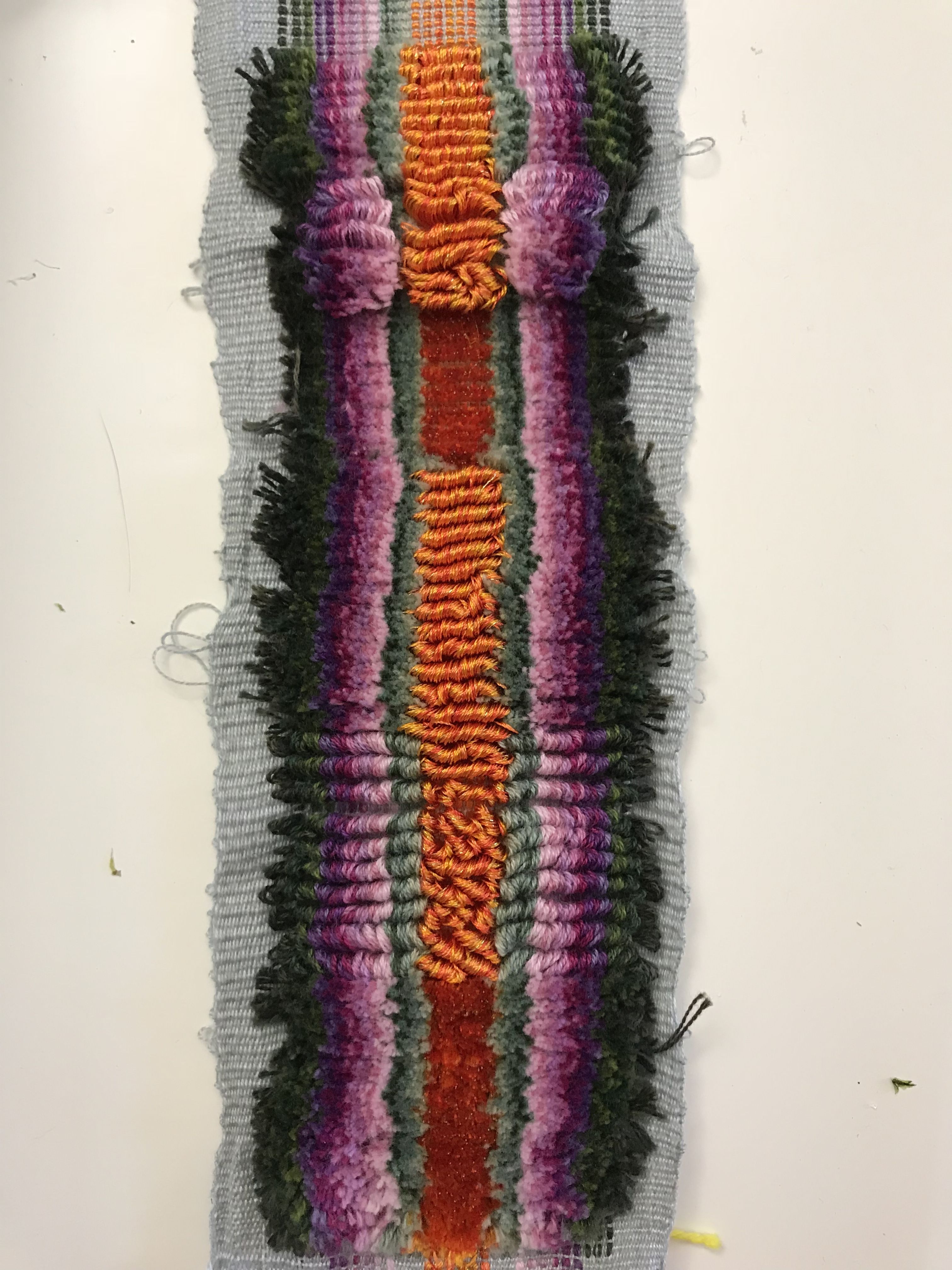
And here’s my finished strip of velvet – three days’ work!

Finished velvet sample

I played with short pile, tall pile, cut pile, uncut pile, and all possible combinations of the above. It was a TON of fun, and I want to work more with this on the jacquard loom. I’m already plotting ways to set up a rack of spools behind the loom. Stay tuned!

Sadly, it looks like more travel is not in my immediate future. A good friend is going to Rwanda next week, and I was going to help him with his excess baggage allowance by stowing away in his luggage. Alas, this is not going to happen: The cats have grounded me.

“You have One Job! One Job! And that is staying right here and catering to our whims, not running off to Reno and spending a week partying with your no-good human friends!”

“But you had another perfectly good cat-slave to cater to your whims! And I made sure he understood that he was supposed to give Fritz belly rubs, play with you, and do whatever you told him to do while I was gone!”

“That’s not the point. You had One Job, and you weren’t doing it.”

“Aw, but Tigress…”

“No buts! You’re grounded until further notice. Now go clean your room.”

My cats never let me have any fun…

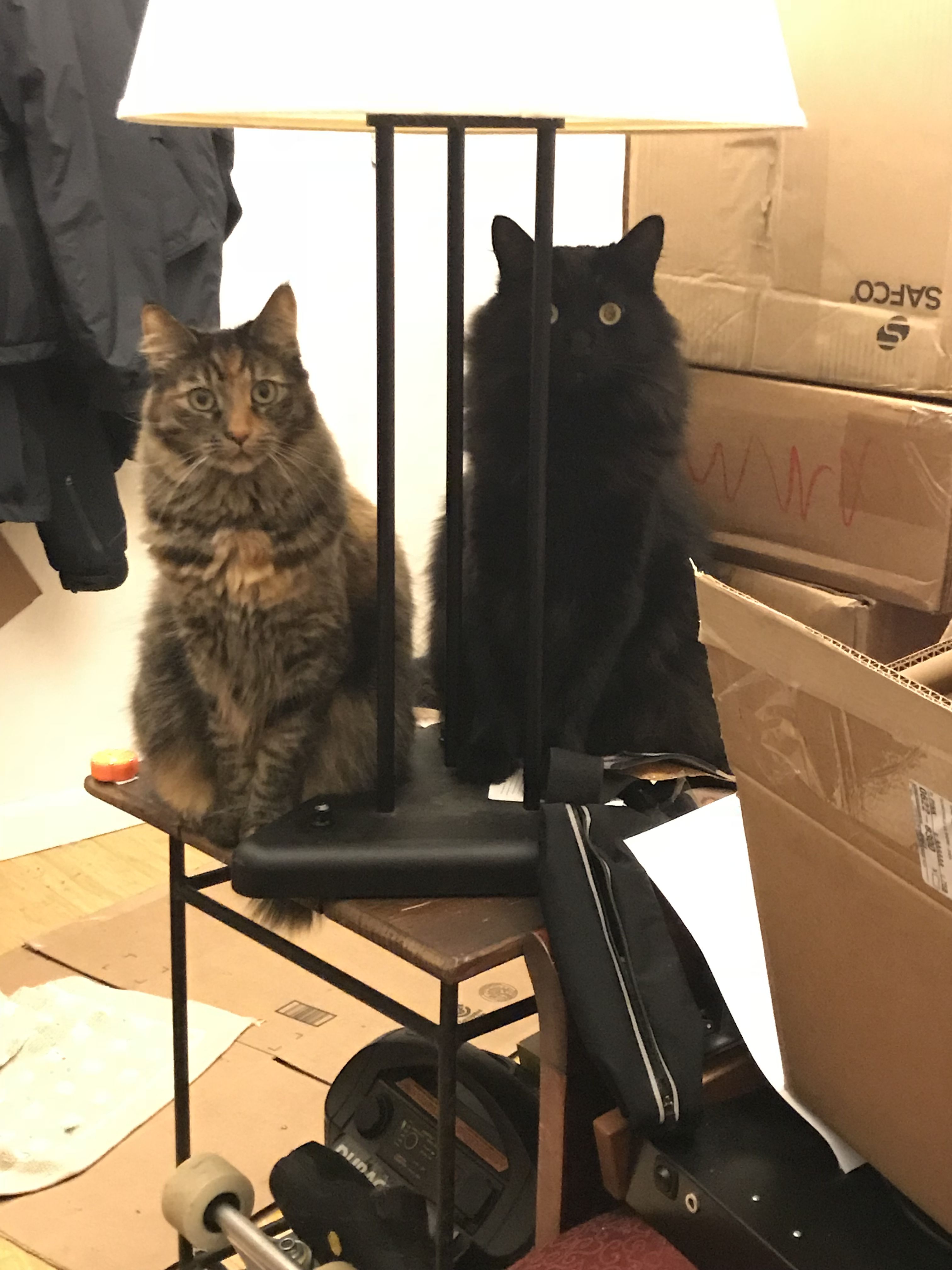
Fritz and Tigress, Rulers of the Universe

Filed Under: All blog posts, textiles, weaving Tagged With: velvet

  • « Previous Page
  • 1
  • 2
  • 3

Archives

Tags

aids lifecycle outfits autumn splendor book cashmere coat cats celtic braid coat color study cross dyeing design design class devore doubleweave doubleweave shawls drawing dye samples dye study group gradient colors house infinite warp jacquard loom katazome knitted blanks kodachrome jacket ma's memorial mohair coat network drafted jacket/shawl project network drafting painted warp phoenix rising phoenix rising dress phoenix rising kimono phoenix rising reloaded pre-weavolution project sea turtles taquete tie-dye tied weaves tomatoes velvet weaving drafts web design website redesign wedding wedding dress woven shibori

Categories

  • Africa
  • aids lifecycle
  • All blog posts
  • All travel posts
  • Asia
  • Bangkok
  • Belize
  • Cambodia
  • Central America
  • Chai Ya (Wat Suon Mok)
  • Chiang Mai
  • Chiang Rai (Akha)
  • China
  • chocolate
  • computer stuff
  • creating craft
  • Creative works
  • cycling
  • Delhi
  • Dharamsala
  • drawing
  • dyeing
  • Fiber Arts
  • finished
  • food
  • garden
  • Ghana
  • Guatemala
  • Hanoi
  • Ho Chi Minh City
  • Hoi An
  • India
  • Khao Lak
  • knitting
  • Knitting
  • Ko Chang
  • Laos
  • Luang Namtha
  • Luang Prabang
  • markleeville death ride
  • meditations on craft
  • mental illness
  • musings
  • Phnom Penh
  • powerlifting
  • Rewalsar (Tso Pema)
  • sewing
  • Siem Reap (Angkor Wat)
  • Southeast Asia
  • surface design
  • textiles
  • Thailand
  • travel
  • Vangvieng
  • Vientiane
  • Vietnam
  • Warp & Weave
  • weaving
  • Weaving
  • weavolution
  • writing

© Copyright 2025 Tien Chiu · All Rights Reserved ·

Loading Comments...