Tien Chiu

  • Home
  • About Tien
  • C.V.
  • Online Teaching
  • Works
  • Essays
  • Travels
  • Book
  • Blog
  • Dye samples
You are here: Home / Archives for All blog posts / garden

March 3, 2019 by Tien Chiu 5 Comments

Relearning laziness

I passed a huge milestone today! I took a day entirely off. (Well, almost entirely. I did answer one urgent email from a student who couldn’t access the course. But that was it.) I’ve spent the day puttering about, going for a nice lazy brunch with B., reorganizing my giant tubs full of machine embroidery thread, tending my tomato seedlings, planning out my velvet sample warp, and threading Amazing Grace. What I haven’t been doing is planning out my next week’s work, answering work emails, worrying about what deadline is coming up next, or hovering over my blog/email statistics.

This is the first real day off I’ve had in over two years. Maybe three. Pretty much every single day, the first two hours of the day have been devoted to business stuff, even on days when I wasn’t officially supposed to be working. There was such an overwhelming load of work that urgently needed to be done – especially the last two months, while I’ve been teaching/writing lessons and lectures for my Color Courage for Weavers Workshop class – that I just couldn’t relax and let it go on weekends.

But I’ve now reached the point where the workload is not quite so insane, either for the class or for the business. In the class, we’ve gotten over the “explaining how color works” hump and are now into the part about how to design with color. As a result, the lessons are more conceptual (less diagram-heavy) and the students are learning more independently. So I am doing less teaching and corrections and more enthusiastic cheering, offering refinements, and words of encouragement as they start flying on their own. This is the most fun part of the class, for me and (I think) for them!

So this week has been a fairly laid-back week. Even on the business side, I decided to take some time to play. I needed some prettier pictures for marketing purposes. Most of my sample photos look like this:

Which is great if you’re trying to demonstrate color principles, but for marketing purposes? Pretty grim, babe.

So I got a bunch of samples together and started playing with them on a lunch break. Here’s one of the pretty pictures that resulted:

And for my latest Warp & Weave blog post, I created a fan out of one of the color gamps that Laura Fry wove for me. I’m very fond of this one:

a color gamp, spread out to look like a rainbow fan

It’s nice to get to do something fun for a change!

Meanwhile, in tomato-land, the seedlings were looking distressingly purple last week:

picture of purple tomato seedlings

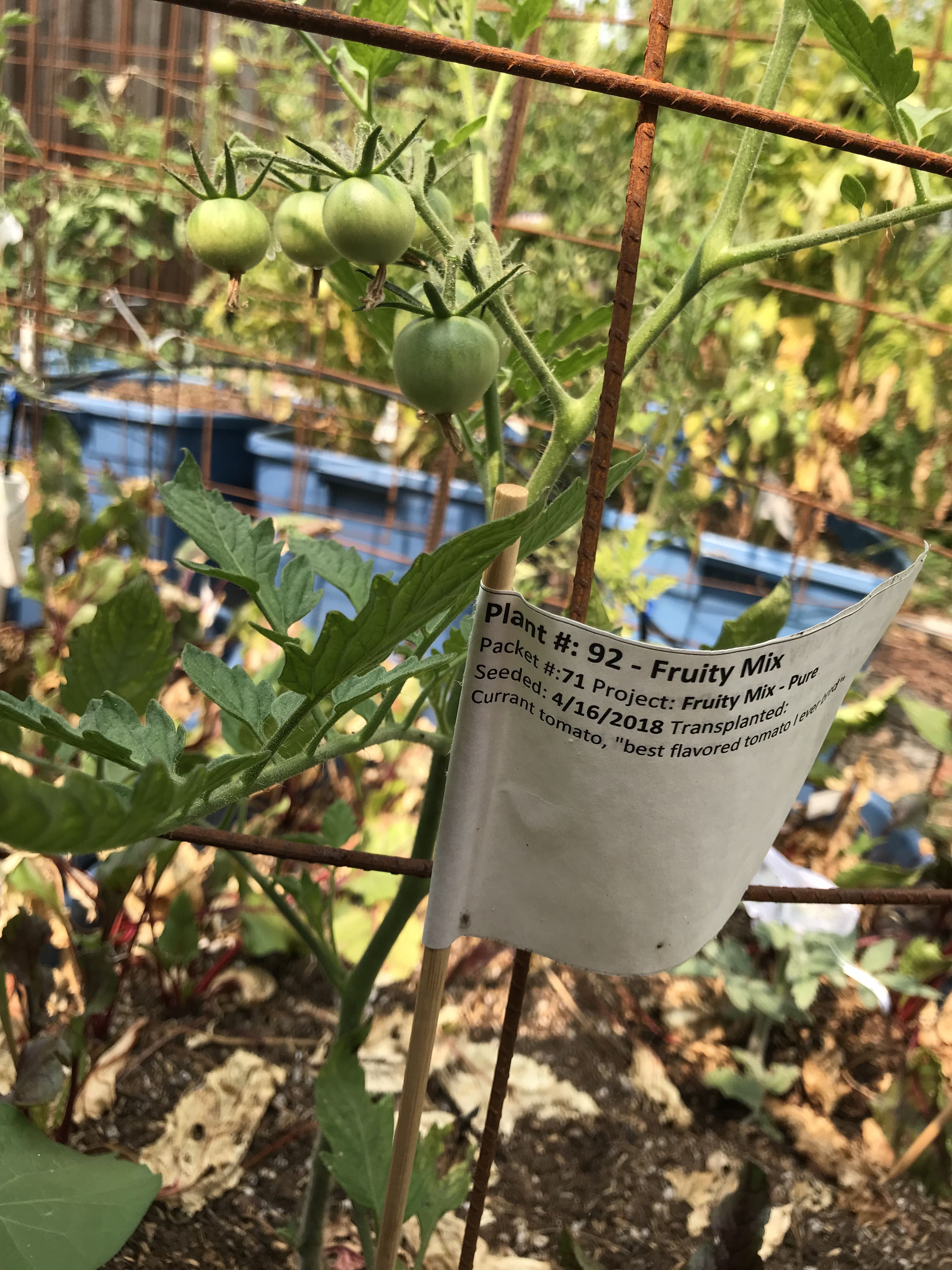
I initially thought “Oh, no problem, they’ve got the Anthy (anthocyanin) gene, that makes tomatoes have purple stems.” Then I remembered that Fruity Mix doesn’t have the Anthy gene. Oops.

A quick Google search turned up the answer: phosphorous deficiency, often brought on by too-cold growing conditions. Well, the tomato seedlings were being kept warm by heating pads – though it had been extremely cold by California standards (down to the mid-to-high thirties at night, scandalous!), the temperature had stayed in the 60’s in their little incubation area. So I didn’t think the temps were the problem. I mixed liquid bone meal with some water and put it into the next watering. While not yet fully recovered, they are looking much better already!

tomato seedlings recovering from a phosphorus deficiency

The interesting part is that they are greening from the center out. Here’s a top view of one of the seedlings:

tomato seedling, purple on the outer edges and green in the center

This looks weird but makes sense when you think about it: the phosphorus comes up from the central stem, and gets grabbed by the nearest cells as it makes its way up the stem. I’m looking forward to seeing them turn completely green. It’s hard going around with a purple thumb!

Nothing much on the velvet front, except a small amount of progress threading Amazing Grace. Maybe an inch’s worth of progress. Still, an inch is an inch, and there are only about 16 inches’ worth to go. Ricki is coming over on Friday and hopefully will get a bunch more threading done. It “only” takes about an hour for me to thread an inch’s worth of heddles, so in theory there is only about 16 hours’ work left to get her threaded.

Of course, then the next step (after sleying and tying on) is debugging, which is almost as tedious. Oy. Well, you only have to do it once.

My approach to these sorts of tasks is much the same as my approach was to large cross-stitch projects, back in college. They are much more manageable once you accept, like Sisyphus, that you are doomed to roll the boulder uphill forever. Then you can simply lose yourself in the process of doing this tedious task, put on an audiobook or a podcast, and be pleasantly surprised 400 hours later to discover that (unlike Sisyphus) you are actually done AND you have a finished piece!

Speaking of threading, I believe I’ll run off and do some more of it now. But I will leave you with this photo to console you. A few days ago, I was photographing my “Tiger Eye Shawl,” my very first attempt at designing my own draft (it’s an adaptation of the “Heart Throb Scarf” in the Twill Thrills Best of Weaver’s book). Or more accurately, I was attempting to photograph it, because of course the moment I laid it down on the bed, the inevitable happened.

“What’s this?” said Tigress.

“My Tiger Eye Shawl,” I replied. “I need to take photos of it for the talk I’m giving tomorrow.”

“But there’s only one tiger in this house worth taking photos of,” she replied, “so it’s a good thing I stopped by.” And curled up for a nice long nap.

Of course, she was right. The cat is always right.

My cat Tigress on my Tiger Eye Shawl
Tigress on my Tiger Eye Shawl

Filed Under: All blog posts, garden, textiles, Warp & Weave, weaving Tagged With: tomatoes

February 10, 2019 by Tien Chiu 12 Comments

Garden beginnings

A bit over a week ago, the East Coast and the Midwest were seized in a polar vortex. It was colder in Wisconsin than it was in Antarctica.

And in California?

The peaches were blooming:

So were the roses, despite our winter pruning:
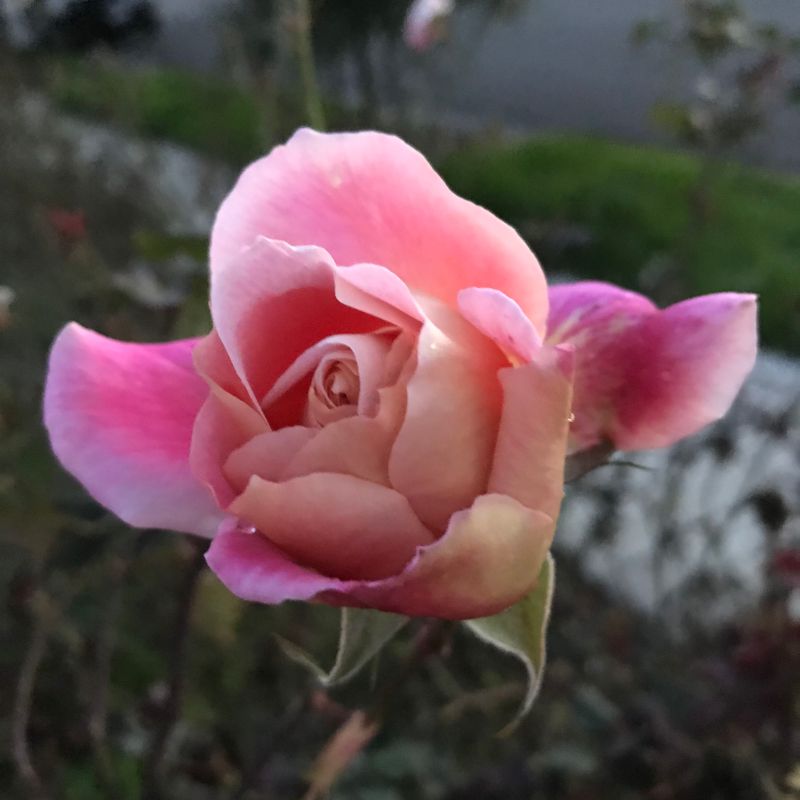
And the violets:

The violets deserve special mention. I love violets because I grew up on the East Coast. They are not native here, and in Sunnyvale, it is too warm, too sunny, and too dry for them. We have had to resort to extreme measures to keep them alive: a shady spot and daily spraying with misters to keep things moist enough for them to survive. Friends who visit from the East Coast take one look and say, “Why are you growing weeds??” Well, I happen to love these weeds. They were part of my childhood, and they are by the front door because they make me happy every time I see them. 🙂

At any rate, in California, the beginning of February can mean only one thing: Time to plant tomatoes! And so it began.

This year, because I was planting saved seed, and because I was planting seed from other seed savers, I decided to try something new: a hot-water treatment to kill fungi and other pathogens. To do this with tomatoes, you put the seeds in a hot-water bath at 122F for 25 minutes. This is hot enough to kill the pathogens, but not hot enough to kill the seeds.

So I got a sous vide cooker (because doesn’t everyone cook their tomato seeds sous vide?), got a bunch of paper tea bags, and set to work with my twenty or so packets of tomato seeds. (Lest anyone think I’m only growing twenty tomato plants – quelle horreur! – I’m actually growing 32 Fruity Mix plants this year, from 4 different seed collections, plus 10-12 other varieties, both for breeding and for breeding to my Fuzzy Mix plants, which will be sown about a month later. I plan to grow 60-70 plants total, though I will likely pull out all but the best ones later in the season.)

Here’s what my setup looked like shortly before plunging into the sous vide. The teabags with seeds are clamped together at the top to keep them shut, so the seeds don’t escape in the water bath.

And here they are in the sous vide bath (just as it was cooling):

I planted them in soil blocks, which are preferable to pots because the roots naturally air-prune, rather than reaching the sides of the pots and then circling around and around. The labels are printed on the nearly-indestructible labels I used for my dye samples, and will last through an entire season of sun, water, and slugs. (I tried paper labels once. Slugs ate them.)

I worried that the hot water bath might kill some of the seeds. Quite the opposite. Tomato seeds normally take 7-10 days to germinate. I came back four days later to find the first ones popping out of the soil!

A day later, most of them had germinated. Wow! I’m definitely doing that again next year.

My nefarious breeding plans for this year are primarily to stabilize Fruity Mix. This year’s batch had only three out of twenty plants with the intense, fruity flavor I remembered. I saved seed from those three plants and am growing 32 plants from that seed. I will save seed from the best of those plants, grow another 30-odd plants next year, and continue until I have enough stability in the line to feel good about sending it to others.

Fuzzy Mix, on the other hand, is stable enough to use for breeding work as-is. The flavor is terrible, though, so I want to breed it to a better-tasting tomato. My goal is a dwarf tomato maybe 18″ or shorter, with fuzzy leaves and beautiful fruit, that would make an attractive container plant – suitable for people who want a beautiful plant that also bears beautiful, tasty tomatoes. So this year I’m growing an assortment of tomatoes with small, yellow-and-red striped, tasty fruit. My intent is to breed them to Fuzzy Mix and see what happens.

I’ve also just gotten seeds for some fuzzy leaf, multiflora, red and yellow striped microdwarfs from another tomato breeder. Microdwarfs are very small tomatoes, that grow maybe 10-12″ tall, and multiflora tomatoes grow large bunches of tomatoes. These seem like great candidates for breeding to Fuzzy Mix, too – Fuzzy Mix could add drought resistance and additional fuzziness to the other characteristics, both of which would be good for a houseplant or patio plant. Also, smaller plants are better for me since I have limited space.

All the possibilities!

Finally, lest you think that I am the only mad-scientist breeder out there, I found these at the farmer’s market last week:

“I don’t know what they are,” said the vendor, “but I found them growing behind one of the labs. Want some? No one’s died yet…”

No, seriously. They’re pometrons. A cross between a pomelo and a citron. Apparently they’re mostly skin, like a citron, but the interior flesh is edible, like a pomelo. I’m going to try candying the peel. I’ve been so busy teaching my online course, though, that I haven’t had time to cut it up until today, so I have no idea what the peel tastes like. Looking forward to finding out!

Finally, I’m pleased to say that, after years of waiting, I finally have my first bergamot!

Bergamots are an ancient citrus, and the source of the special flavor of Earl Grey tea. Candied bergamot peel dipped in chocolate has been one of the signature flavors in my chocolate boxes for many years, and I made the candied bergamot peel myself. But sourcing fresh bergamots has been a huge challenge. After the third source dried up, precipitating yet another a frantic search for a new one, I lost my temper and got B. to plant a bergamot tree. And so, three years later, I finally got my very first bergamot!

“But wait,” you say. “Didn’t you retire as a chocolatier last year?”

Well, yes. But my friend Chris is carrying on the tradition. And candied bergamot peel makes great fruitcake. I’ll find something to do with it, dammit – the stuff is delicious. And now I have my very own source!
Filed Under: All blog posts, garden Tagged With: tomatoes

September 21, 2018 by Tien Chiu 2 Comments

Nefarious plots

The National Heirloom Expo and my wonderful visit with John Marshall have inspired me to start planning all sorts of mischief. In particular, I am working on nefarious plots – garden plots, that is. And evil plans (coming soon!) – plans for tools and equipment that will enable me to weave luscious velvet!

I am, believe it or not, already late on garden planning. That’s because I live in an area with extraordinarily mild winters – the lowest temperature all year is usually around 30F, and it only frosts five or six times a year. So gardening year-round is definitely a “thing” – and September and October are the best months to start planting fall crops. That means I’m already late in planning out the garden.

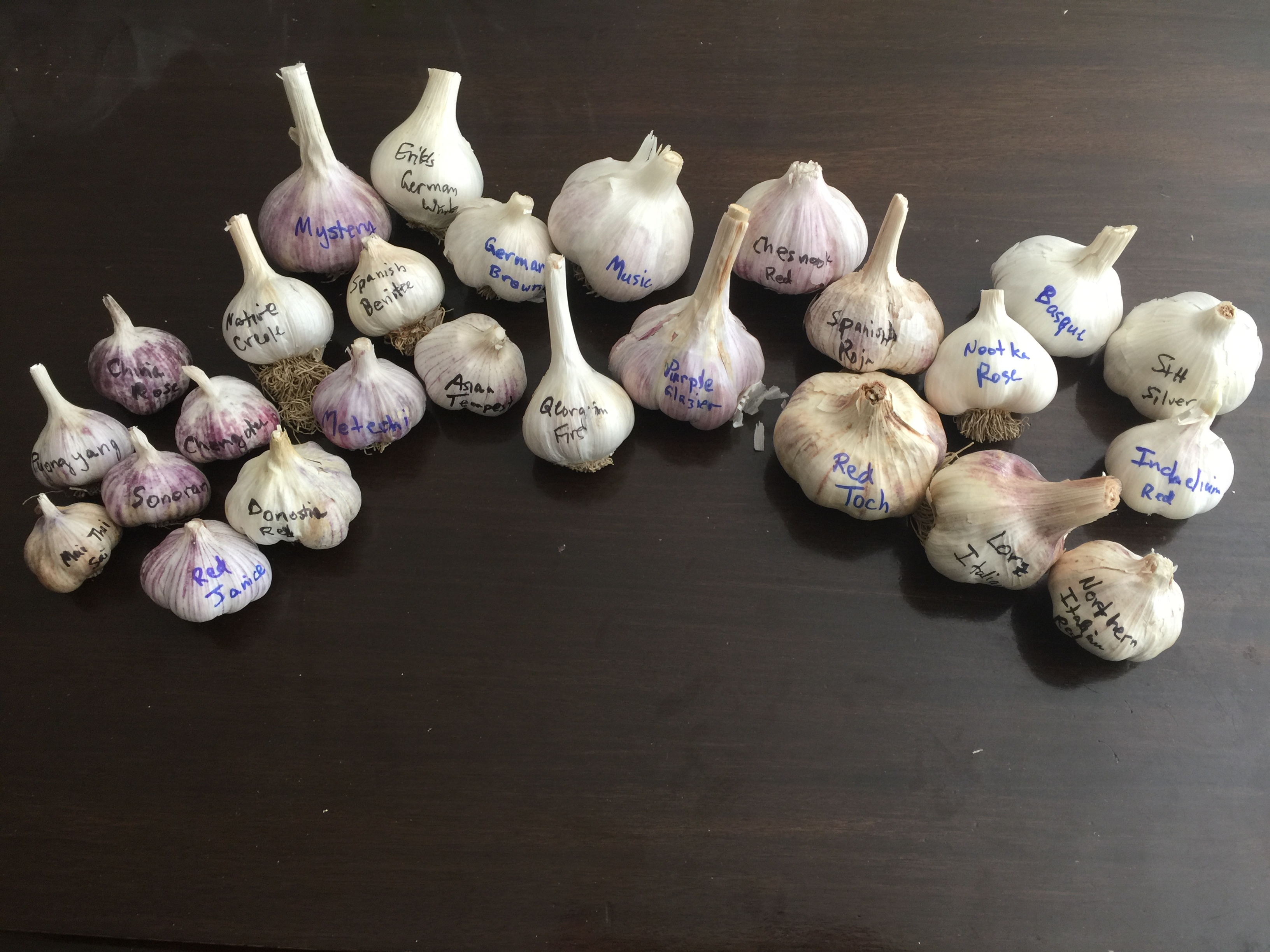
My winter plans are fairly simple. I love English peas, so I’m going to plant pounds and pounds of them all over the garden and then eat peas until I sink down roots, turn green, and start sprouting tendrils. (Don’t worry – if that actually happens, I’ll post photos.) But I’m also going to plant lettuce, kale, brussels sprouts, and this weird hybrid that bears tiny mini-kales on a brussels sprouts stalk (amazing what these mad geneticists get up to in the lab!). And some tasty mustard greens. And oh yeah, didn’t someone mention getting 25 kinds of garlic in last week’s blog post?

many kinds of garlic!

Actually, nope. That’s twenty-six kinds of garlic, not twenty-five. Apparently someone is not so good at counting. 🙂

My foodie buddy Chris Cianci and I set out to taste-test the garlics. We decided to split the group into three parts – the softnecks to the right, the hardnecks to the middle, and the Creoles to the left. (The varieties were classified on the fly, so may not be in the right categories – look them up yourself if you want to be sure.)

Chris and I decided to start with the milder garlics, the softnecks. We separated out the eight varieties on the right of the photo, picked two cloves off each bulb, and then roasted one clove and left the other raw. For each variety, we tasted a roasted clove, then a paper-thin slice of a raw clove. In between, we cleansed our palates by chewing on bread and Italian flat-leafed parsley, which reputedly is good for cleansing garlic flavor, and rinsing down with plenty of water. We recorded our taste impressions in a shared Google spreadsheet. (Because doesn’t everyone?)

Naively, we had assumed we’d be able to taste all eight varieties in one day – especially since we started with the softneck garlics, which are generally milder than the other two types. But after just five varieties, we had to give up because we could no longer taste anything but garlic, even if we were chewing on something else (like Italian flat-leafed parsley). Truthfully, we should have stopped after three or four – especially since, 24 hours and much tooth-brushing and palate-cleansing later, I could still taste garlic on my tongue.

Clearly, this garlic-tasting is going to be a long-term project.

Garlic, in the Bay Area, gets planted in the fall – usually in October, to be harvested around July. So sometime in the next two weeks I need to figure out where to put 25 – wait, 26! – varieties of garlic such that they won’t interfere with tomato-growing. Since I’m space-limited at home, I’m thinking I may put them into a friend’s backyard. Since my buddy Chris has a nice big backyard that he is not using, clearly he needs a bunch more pots, this time containing garlic as well as tomatoes. (Fortunately, Chris loves both tomatoes and garlic.   🙂 )

Which gets me to tomato planning.

This is what the future of a tomato variety looks like:

freshly fermented tomato seeds
freshly cleaned tomato seeds

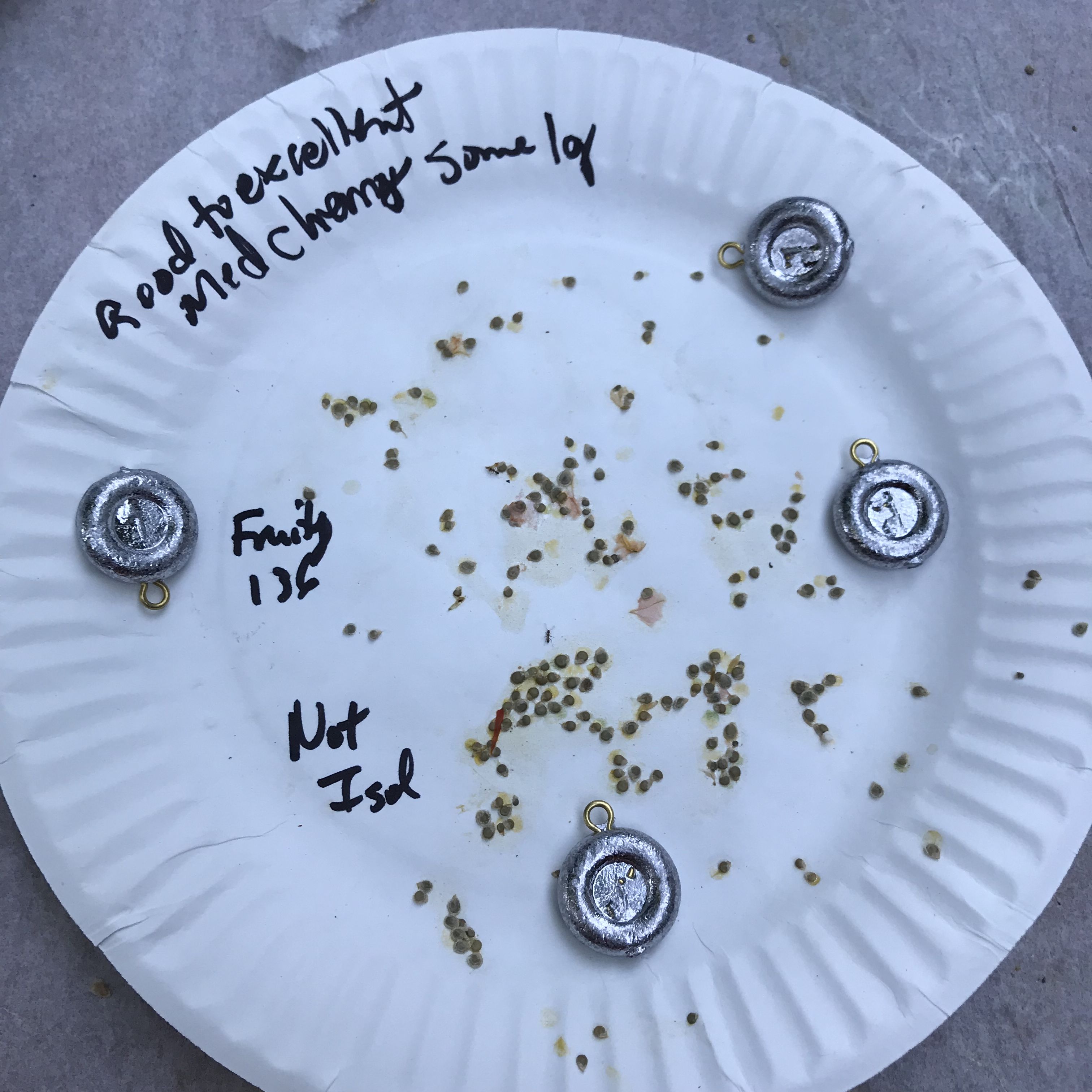
These are tomato seeds after cleaning and drying. I’m using two different methods for cleaning seeds – the traditional way is to squeeze the juice, seeds, and gel into a small cup, then let everything ferment for a day or two. The fermentation removes the gel around the tomato seed, which contains a germination inhibitor, and also kills some seed-transmitted diseases. You can also clean the seeds chemically, using TSP (trisodium phosphate, a powerful detergent) followed by a 10% bleach bath to kill pathogens. I tried both ways, and plan to do a germination test soon to see which works better for me.

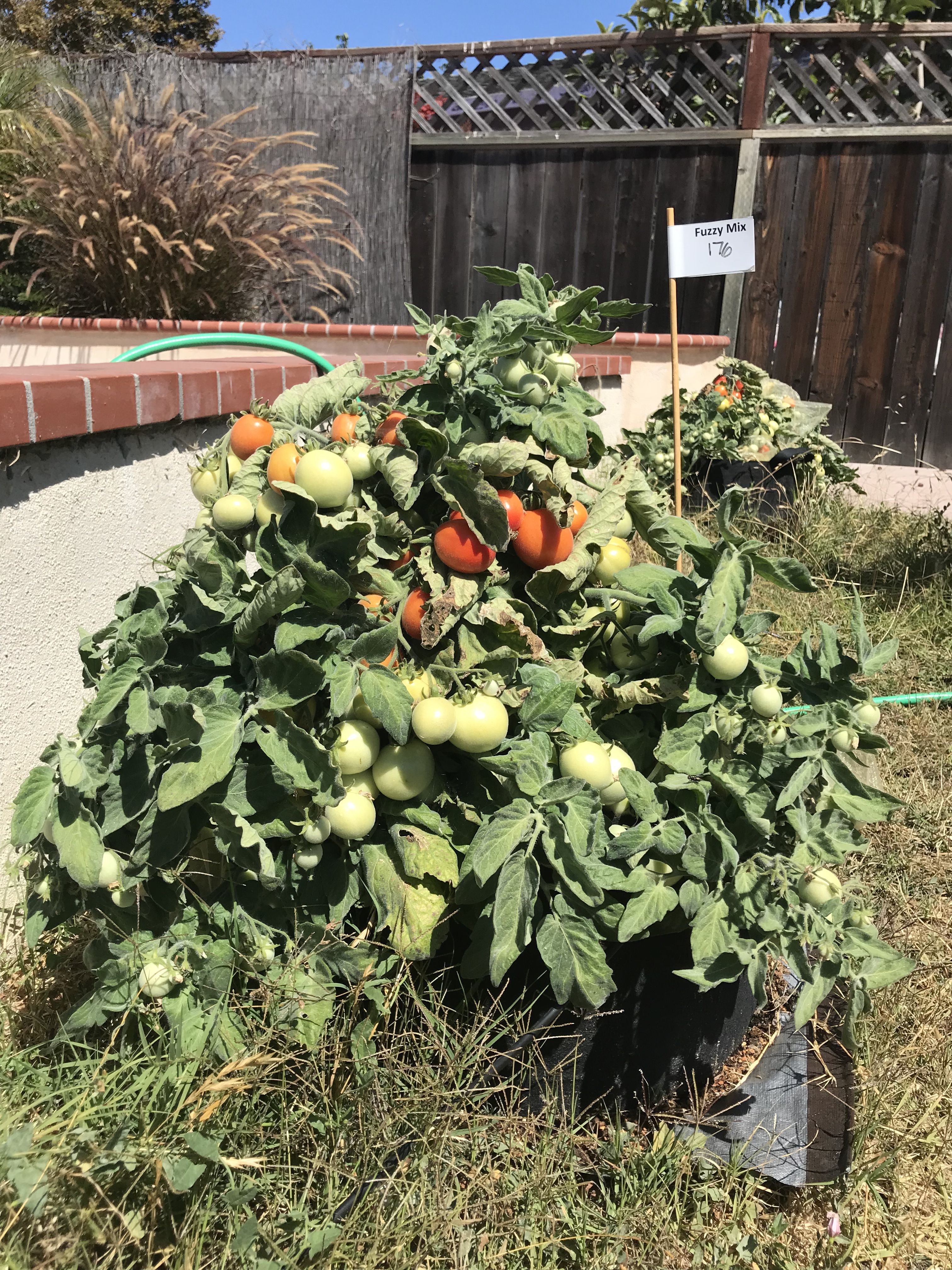
The notes on the paper plate are my field notes. Every plant has a label with a description of the variety and the number of the plant. Here is Fuzzy Mix #176, which grows upright:

Fuzzy Mix, upright growth habit

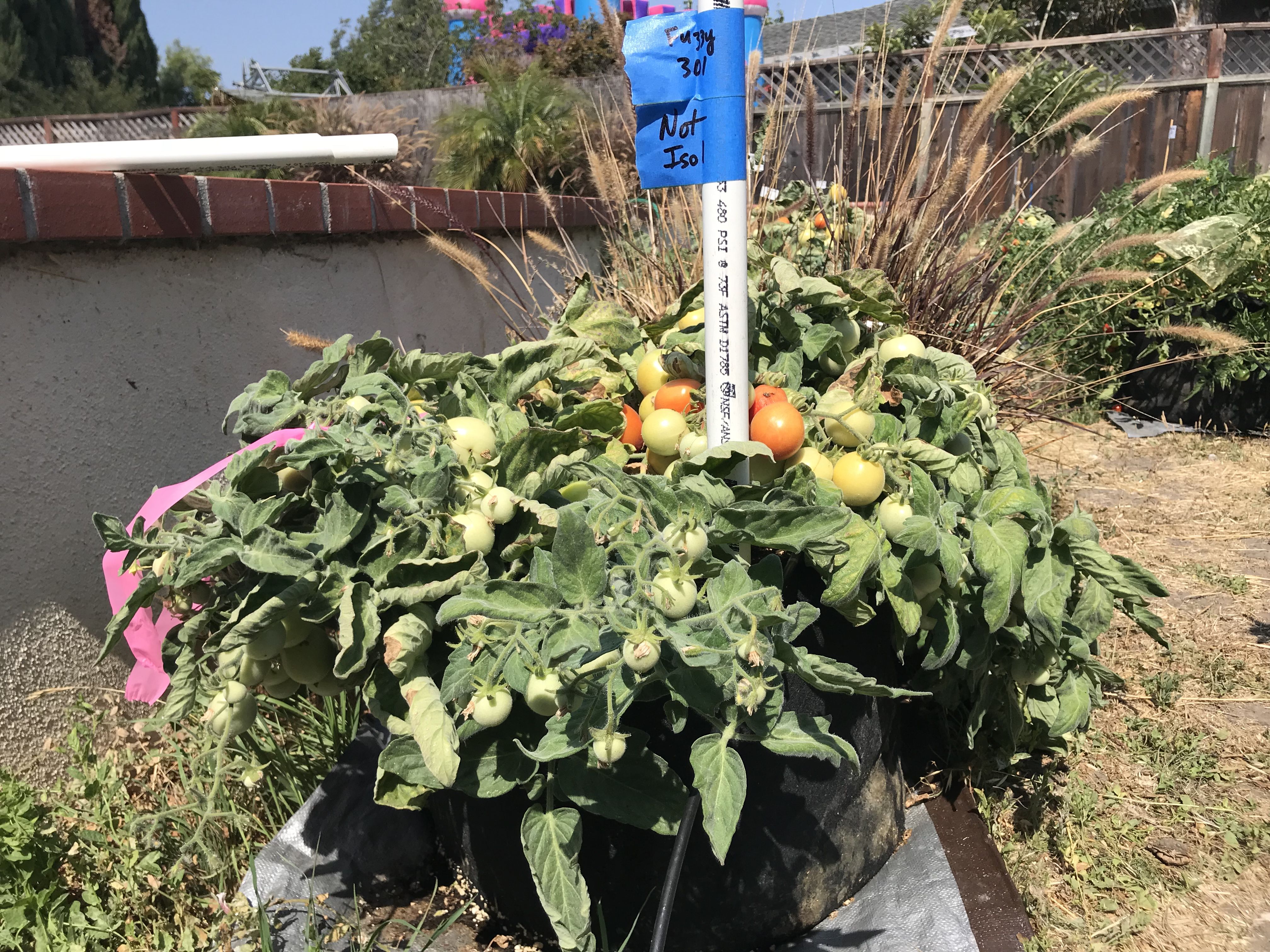
And here’s Fuzzy Mix #301, which is almost flat:

Fuzzy Mix, flat growth habit

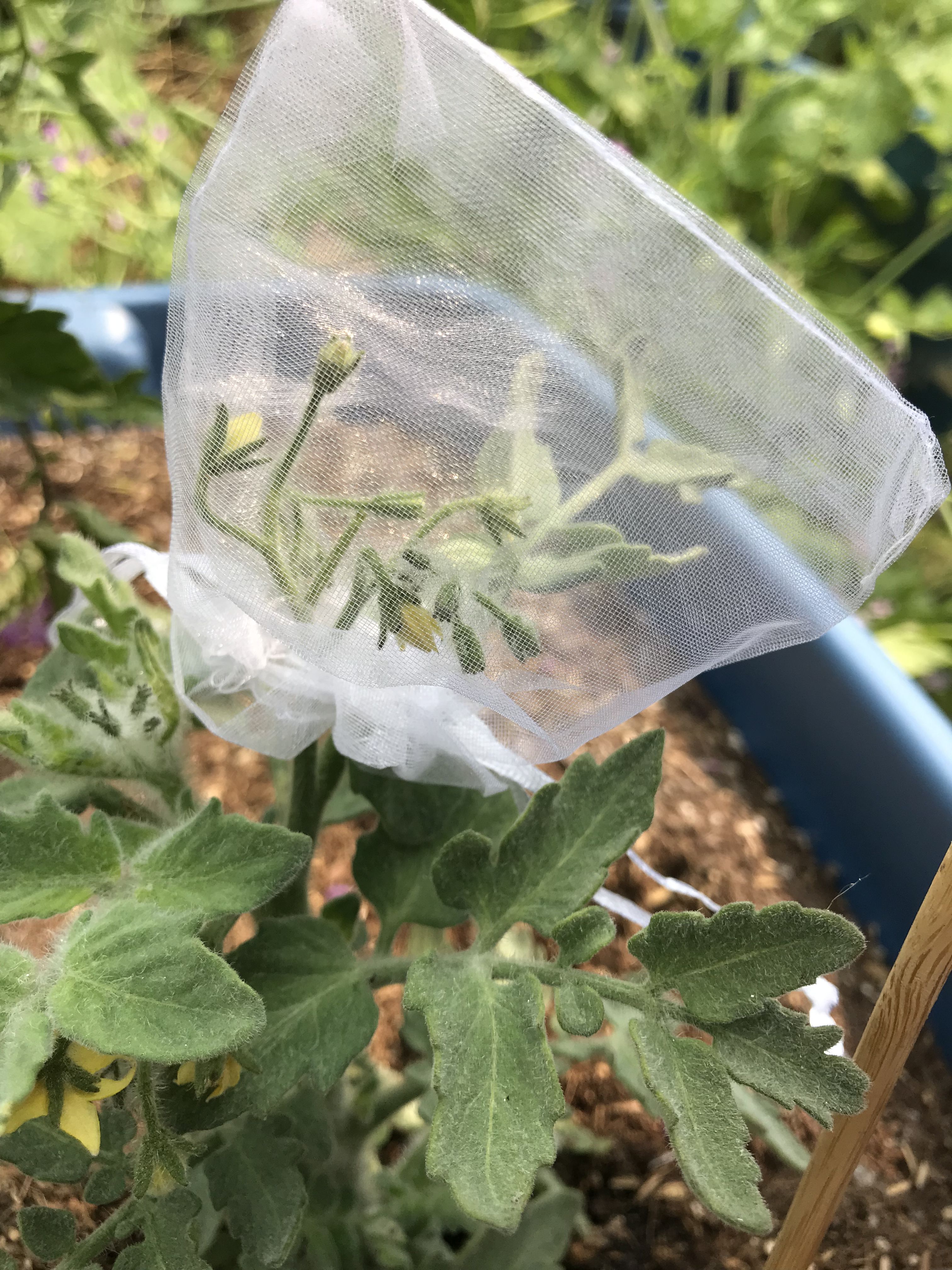
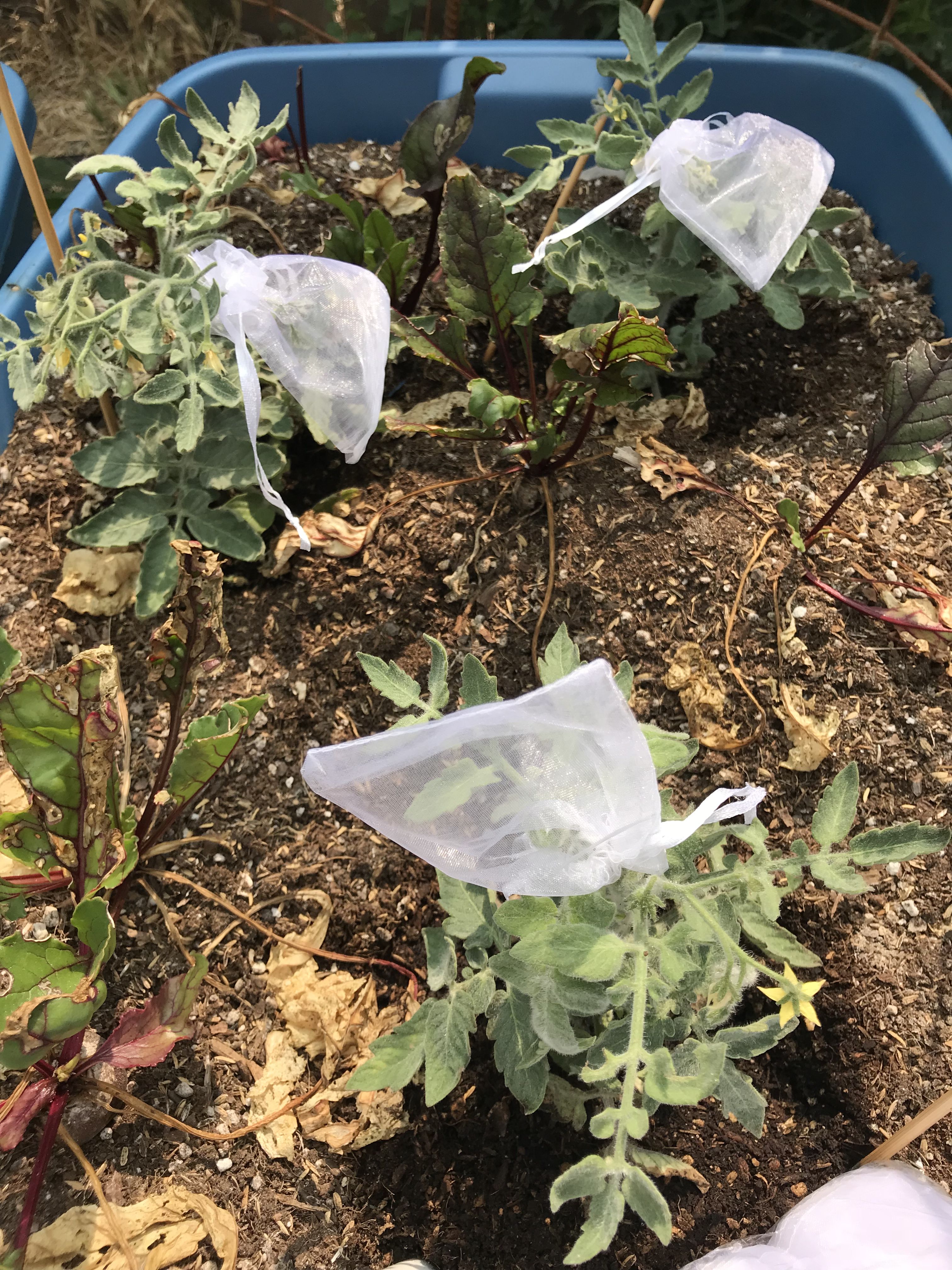
When I collect tomatoes from a particular variety, I write down the plant number, the name of the variety, and any relevant notes about the plant or the fruit (good tasting, upright/flat, etc.). I also note whether the tomato grew from an isolated blossom (covered when flowering to prevent cross-pollination) or from a non-isolated blossom, which might contain an accidental cross with another tomato.

This information then follows the tomato seeds through fermentation, and eventually winds up in my database, which I affectionately call Tien’s Tomatobase. (What? You mean every gardener doesn’t have a tomato database? Scandalous!! What are they thinking??) There is an online wiki of tomato varieties called Tatiana’s Tomatobase that inventories literally thousands of tomato varieties, but mine is far more modest: so far there are only 200 plants and 72 varieties in my database. (See! Still a total piker. Lots more room to obsess.)

I won’t bore you with the details of the database structure – especially since I may be tweaking it soon. But the basic idea is to track the parentage of each plant as I start mixing varieties together. I don’t have a lot of space – I can fit maybe 100 plants in my back yard if I really squeeze – and you really want to grow out at least 25 of each variety you’re trying to create. So I’m thinking I can try creating a max of four new varieties. (Sadly, B. will not allow me to destroy our neighbors’ houses with a flamethrowing mini-tractor so I can clear room for more tomatoes. If he weren’t the most awesome spouse ever I might get upset with him for nixing all my perfectly reasonable ideas.)

Anyway, I am considering what crosses to try now.

Meanwhile, these are lurking ominously:

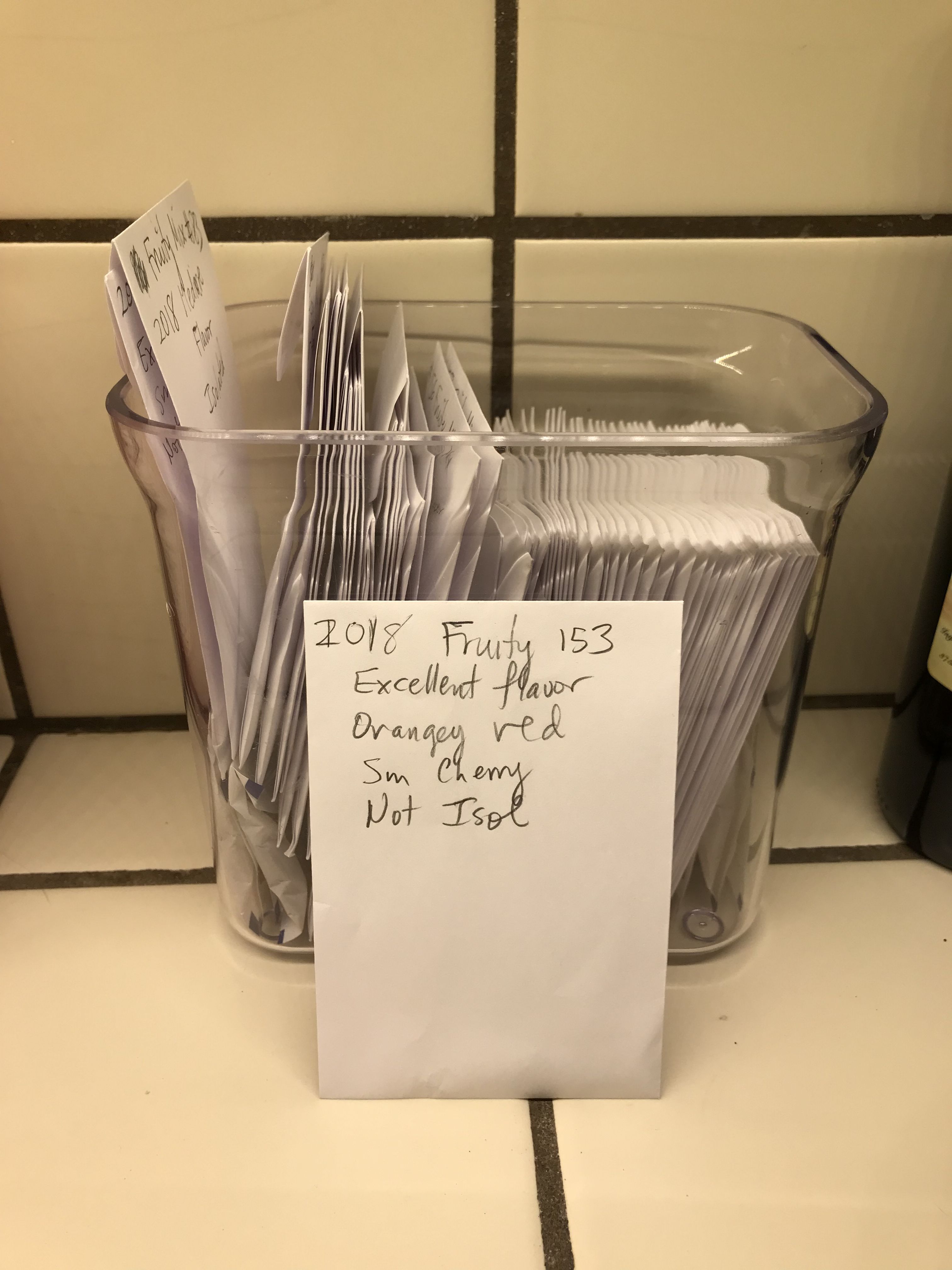
box of saved tomato-seed packets

There are 61 seed packets so far, each of which will have to be entered into the database. I also need to do germination tests on a couple of the more critical ones to ensure that the seeds are viable. After that I can pull out the plants and start planting peas!

(And making velvet. Lots of adventures around velvet. But this post is already too long. What’s a girl to do?? …next blog post, I promise!)

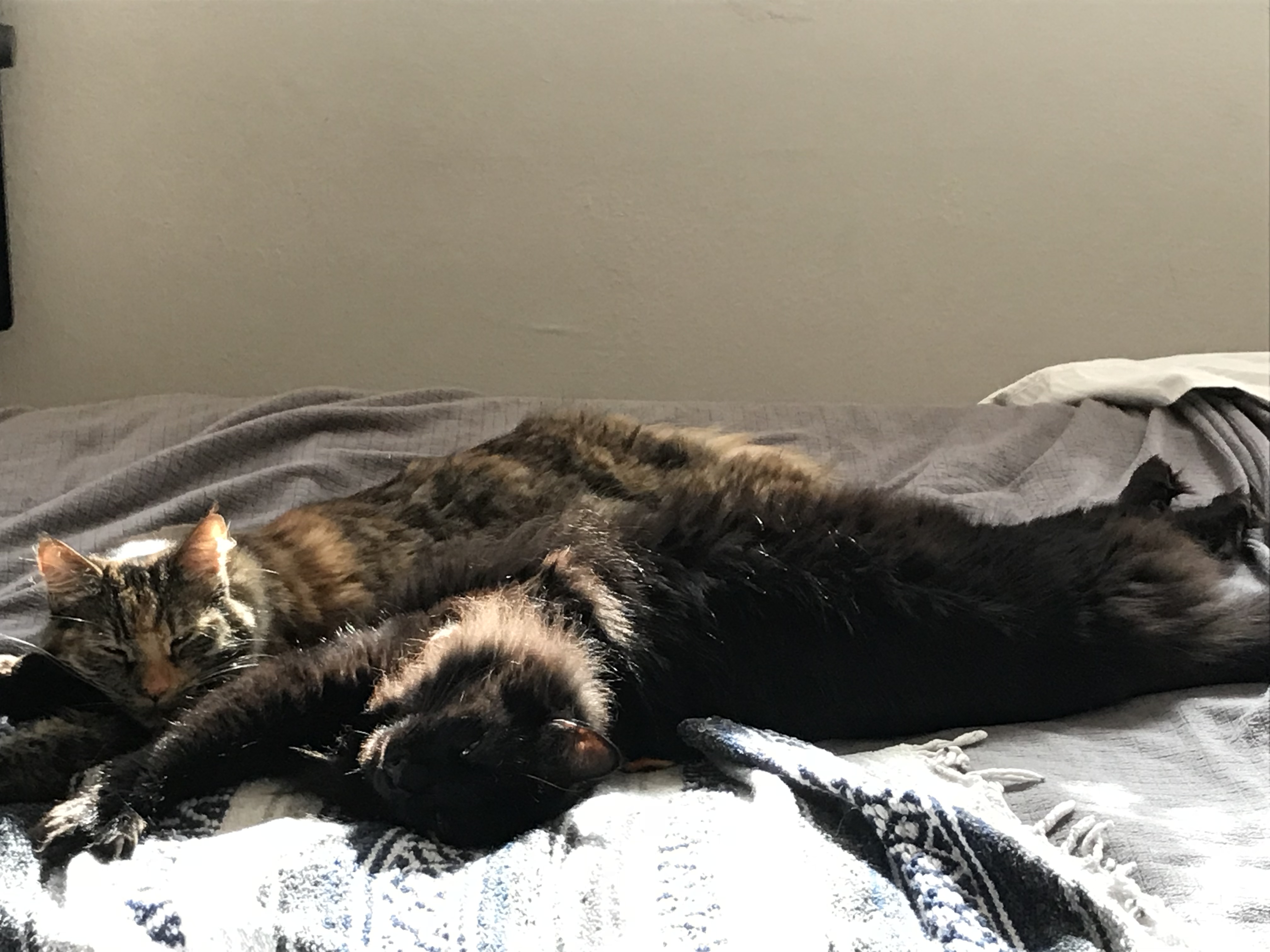
Meanwhile, tomorrow is a very special day. An anniversary! I’m not telling you of what or who, but I’m betting you can guess. Here’s a hint.

What is the sound of two cats napping?
Ancient Zen riddle: What is the sound of two cats napping?

Filed Under: All blog posts, garden Tagged With: tomatoes

September 15, 2018 by Tien Chiu 1 Comment

The National Heirloom Expo

You may recall that the cats grounded me a couple months ago because I had derelicted my duties as humble cat slave. Also because, as they pointed out, “We can’t let you go anywhere unsupervised! You’ll just get into trouble.”

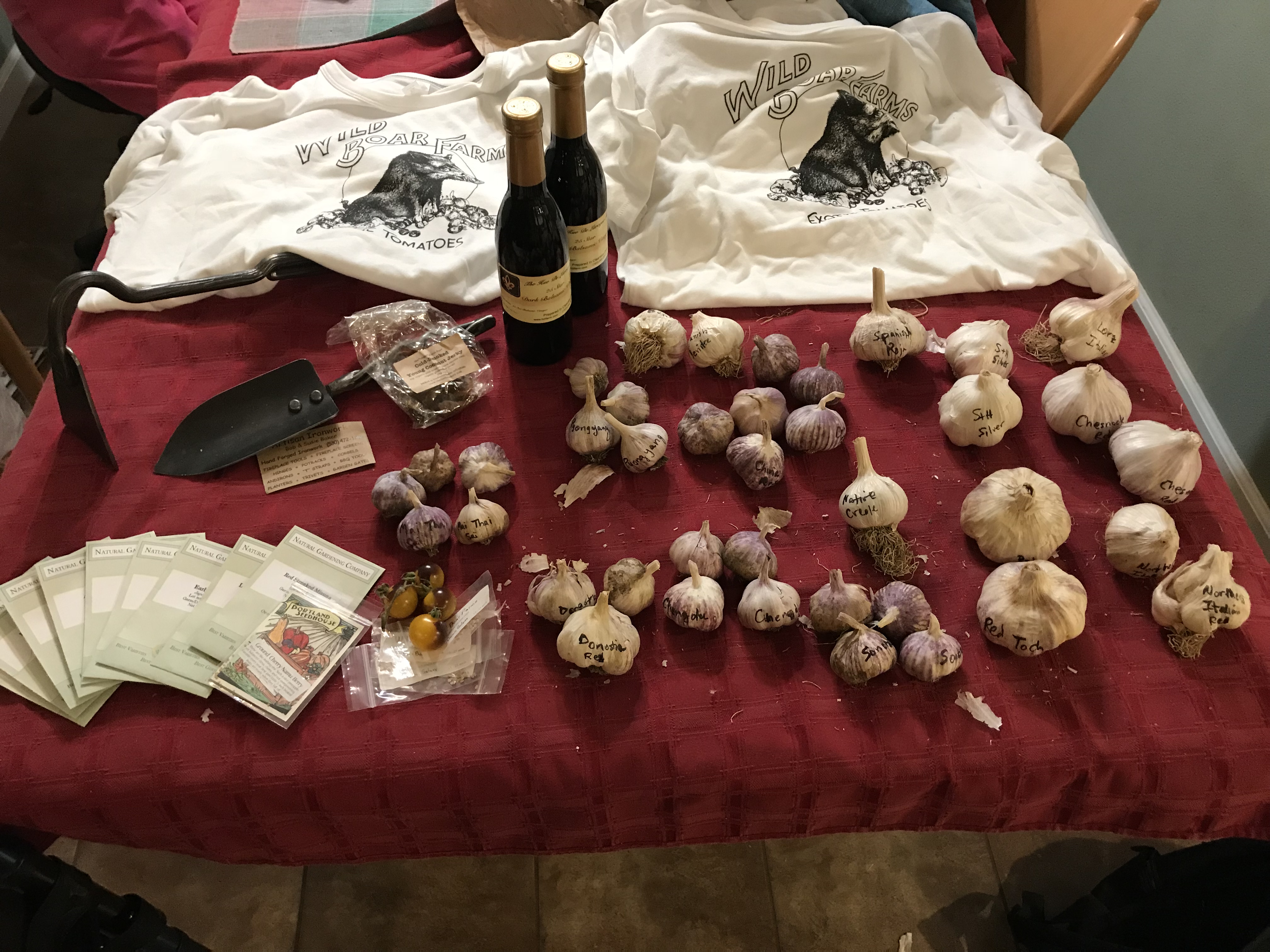
Which is entirely true, as I demonstrated last Tuesday by sneaking out of the house and heading up to the National Heirloom Expo in Santa Rosa. Here’s what came back with me:

My loot from 2018 National Heirloom Expo
My loot from the 2018 National Heirloom Expo

This is, of course, not an excessive amount of garlic. Not at all. There  were at least 21 kinds of garlic available at the Expo, and I only bought fourteen of them! The soul of restraint.

Those 14 varieties, plus the 3 varieties I’m carrying over from last year, the variety I picked up at the farmer’s market a month or two ago, and the seven varieties that just arrived from Filaree Farms, bring me up to 25 varieties. I’ll note that Filaree Farms offers 120 varieties of garlic, so with only 25 varieties, I am still nowhere near obsessive. (At least, compared to a farm that specializes in selling seed garlic. 🙂 )

I also fell in love with these two hand-forged garden tools:

hand forged trowel and hand hoe

I actually fell in love with the twisted handle on the trowel, but the hand hoe fell into my bag while I was admiring the trowel, and it just wouldn’t come out, so there was clearly nothing to do but buy it. 🙂 

Then I hit up the seed vendors, bought some terrific balsamic vinegar that had been aged in the barrel for 18 years (and was being sold for WAY too little!), and got seduced by an array of potted plants. I wound up buying three cardamom plants, a yacón (South American tuber, used for food), and a rose geranium. I even succumbed to temptation and bought a flowering plant! Almost all my plants are edibles, but this geranium was too pretty to miss – each of the flowers in the umbels looked like a tiny peony, white blushed with pink at the edges. Pics once it’s blooming!

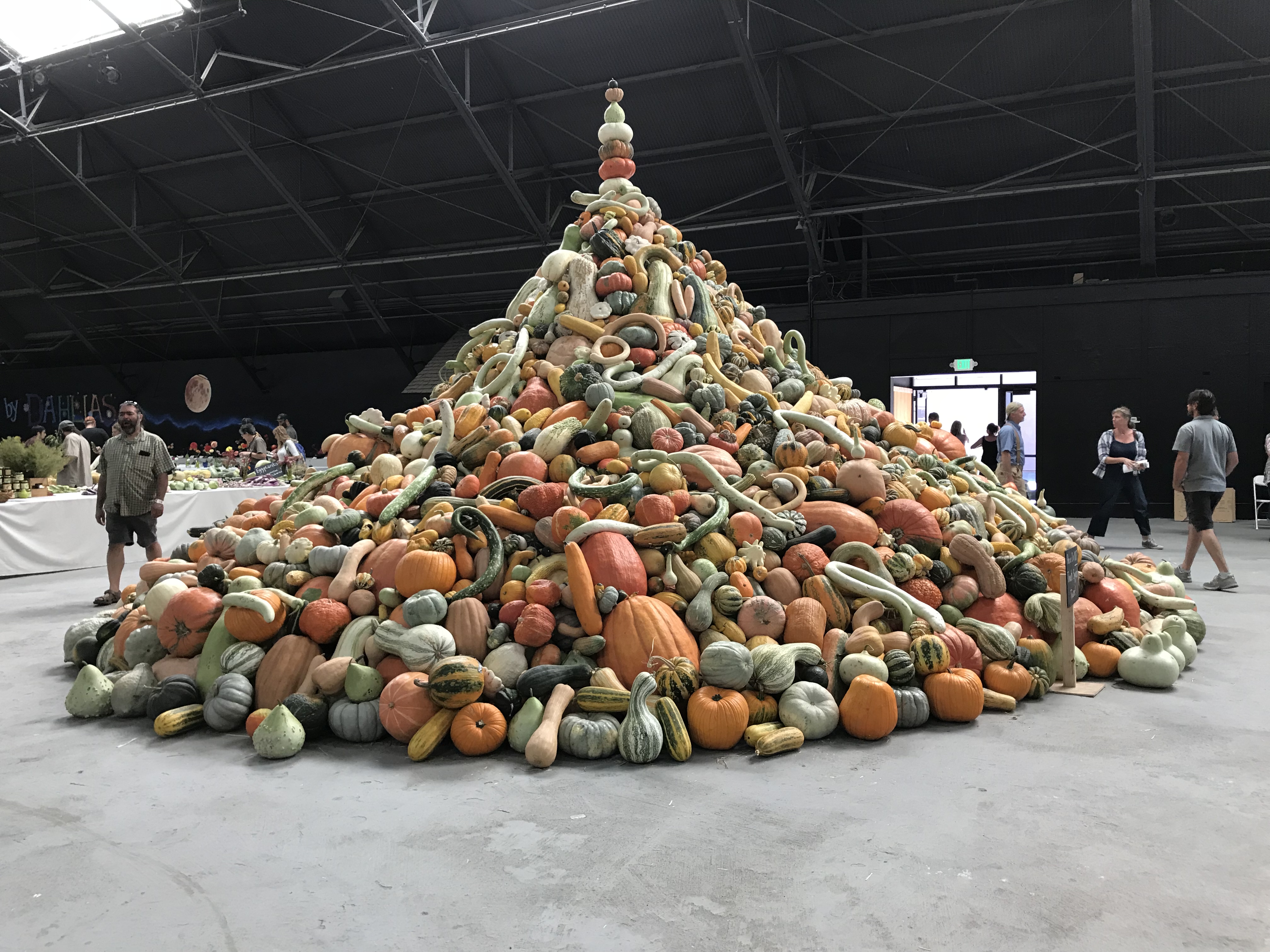
The coolest part of the exhibit was the giant mound of squash in the center of the exhibit floor:

A giant mound of winter squash. Kinda like a pyramid of skulls, only more fun!

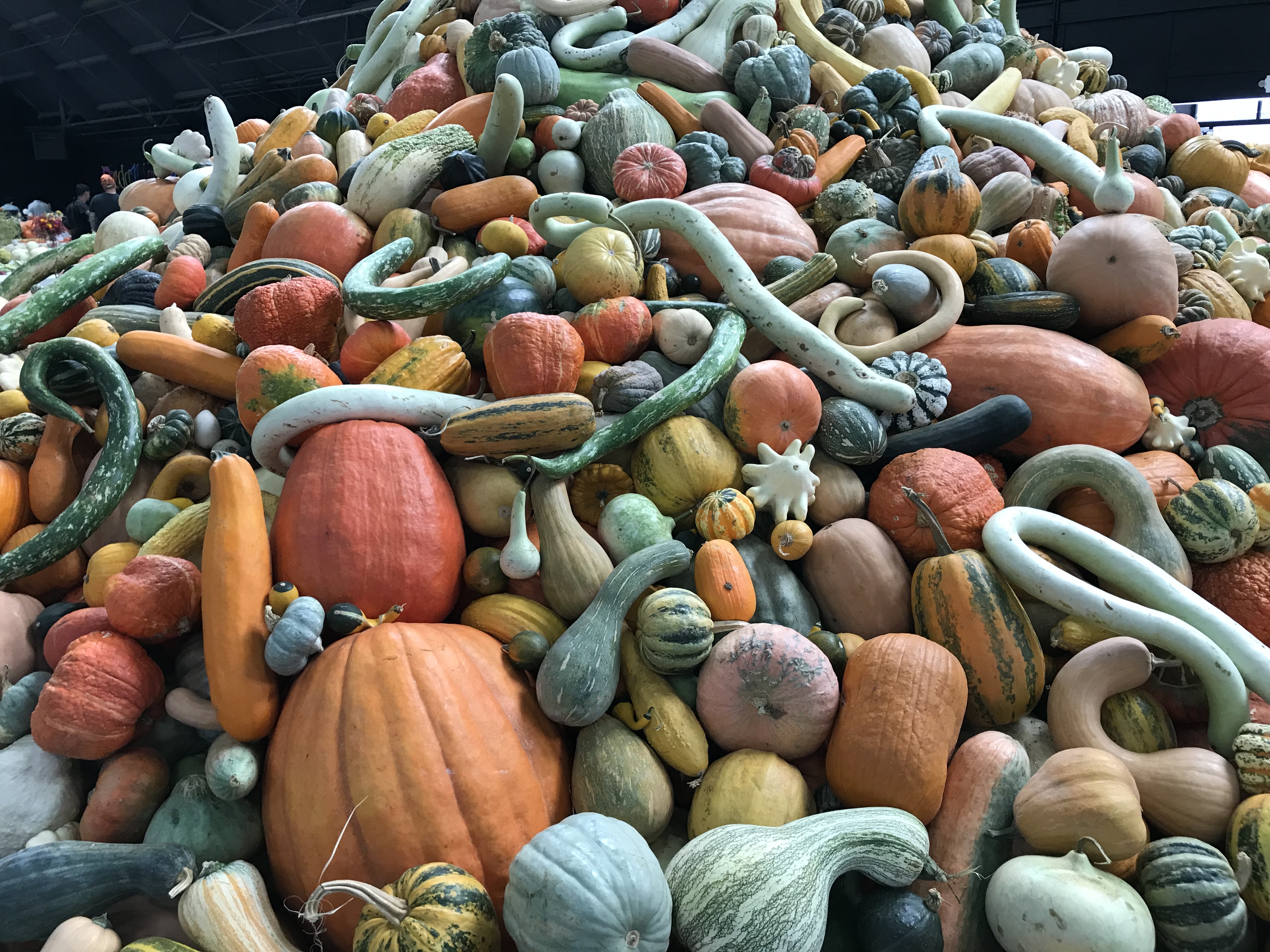
Here’s a closer look – I love the “snakes” slithering through the pile!

Giant mound of squash, viewed slightly closer

There were rows and rows of tables exhibiting squash, tomatoes, peppers, and other fruits and veggies:

A view of the Expo floor

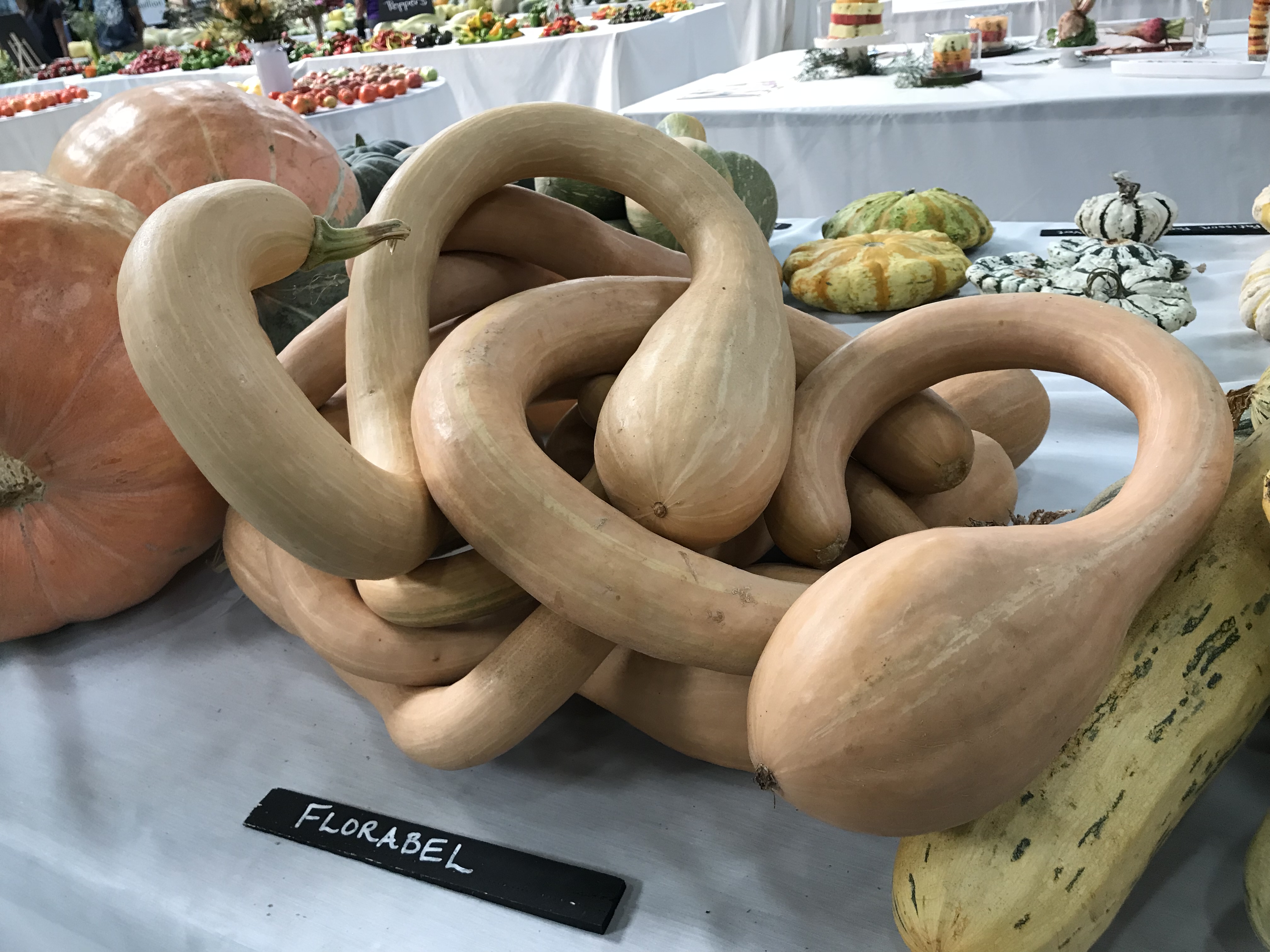
And a display of Florence winter squash, which I wanted to title “Orgy”:

A squash orgy?
A squash orgy?

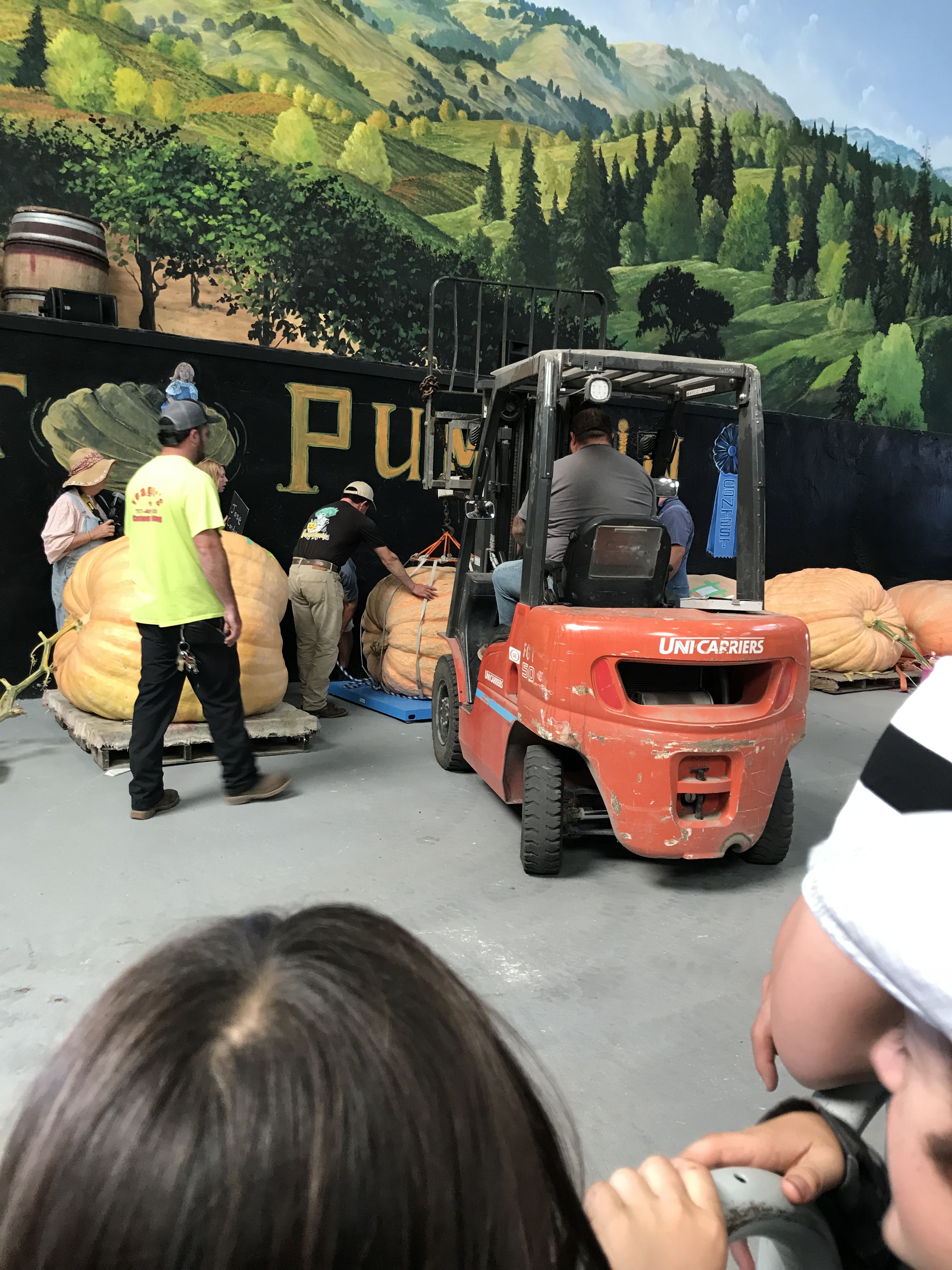
There was an impressive squash contest. I didn’t stay until the end, but at least one of those squash weighed in at 1,155 pounds!

The squash contest. A small tractor was needed to help with the weighing.

But here’s the prize photo of the day!

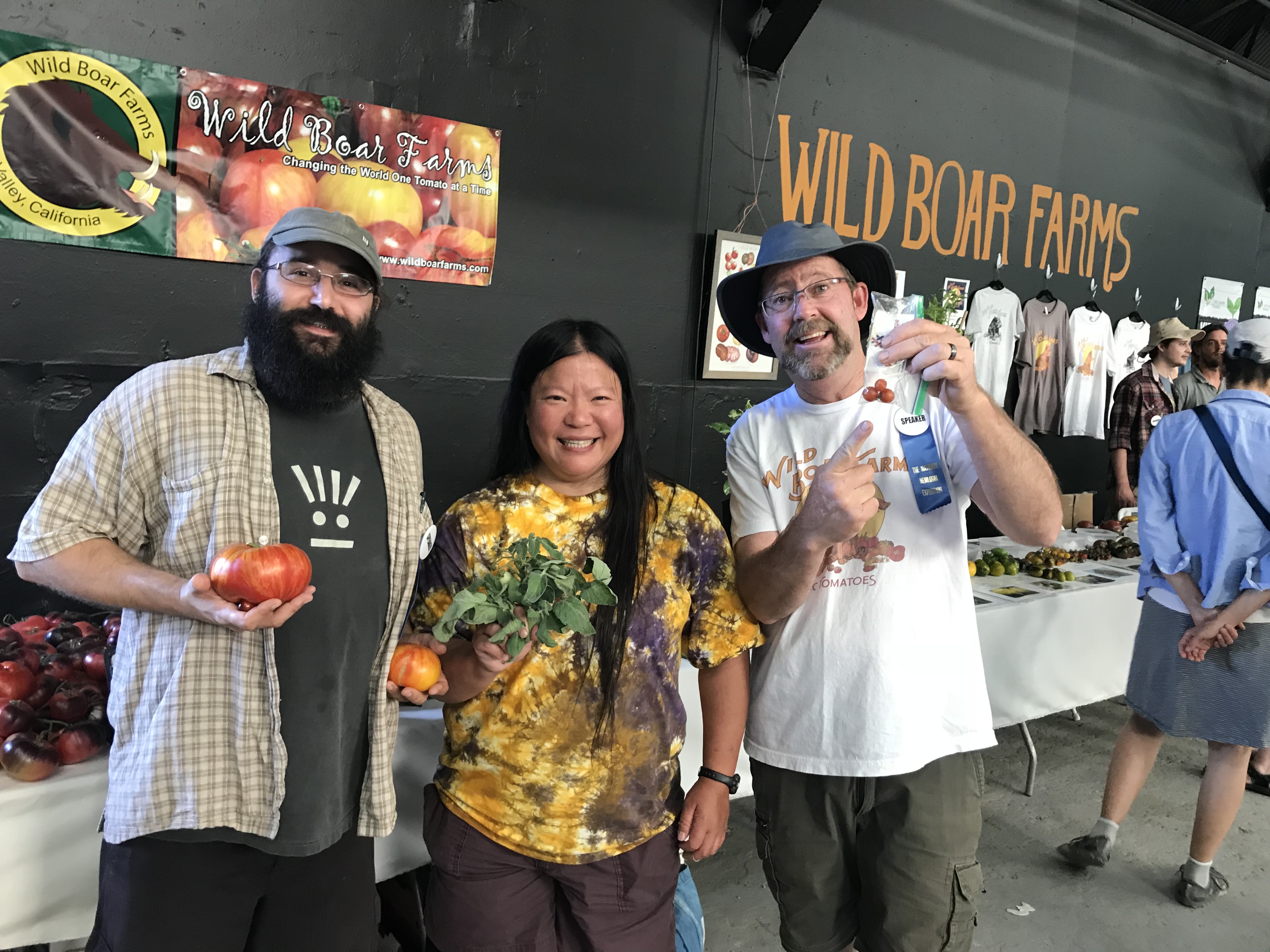
Tien, Ben Cohen, and Brad Gates at the Expo

That’s me with Brad Gates and Ben Cohen, both of whom are professional tomato breeders. I’m holding a branch of Fuzzy Mix, and Brad is pointing at a baggie full of Fruity Mix samples that I brought to the Expo. Both of them are very interested in breeding with both Fuzzy and Fruity – which means that the lines will not be lost again. Which means I have achieved my goal of rescuing both varieties and ensuring their future!

Brad and Ben aren’t the only ones interested, either – I spent two hours walking the vendor hall, handing out samples of Fruity and showing people the branch of Fuzzy that I’d brought with me. It was impressively unwilted despite having been broken off the previous day – Fuzzy is very drought-tolerant – and of course attractively furry. I now have a list of five or six tomato breeders who are interested. As soon as I get enough seed to send them, I’m pretty sure that the future of Fuzzy and Fruity Mix (or rather, of the genes and characteristics they represent) is secure. What a relief!

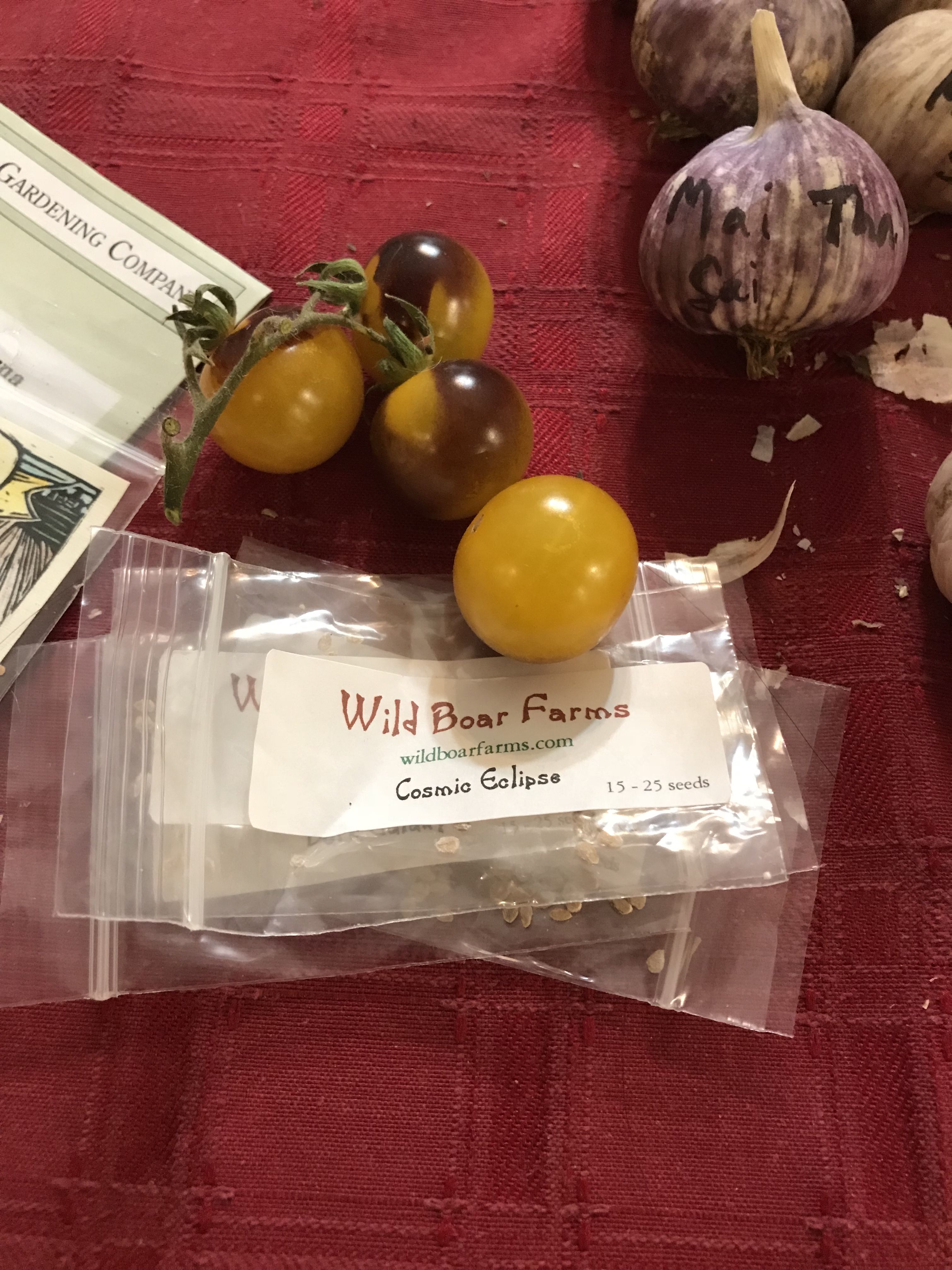
Brad gave me seeds for some of his tomatoes:

tomato seeds from Brad Gates

He was out of seeds for a variety that I liked, Gold Berries. I asked him if he had any more seeds, and he said, “No…wait!” He popped over to the tomato display and handed me four Gold Berry tomatoes. It took me an instant to realize that he was giving me a packet of seeds – still tucked inside the tomato. (I thought it hilarious that it took me a second to connect ripe tomatoes with tomato seeds – especially since we’d just been discussing tomato breeding and seed-saving.)

I also went to Brad’s lecture on tomato breeding, which gave me all sorts of ideas for what to do next. I’ll detail those when I get a chance to do a tomato update.

I had a great time at the Expo, but an even better time the following day, when I ran up to visit my buddy John Marshall in Covelo. John has an enormous collection of fine Japanese textiles, and when I told him I’d been obsessed with velvet recently, said, “Oh, I have several trunks of Japanese velvets! Come up and I’ll show them to you.” So I turned up on his doorstep, and he not only showed me his collection of spectacular Japanese velvets, but insisted on loaning me two enormous boxes of them so I could inspect/analyze/be inspired by them at home. John is every bit as generous as he is skilled at dyeing, and that’s saying a lot!

But that is a subject for another blog post, and I need to photograph and analyze (i.e. drool over) the velvets first. So watch this space! Next week, I promise.

Filed Under: All blog posts, garden Tagged With: tomatoes

August 20, 2018 by Tien Chiu 3 Comments

The Tomato Grower’s Plate

Forget silly competitions that give a championship cup to the winner and nothing to the rest. The Tomato Grower’s Plate is a far more delicious prize, and anyone can win it!

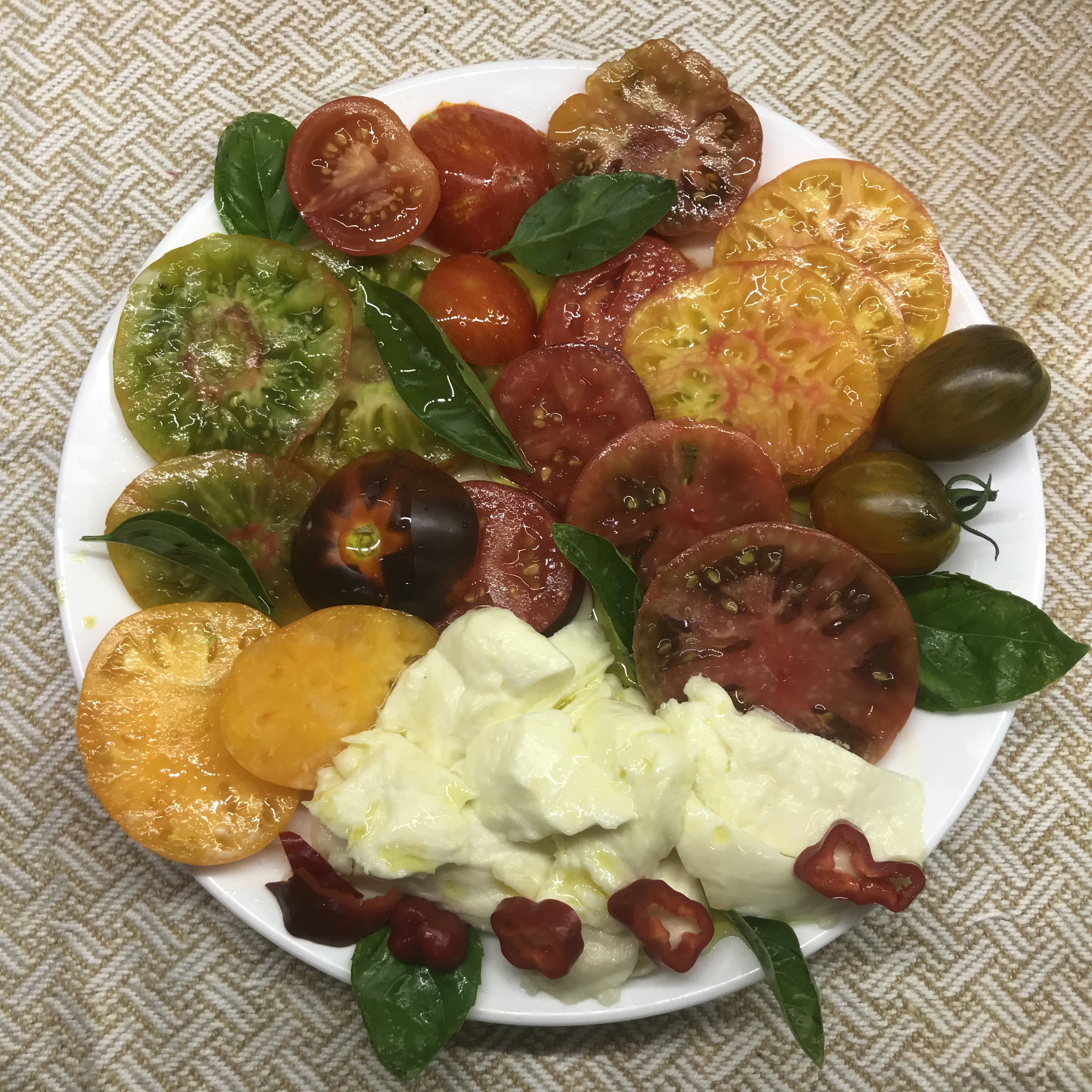
plate of heirloom tomatoes
The Tomato Grower’s Plate!

Everything on the plate is homegrown or homemade (except the drizzle of olive oil). I even wove the place mat and made the raw-milk mozzarella! (It’s unbelievably rich and tasty, and was still warm in this photo. Delish!)

Tomato varieties (starting at bottom left and going clockwise around: Orange Strawberry, Berkeley Tie-Dye, Darby Red and Yellow, Purple Calabash, Copia, Brad’s Atomic Grape, Cherokee purple. The center tomato with the black skin/red star on top is Kaleidoscopic Jewel. I’m not sure about the round red tomato in the center – I have a lot of those in the garden right now!

The basil is homegrown as well. I planted two five-gallon buckets of it and hoo boy do I have basil now!

This resulted in a not-atypical summer conversation with a friend:

Me: Hey Carolyn, the basil’s doing well at my place. I’ve got more than I can use. Want some?

Carolyn: Sure!

Me: Great! How much would you like? I can offer you a choice between “too much basil” and “way too much basil”.

Carolyn: Uh…

Me (helpfully): There’s also the option of “HOLY F—, WHAT WERE YOU THINKING???” amount of basil…

Carolyn: Uh, Brian is out of town and I’m not a basil person…so maybe a smaller amount?

Me: Okay, I’ll bring over a just-barely-way-too-much amount of basil.

My friends are very lucky that growing zucchini is not among my passions. 🙂

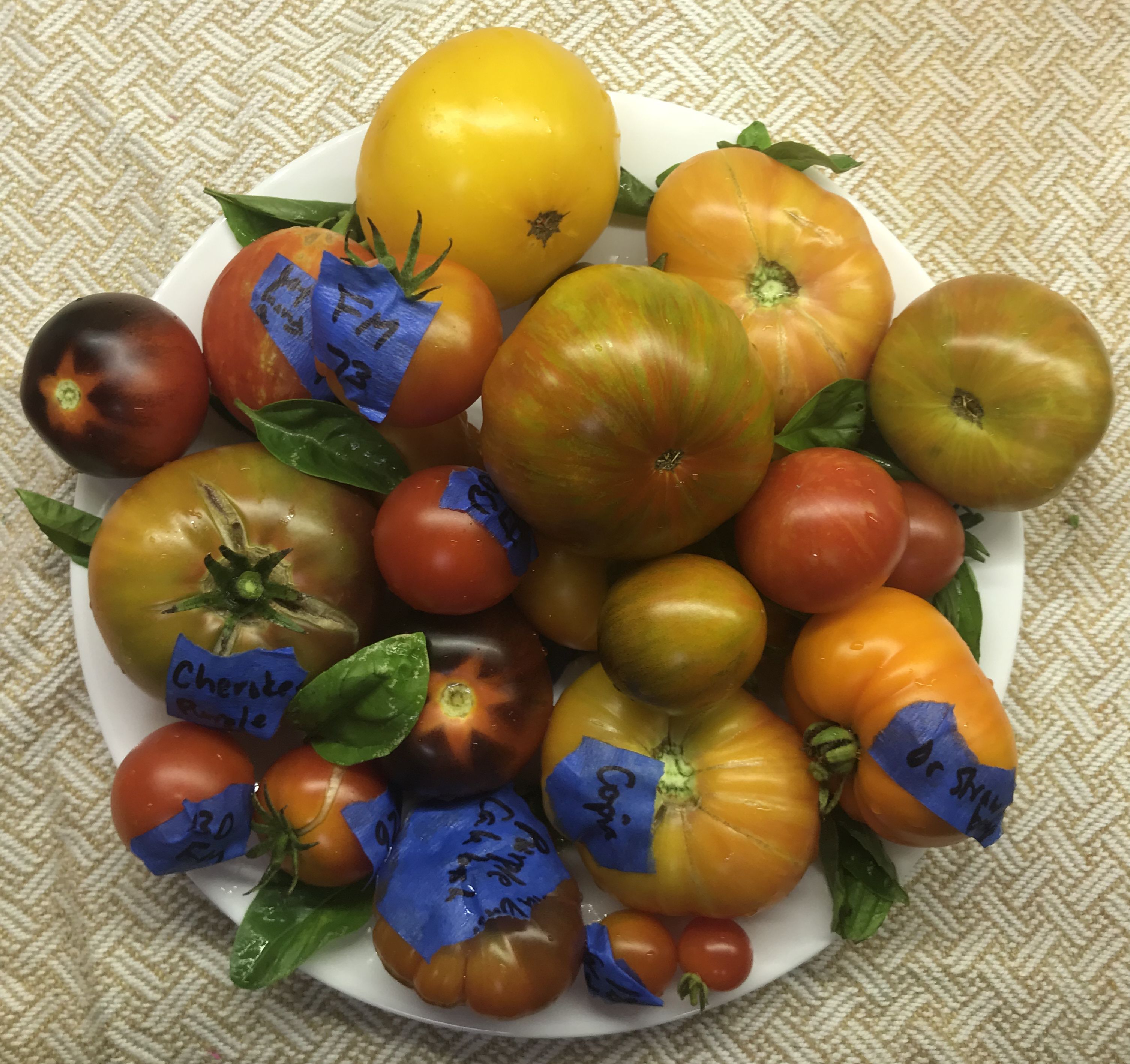
But “tomato grower’s plate” isn’t exactly the right description for what I’ve got in that photo. Here’s the behind-the-scenes view: The Tomato Breeder’s Plate!

tomato breeder's plate!
tomato breeder’s plate!

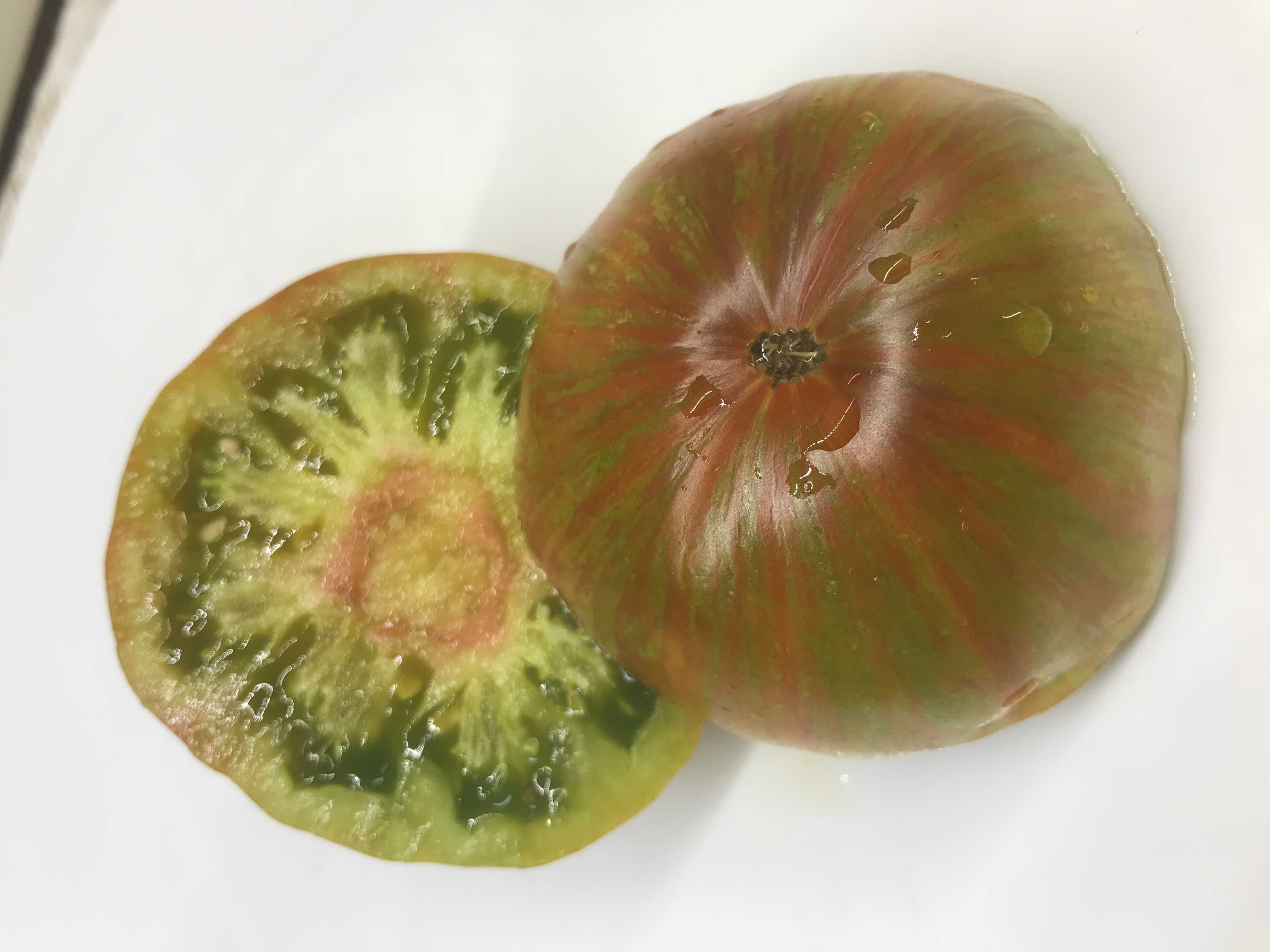
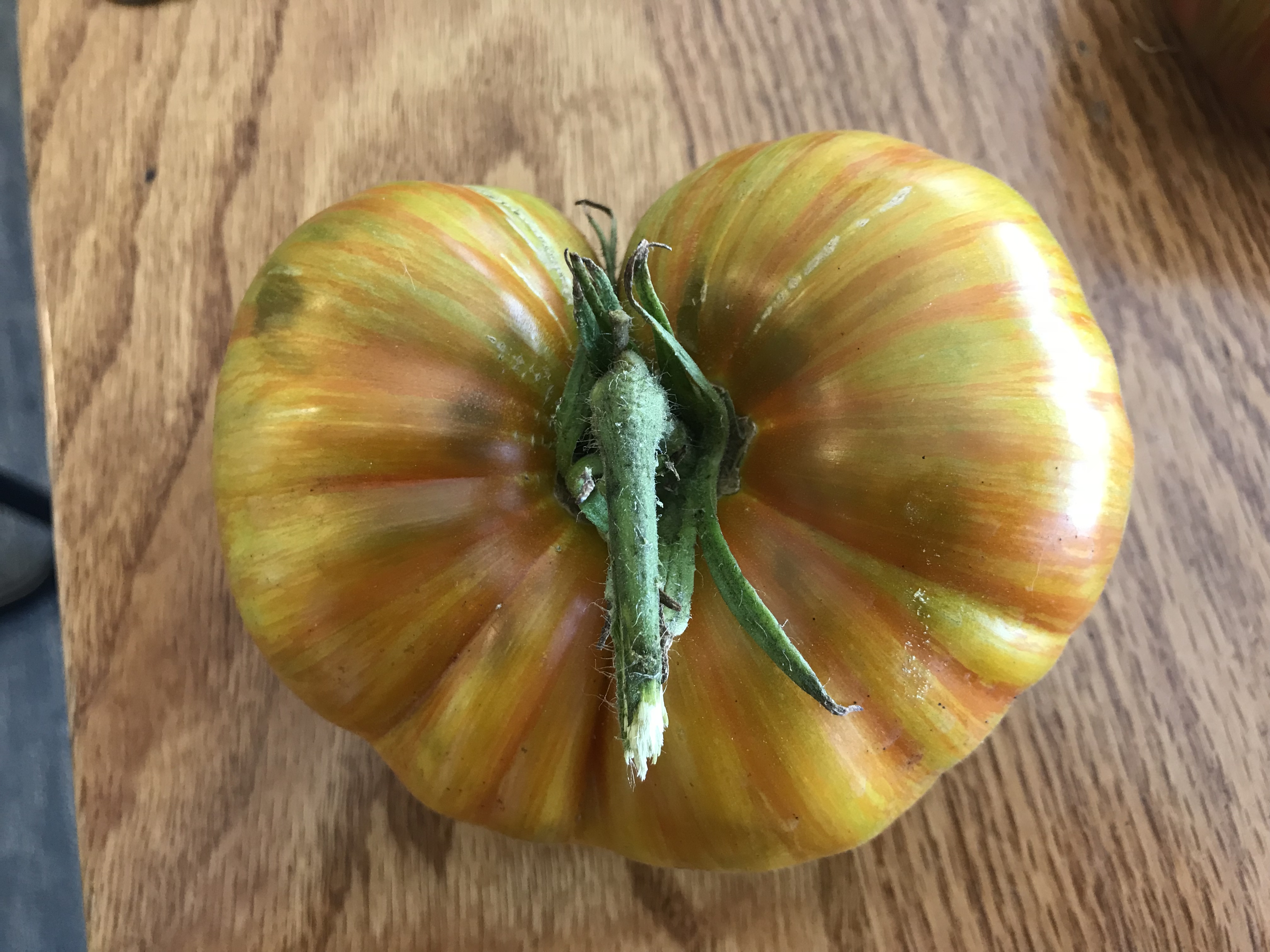
The blue tape labels indicate each breed of tomato. For example, the golf ball size tomato labeled “FM 73” stands for “Fruity Mix, plant #73”. I did a tomato tasting the following day to see which varieties I liked most and wanted to use in future breeding projects. So far, my favorite of the non-experimental breeds is this one, Berkeley Tie-Dye:

Berkeley Tie-Dye tomato

Berkeley Tie-Dye tomato

This one is bred by Brad Gates at Wild Boar Farms. Not only does it have excellent flavor, it’s the most beautiful tomato I’ve ever seen. Red, yellow, and green stripes on the outside, and red/yellow/green flesh on the inside. Be still my tomato-artist heart! 🙂 I definitely want to try breeding it to Fruity Mix next year.

You may have noticed the stupendous good news that I’ve slipped in twice now. FRUITY MIX AND FUZZY MIX ARE ALIVE AGAIN!! That is to say, not only are the plants growing, but they are producing new seeds to propagate the varieties forward. They aren’t in full swing yet, but I have enough fruits to taste and evaluate each variety, and I am starting to save seeds from the earliest fruits (which were not isolated from cross-pollination) as a hedge in case some massive disease outbreak takes out all the plants in each of the four locations I’ve got them growing in the Bay Area. (Uh, yes, I’m paranoid, why do you ask?)

It is looking like the Fruity Mix are not all “true to type”. Some are larger fruited and some smaller. The smaller ones are the ones with the unforgettable flavor, and there aren’t that many of them – at least, not at my place, where the tomatoes are bearing early. So far only four have borne fruit – two of which are insanely good, two mediocre. I’ve marked the plants to make sure I save more seed from the better ones. But it’s clear that I’ll have to do at least a couple generations of breeding work to stabilize the variety. Next year I’ll see whether I can cram two breeding seasons into one year. They are not exceptionally early varieties, but two generations from seed to fruit is about seven and a half months according to my calculations. We have an amazingly long growing season, but that’s still stretching things. I’ll probably try it with a few seeds.

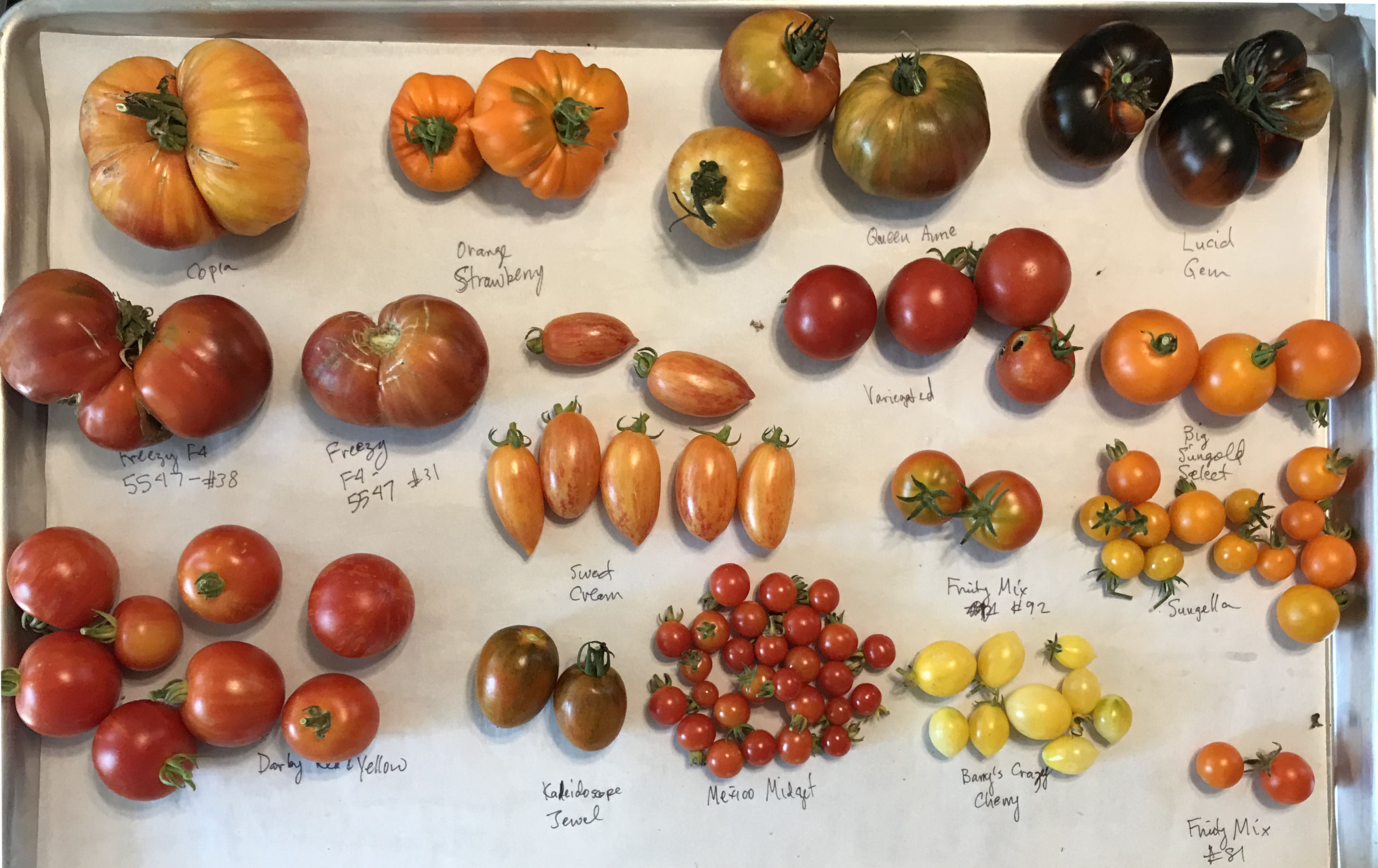
If you’re wondering how the tomato tasting gets done, here’s a tray that I put together and tasted with my sister in law Johanna when she visited:

tomato tasting tray
tomato tasting tray

After laying everything out, we taste-tested everything and wrote our notes directly onto the parchment sheet (because it was the simplest thing to do). I’ll transcribe it this week into my tomato database. The database needs a lot of cleaning up, so one more back-burner project!

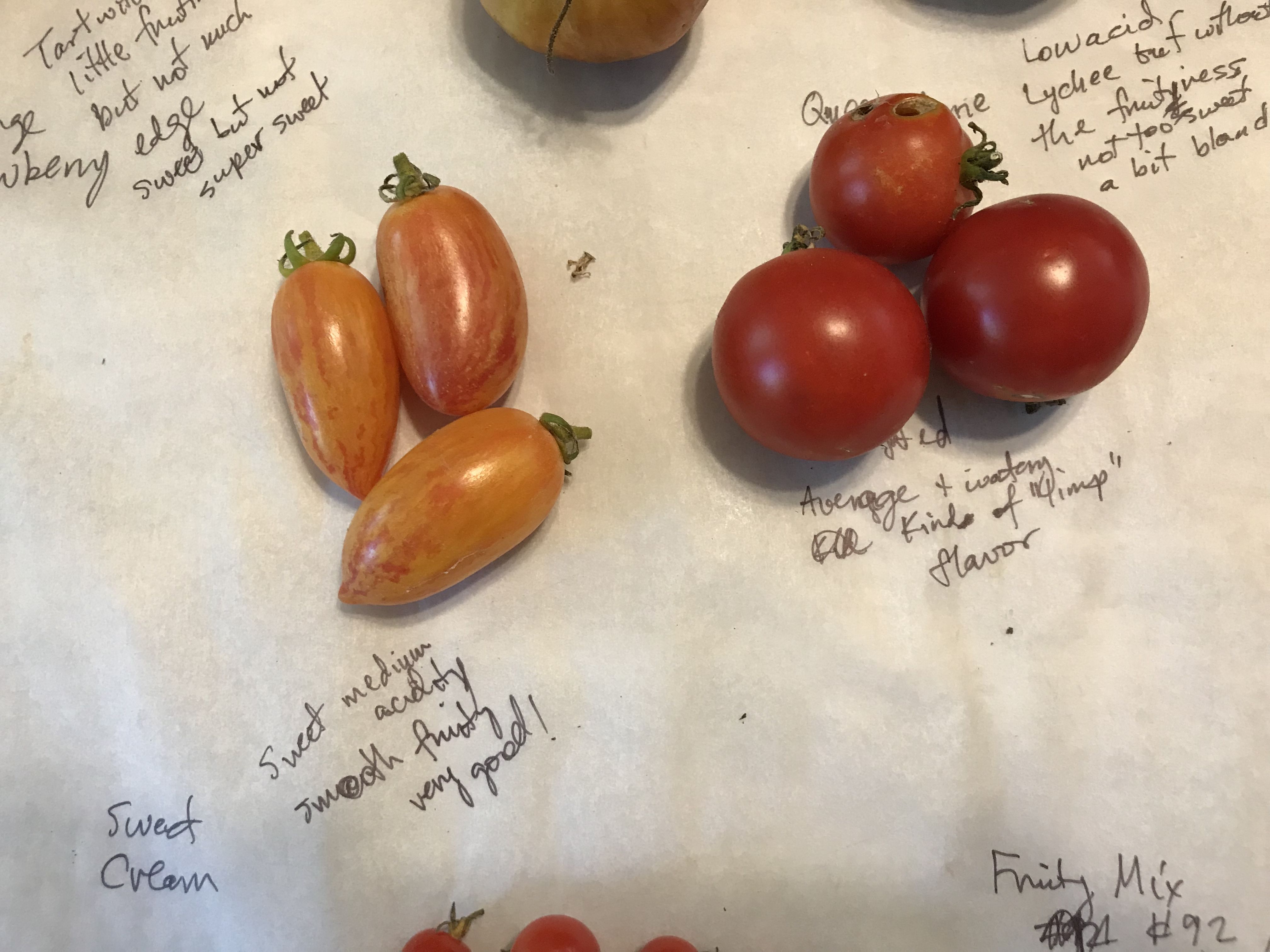
Here’s an example of our notes:

tomato tasting notes

The paste tomato on the left side is “Sweet Cream,” also by Wild Boar farms, and is the most delicious Roma-shaped tomato I’ve ever tasted. Plus, gorgeous! Definitely a winner for next year.

And of course, where would tomatoes be without garlic?

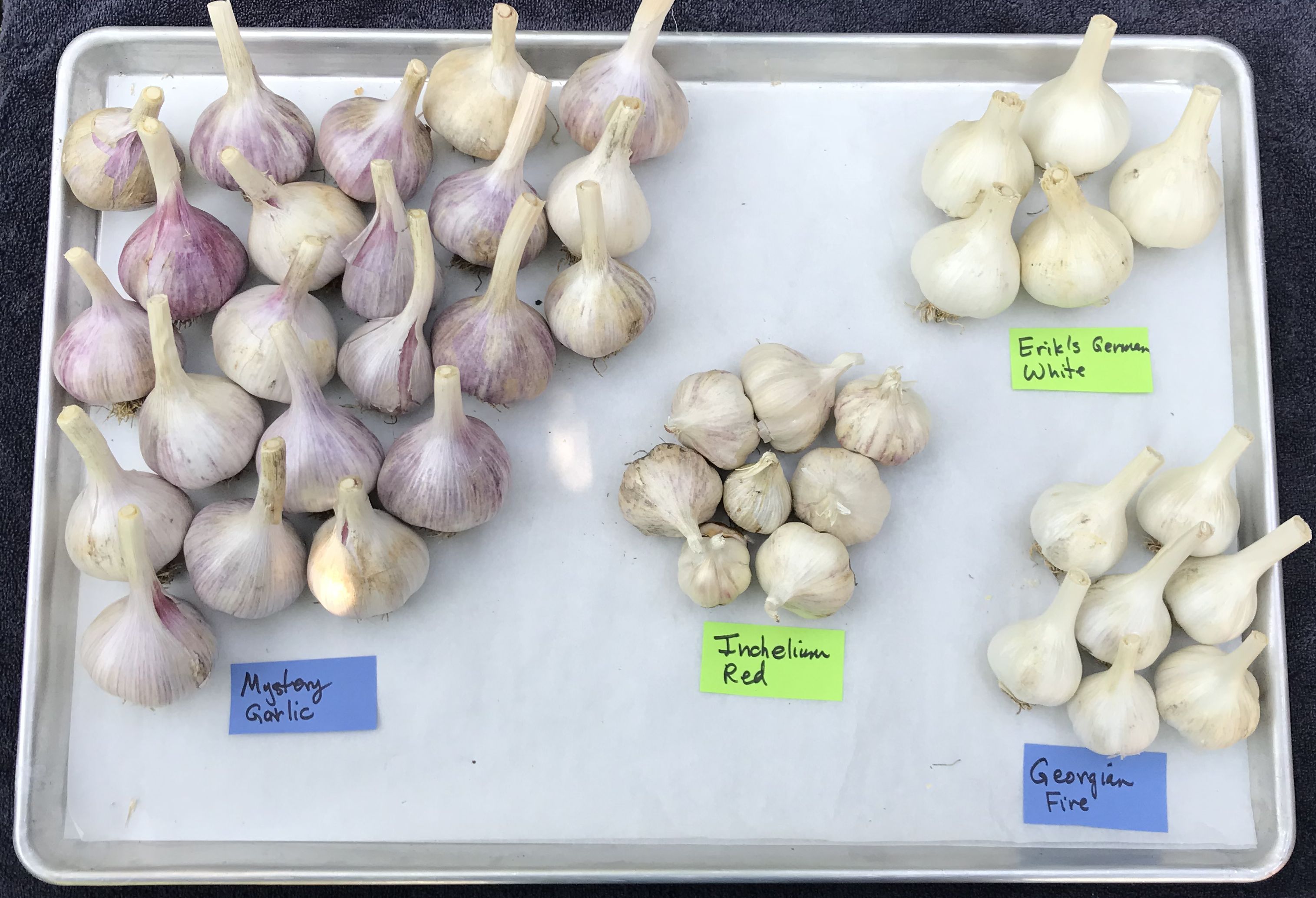
2018 garlic harvest
2018 garlic harvest

This is only about 2/3 of the garlic crop, as I had already unceremoniously dumped graciously given about twenty bulbs to various terrified grateful friends by then. I did an impromptu raw-garlic tasting with my friend Chris Cianci. It was enlightening! I hadn’t realized how different garlic flavors can be. Mystery Garlic (which actually is a named variety, but I lost track of which one) won the taste tests last year. It has a nice, balanced garlic flavor. Erik’s German White has a sweeter, more caramelly flavor, heavier on the roasted-garlic side. Inchelium Red did not grow well for me and wasn’t exceptional in flavor, so I’m dropping it next year. And Georgian Fire – which was advertised in the Seed Savers catalog as “the hottest garlic variety there is” – lives up to its name. Somehow, without capsaicin, it still packs the wallop of a hot pepper! I bet it would go great in salsa.

Inexplicably, I only grew one kind of sweet basil this year. I will do better next year!

I’m definitely growing Mystery Garlic, Erik’s German White, and Georgian Fire next year. I was going to order 2-3 more garlic varieties to experiment with next year, but then I vaguely remembered receiving some sort of email about garlic in April. So I did a search and discovered that someone had already ordered seven more garlic varieties to be delivered in the fall!!

I have no idea who could have been so excessive as to order seven garlic varieties, knowing that some of this year’s varieties might come forward to the next year. So now I have ten varieties to grow next year, plus two bulbs of “Purple Glazier,” a gorgeous garlic I got at the San Francisco Ferry Plaza Farmer’s Market. Which makes 11.

Clearly I am in trouble, and whoever ordered those seven varieties needs a serious talking-to. But it clearly wasn’t me! I mean, I’m not in the habit of doing excessive things (not at all!), so someone must have framed me. I blame the cats. Behind those adorable faces lie diabolical (and thoroughly lovable) mischief.

Fritz and Tigress plotting against me


Filed Under: All blog posts, garden Tagged With: tomatoes

  • « Previous Page
  • 1
  • 2
  • 3
  • 4
  • Next Page »

Archives

Tags

aids lifecycle outfits autumn splendor book cashmere coat cats celtic braid coat color study cross dyeing design design class devore doubleweave doubleweave shawls drawing dye samples dye study group gradient colors house infinite warp jacquard loom katazome knitted blanks kodachrome jacket ma's memorial mohair coat network drafted jacket/shawl project network drafting painted warp phoenix rising phoenix rising dress phoenix rising kimono phoenix rising reloaded pre-weavolution project sea turtles taquete tie-dye tied weaves tomatoes velvet weaving drafts web design website redesign wedding wedding dress woven shibori

Categories

  • Africa
  • aids lifecycle
  • All blog posts
  • All travel posts
  • Asia
  • Bangkok
  • Belize
  • Cambodia
  • Central America
  • Chai Ya (Wat Suon Mok)
  • Chiang Mai
  • Chiang Rai (Akha)
  • China
  • chocolate
  • computer stuff
  • creating craft
  • Creative works
  • cycling
  • Delhi
  • Dharamsala
  • drawing
  • dyeing
  • Fiber Arts
  • finished
  • food
  • garden
  • Ghana
  • Guatemala
  • Hanoi
  • Ho Chi Minh City
  • Hoi An
  • India
  • Khao Lak
  • Knitting
  • knitting
  • Ko Chang
  • Laos
  • Luang Namtha
  • Luang Prabang
  • markleeville death ride
  • meditations on craft
  • mental illness
  • musings
  • Phnom Penh
  • powerlifting
  • Rewalsar (Tso Pema)
  • sewing
  • Siem Reap (Angkor Wat)
  • Southeast Asia
  • surface design
  • textiles
  • Thailand
  • travel
  • Vangvieng
  • Vientiane
  • Vietnam
  • Warp & Weave
  • weaving
  • Weaving
  • weavolution
  • writing

© Copyright 2025 Tien Chiu · All Rights Reserved ·

Loading Comments...