Tien Chiu

  • Home
  • About Tien
  • C.V.
  • Online Teaching
  • Works
  • Essays
  • Travels
  • Book
  • Blog
  • Dye samples
You are here: Home / Archives for All blog posts / textiles

July 6, 2025 by Tien Chiu Leave a Comment

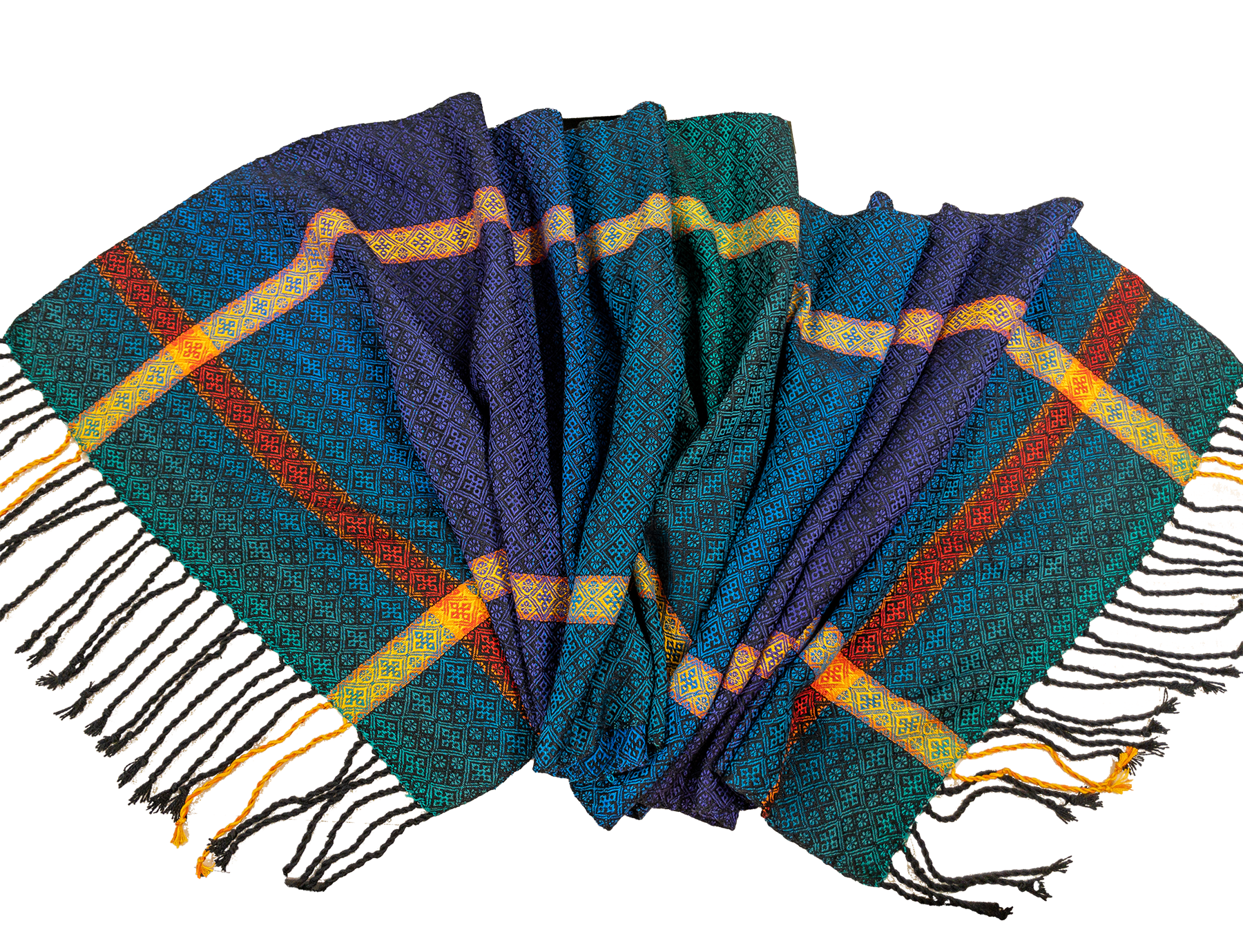
Phoenixes: even better than I’d hoped!

I finished the spinning for the phoenix a week or so ago – just over 1,000 yards of superfine silk, a bit thinner than sewing thread. So now it was time to finalize the design.

Designing the scarf was complicated – I had to juggle dozens of competing objectives. I had spun the yarn in two ~525 yard color gradients that would (hopefully) match to produce a symmetric scarf. I had also dyed 1,200 yards of 60/2 silk in a gradient from navy to royal blue, to use as a background color.

Here are the yarns for the first half:

Handspun and hand-dyed gradient yarns for handwoven phoenix scarf

The yarn changed color smoothly along its length. To retain that smooth, even gradient, I would need to use up all the yarn, leaving no jumps or gaps. So that was the first challenge: design a scarf that would require almost exactly 1,050 yards of the handspun gradient weft.

That meant juggling width, length, and picks (number of weft threads) per inch to get the numbers to line up precisely. Very precisely.

First I needed to estimate how many picks there would be per inch. I didn’t have any handspun to spare, so I wove a beautiful sample using 60/2 silk as a proxy for the handspun. When twisted together, they appeared about the same size, so I figured it would give me a good starting point.

Here’s my sample in 60/2 silk:

Samples for the handwoven phoenix scarf, woven with 60/2 silk

This sample came in at 72 ends per inch, which would be just perfect for a scarf 72” long and 14.5” wide.

So I worked up a design that suited perfectly. Here’s a picture of how it would look when worn (the white line divides the two sides):

Design for a 72” handwoven phoenix scarf

I made the final tweaks, added a short hem, and started weaving.

A few inches in, I discovered two VERY, um, exciting things. (Yikes!)

First, the handspun wove up very differently from the yarn I’d used for sampling. Instead of 72 picks per inch, I was getting 50! That meant that my perfectly reasonable 72-inch scarf was turning into an ultra-long “Dr. Who scarf” at 103 inches, with skinny, stretched-out phoenixes.

Second, I had less warp than expected. WAY less. I was using a previously painted warp that changed colors every 2-3 yards. I had thought this section was three yards long, giving me plenty of leeway. Nope. It was only 69-70” between color changes – not long enough even according to the original plan.

Back to the drawing board. I eliminated one phoenix on each side and re-spaced the design:

Revised, shorter handwoven phoenix scarf design

Now I had a design that would weave up to 66” long – which would let me squeak in with an inch or two to spare.

I wove up the first phoenix, then realized that I’d created a different problem! My original design called for 525 yards of handspun, perfect for the amount I had. My shortened design only required 325 yards. As a result, the colors were changing far too slowly along the length of the scarf. My first phoenix was almost entirely brown!

First section of handwoven phoenix scarf, with brown phoenixes

To speed up the color changes, I decided to throw away about half the handspun I’d just spent two months painstakingly creating. (Gulp.) I’d weave half an inch, then pull out and throw away four or five yards of yarn. Then I’d weave another half-inch, and pull out more yarn. That removed the yarn a little bit at a time, which mostly preserved my smooth flow of color.

The second phoenix came out beautifully – everything I’d hoped for.

Red, gold, and yellow phoenix in handwoven phoenix scarf

The photo doesn’t really do it justice. The handspun has small irregularities in the color and size that add wonderful texture to it. It’s much more interesting and, well, handmade than the original samples woven in machine-spun silk. Those were lovely too, but didn’t have the same liveliness and joy.

I’m definitely going to do more projects with handspun! I’m really excited by the possibilities.

I measured the remaining navy blue warp periodically as the scarf grew, and decided that I had just baaaaaarely enough for the rest of the scarf + hem. In a real pinch I could also overdye the white portions at the very end – though I hate dyeing on the loom.

I wove like a maniac (1,000 picks per hour!) and quickly reached the halfway point:

Yellow phoenix at the halfway point on the handwoven phoenix scarf

I’m now at about the 2/3 point, but I won’t make any more progress until Wednesday.

Why? Because I’m on a plane to LAS VEGAS, where I’ll be competing at the USPA Drug Tested National Championships in just two days!

My goal weights are:

  • Squat: 137.5 kg (303 lbs)
  • Bench press: 80 kg (178 lbs)
  • Deadlift: 152.5 kg (336 lbs)
  • Total: 370 kg (814 lbs)

If I hit all three of those target weights I will set new PRs (personal records) in all three lifts, break the California state record for bench press and meet total, and achieve my primary goal, which is totaling over 800 lbs.

I think I’ve got a decent shot at it. Fingers crossed!

Wish me luck!

Filed Under: All blog posts, powerlifting, textiles, weaving Tagged With: phoenix scarf

June 24, 2025 by Tien Chiu Leave a Comment

Two weeks and counting

It’s now exactly 2 weeks to USPA Drug Tested Nationals.

I’m doing my final training this week (next week will be a rest week). It’s tough! I’ve been coming back from the gym exhausted.

This week I’m practicing lifting heavy, and trying to figure out how much I can realistically lift in competition. So the weights are at 90-95% of my estimated maximum. That’s HEAVY.

As the weights get heavier, form becomes much more important. Being off by even half an inch can make a lift fail.

For example, here’s a video of me deadlifting 295 pounds last week, clean and sweet.

And here’s a video of me failing to deadlift 315 lbs:

If you look closely at the second video, you can see that, just as the lift starts, my shins hit the bar and it swings forward, away from me. Not much, well under an inch. But that teeny diversion is the difference between success and failure. (It’s not a strength issue; I’m perfectly capable of lifting 315 pounds.)

(I was going to write something about the precision and discipline that I’ve learned from powerlifting, because it’s a much more interesting sport than you might think, but honestly, I’m just too tired. Wait ’til after Nationals!)

My favorite lift right now is bench press. The weights are FLYING!

Here I am benching 165 pounds:

It took effort, but not significant struggle. Extrapolating, I should be able to lift 175 pounds in competition. That’s a HUGE improvement over last year, when my max lift was only 165.

I have two personal goals for Nationals:

  1. Lift a total of 800+ pounds across the three lifts. My total from my last competition was tantalizingly close – 793 lbs – but not quite there. Fingers crossed.
  2. Break the California state record for bench press, which is currently 77.5 kg, or 170.9 lbs. Fingers crossed.

I have three stretch goals:

  1. Break the California state record for squat, which is currently 140 kg/308.6 lbs. This is do-able on a good day, but my squat form has been a bit squiggly lately, so I’m not sure I can do it.
  2. Break the California state record for deadlift, at 155 kg/341.7 lbs. This is a bigger stretch, but not impossible.
  3. Break the California state record for meet total, which is currently 810.2 lbs.

With luck I’ll come back with at least one state record!

In fiber news, I’ve made considerable progress on the phoenix scarf. I’ve spun over 1000 yards of yarn on my drop spindle, and should be able to finish the last 300 yards within the next two weeks. I’ve started weaving samples on the jacquard loom using commercial yarn. Here’s a quick peek so far:

I’m weaving the sample in 60/2 silk, which is about 15,000 yards per pound. That’s about the same size as my handspun yarn, so it should give me a pretty good idea of how the math will work out. The warp in this sample is bright magenta, but the actual scarf will be woven on dark blue warp instead.

If I haven’t spun enough yarn by Nationals, my plan is to take my spindle with me to Las Vegas. Hey, if an Olympic diver can knit in the stands, I can spin at a powerlifting competition!

Filed Under: All blog posts, powerlifting, textiles, weaving

June 4, 2025 by Tien Chiu 2 Comments

Phoenixes, packing, and meet prep

I’m making slow progress on spinning the phoenix yarn. I started getting repetitive strain injury symptoms in my right hand, so I took a few days off and did some active recovery work (stretching, band flossing, etc.) before starting up again. And I’m going fairly slowly, about half an hour a day.

Here’s today’s skein. I’m getting out of the orange section and into some lovely golds!

orange to gold yarn on niddy noddy

And here is the full gradient so far:

gradient yarn (several skeins lined up)

To jog your memory, I’m spinning these braids of silk fiber:

Gold and yellow are yet to come!

Move-wise, I’ve finally started packing my stuff. The move is still two or three months away, but I hate last-minute panics, and I’m planning to sell some things, so better to start sooner. I found a phenomenal iOS app called Boxes that is teeeeeeerrific not just for packing but for anything that involves labeling and inventorying. You create “spaces” (categories) first, then put boxes into each space. For each box, you can do a list of items, and add photos of each item. Then you can add tags (“weaving supplies”, “yarn,” etc.) And then, you can print a label with all the box info on it AND a QR code so you can scan the box and instantly bring up all your notes, pictures, etc. on your smartphone or tablet.

I think this is phenomenal even if you aren’t moving. It would be perfect for inventorying things for homeowner’s insurance, for example, or just to know where the heck you put that widget 10 months ago.

So I am gleefully packing up and photographing yarn. I’m not going overboard on inventorying everything, but I am taking photos and putting in general descriptions.

I’ve packed five small moving boxes so far, mostly silk and metallic threads. I’m guessing another 10 boxes at least to contain everything. Maybe more. I have at 400+ pounds of yarn! Don’t ask where it all came from, please. (I suspect it of multiplying when I’m not looking.)

Powerlifting-wise, I’m now only five weeks out from Nationals (SQUEEEEEEEE!!!!!!). The final week is typically a rest week, so I have four training weeks left to go. So my coach is pivoting me from general strength training to meet prep. That means that instead of doing 3-5 reps in my first (heaviest) set, I’m doing one HEAVY single-rep set before backing down and doing more work at lighter weights.

Here’s what a typical exercise entry in my training spreadsheet looks like now:

Translating the shorthand, it says to do 1 rep at a weight heavy enough that I could only do two additional reps if I continued.

Once I input that weight into the Set 1 row, the program estimates the maximum weight I can lift, and puts that in the bottom row.

Then I multiply that max weight by 80% and lift that weight (rounded to the nearest five pounds) for four reps, doing a total of four sets of four reps each.

The practical difference is that now, instead of doing an initial set of 3-5 reps at 140 pounds in bench press, I’m now doing a single rep at 160 pounds. That is roughly a 15% increase in weight from my usual training, and puts me up around 90-95% of my max lift. That is HEAVY.

This shift from lighter weights/more reps to heavy singles is prepping my body and my central nervous system for an all-out effort. It’s also giving the opportunity to perfect my form at heavy weights. You can get away with less than perfect form when you have lighter weights, but as you near your max, you have to be much tighter and more focused on getting everything perfect, or the bar won’t come up.

(You won’t hurt yourself if you fail, though – the rack’s safety arms will catch the weight. Powerlifting, and weightlifting generally, actually has one of the lowest injury rates of any sport.)

Here’s what 160 lbs x 1 rep in bench press looks like right now. Significant effort, but not a real struggle. I am hoping to hit 172 lbs at USPA Nationals to break the California state record for my age/weight class.

Filed Under: All blog posts, powerlifting, textiles, weaving Tagged With: phoenix scarf

May 31, 2025 by Tien Chiu 7 Comments

Try to love the questions themselves

I’ve run into a snag on the phoenix project. I started predrafting my fiber to loosen it up and also to allow me to spin directly from the end of the roving. However, the change in fiber prep method has also changed the diameter of my “default” yarn. Instead of 7,000 yards per pound as it was before, it’s now averaging almost 10,000 yards per pound. That’s about 30% thinner than it was! That will definitely be a problem for my scarf design.

Here’s a picture of my three skeins so far:

Skein 1 (the dark brown one) was spun using my earlier method (spinning off the fold), and is 7100 yards per pound.

Skeins 2 and 3 (top two) were spun using the second approach (predrafting fiber and then spinning off the end), and average about 10,000 yards per pound.

This makes nice hash out of all my calculations. At this point there are two things I could do:

(1) spend some time figuring out how to spin a consistent 7,000 ypp yarn, then start over

(2) keep going, and accept that the yarn is going to be much finer than anticipated (and possibly different diameter from skein to skein).

I’m thinking that I will just keep going.

This is a bit of a departure for me. Usually I start with a vision, then plan and execute a project around the vision. Lots of side trips and changes along the way, but I always keep the vision in mind. I also like to keep tight technical control over my work.

But this project is a phoenix project, meaning it isn’t about achieving a goal. In fact, it is very specifically NOT about achieving a goal. It’s about letting go of all the old goals, ideas, and relationships, opening up to possibility, and eventually discovering new things (and a new life!) to replace what went before.

So I think I’m going to do something very out of character: embrace process over product, and simply spin up the rest of the yarn without worrying about what it will become. I’ll play with some ideas, sure, but until I have a better idea of what is coming down the pike, there’s no point in planning too far ahead. So I’m just going to enjoy spinning for however long it takes to spin all four ounces. At that point the future will be less murky and I can decide what comes next.

This meandering matches my plans for my future. I have no idea where I’m going to live six months from now. In fact, I am working very hard at NOT figuring out where I’m going to live six months from now. This is extremely uncomfortable for me, because I am the sort of person who likes to have everything decided. I was a professional project manager – being decisive was my job for twenty years.

But I want to hold open space to rediscover things, to allow Future Me to have possibilities and choices that are different from what Past and Present Me would choose. So I am going to shake things up by resolutely refusing to commit Future Me to anything right now. It is rare that life gives us a chance to do a complete reset. I have had that privilege a few times, and I don’t want to waste that opportunity now.

This reminds me of one of my favorite quotations:

“You are so young, so much before all beginning, and I would like to beg you…to have patience with everything unresolved in your heart, and to try to love the questions themselves as if they were locked rooms or books written in a very foreign language.

Don’t search for the answers, which could not be given to you now, because you would not be able to live them.

And the point is, to live everything. Live the questions now. Perhaps then, someday far in the future, you will gradually, without even noticing it, live your way into the answer.”

– Rainier Maria Rilke, Letters to a Young Poet, Stephen Mitchell translation

So with the phoenix, I am planning to sit with the project now. Walk and spin for forty days, or however long it takes. See what it wants to become.

I think there will be lots of potential, though. Here are the color gradients in the most recent two skeins. Beautiful, and full of becoming.

Filed Under: All blog posts, musings, textiles, weaving Tagged With: phoenix scarf

July 23, 2024 by Tien Chiu Leave a Comment

Weaving faces

I’ve spent the last week or so working on the cyborg design. It’s technically very challenging. That’s because weaving a realistic human face is not easy!

While we humans have only vague ideas of what most objects look like, we are VERY familiar with human faces. In fact, our brains are physically wired to recognize and “read” human faces. That means that, if you want to produce a convincing human face, you need to be spot on about things like skin color, facial features, and proportions.

So I’ve been doing a lot of digital swatching to come up with yarn colors.

The first step in this swatching is to come up with a starting palette. I sampled the colors in the image I’m weaving, looking for colors that would mix into the colors I wanted.

Here’s the image I’m weaving. (The head is human-looking on both left and right sides because I will be sewing on the cyborg parts later.)

image of human head

Then I selected five colors from the image. In the double satin structure I’m using, I can use multiple wefts together, so I constructed a set of swatches that shows all the mixes of 1-2 weft colors, like this.

(Top and left rows show the original color palette; the other rows show combinations of those colors.)

color swatches showing different weft combinations

That gave me some ideas of what the weft colors would look like when blended (in practice the blends are not nearly so neat), but didn’t account for the black warp color. Because of the structure, black would blend with the weft colors. I could have 20%, 40%, 60%, or 80% black on the surface, with the weft color making up the rest.

To simulate this, I added a black overlay in Photoshop, with black stripes at 20%, 40%, 60%, and 80% opacity. The overlay (by itself) looked like this:

black overlay to simulate effects of structure

Placing the black overlay over the extended color palette gave four shades for every weft color combination – 20% black, 40% black, 60% black, and 80% black, for a total of 15 x 4 = 60 possible colors.

final color swatches

However, if I tried to use 60 colors, especially nearly-identical colors, in a palette, I’d drive myself crazy (for a variety of technical reasons that I won’t get into here). So I winnowed them down to 18 colors:

simplified color palette

Then I told Photoshop to simplify the image to a version containing only those colors:

image flattened to 18 colors

It’s pretty good. You can see some graininess in the photo, especially around the tip of the nose, but it’s not bad.

I wasn’t entirely satisfied, though, as I felt the face didn’t have the glow of the original. Mixing in the black had darkened and reduced the saturation of the face. So I went back and created a new palette, with colors just a trifle more saturated and lighter than the previous set.

The new palette did significantly better – the version of the photo using that palette is below – so I decided to roll with it.

photo flattened to second color palette of 18 colors

(This is not what the final design will look like, however. Woven designs have MUCH lower resolution than digital images, so a lot of detail will be “lost in translation”.)

Now I needed to find yarns of the right colors to make up the palette. It would essentially be impossible to source these commercially: the colors would have to be nearly precise matches, and the odds of finding them in the limited commercial palette are essentially zero.

To the dye samples!!

I dyed 1500 samples of yarn in various Procion MX color combinations a while back – you can see them here. This gives me an exceptionally large palette to choose from – still doesn’t cover the entire color gamut, but I get quite a bit of selection when I flip through my books.

I was in luck! There were not one, but TWO palettes that looked like they might work:

dye samples compared to original palette

I think I could work with either of these. The bottom set of samples is truer to the colors of the original palette, but (like the original image) that palette doesn’t seem quite Asian enough for me. Too much pink and not enough yellow. The top set of samples has a more yellowish cast, which I think might mimic Asian skin better.

My plan is to dye all six colors, weave up samples, and see which I like best.

I had originally planned to weave using 20/2 silk, which is about the size I wanted, but there’s a hitch: silk dyes differently from cotton. The colors shift, sometimes dramatically. So if I wanted to dye silk, I’d have to do samples to test the dye formulas, adjust as needed, do more samples, etc. Time is short and silk is expensive, so I think I’ve decided to take the quicker path and use a cellulose fiber – probably mercerized cotton.

I’m still debating what size yarn to use, and will likely weave up samples in both 20/2 and 10/2 cotton. There are a lot of technical questions that will need resolving, so I think I’ll start by weaving samples to test yarn sizes. After that I’ll wind and dye my skeins, and start testing colors.

Meanwhile, of course, there’s the electronics to consider. I’m reading through Adafruit’s (lengthy) document about all the different LED products they carry, and am thinking about how to design the cyborg half as well.

And, of course, continuing my powerlifting workouts. In my fantaaaaaaabulous new belt, which arrived last week! I think it’s amazing, and can’t wait to wear it at my meet in San Diego on August 23.

phoenix belt, stretched out lengthwise
phoenix belt, curved as if being worn

It will go very nicely with my powerlifting competition gear:

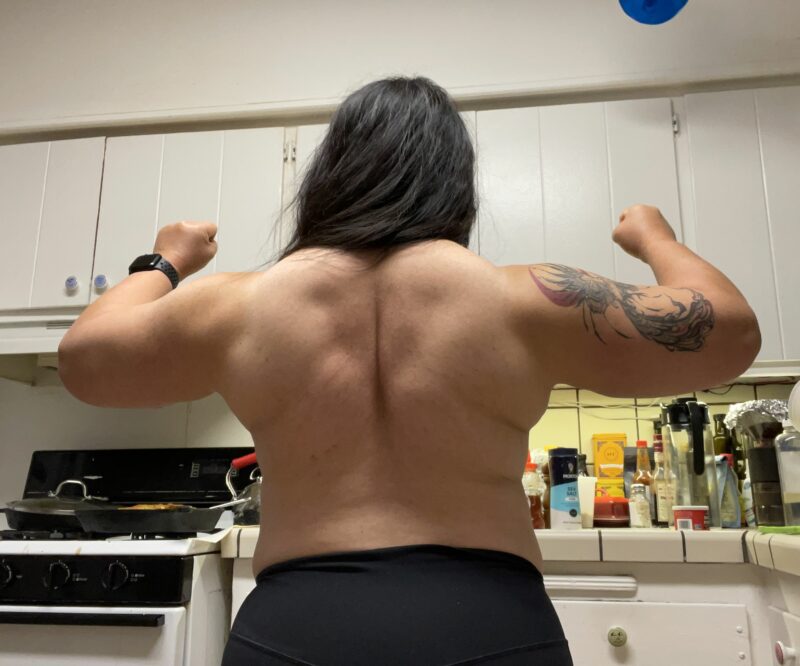
Tien on the powerlifting platform

Because if you’re going to look like a squashed sausage (“I look good in a wrestling singlet,” said no human ever), you might as well look like a FABULOUS squashed sausage!

Filed Under: All blog posts, powerlifting, textiles, weaving Tagged With: AI

  • « Previous Page
  • 1
  • 2
  • 3
  • 4
  • 5
  • …
  • 312
  • Next Page »

Archives

Tags

aids lifecycle outfits autumn splendor book cashmere coat cats celtic braid coat color study cross dyeing design design class devore doubleweave doubleweave shawls drawing dye samples dye study group gradient colors house infinite warp jacquard loom katazome knitted blanks kodachrome jacket ma's memorial mohair coat network drafted jacket/shawl project network drafting painted warp phoenix rising phoenix rising dress phoenix rising kimono phoenix rising reloaded pre-weavolution project sea turtles taquete tie-dye tied weaves tomatoes velvet weaving drafts web design website redesign wedding wedding dress woven shibori

Categories

  • Africa
  • aids lifecycle
  • All blog posts
  • All travel posts
  • Asia
  • Bangkok
  • Belize
  • Cambodia
  • Central America
  • Chai Ya (Wat Suon Mok)
  • Chiang Mai
  • Chiang Rai (Akha)
  • China
  • chocolate
  • computer stuff
  • creating craft
  • Creative works
  • cycling
  • Delhi
  • Dharamsala
  • drawing
  • dyeing
  • Fiber Arts
  • finished
  • food
  • garden
  • Ghana
  • Guatemala
  • Hanoi
  • Ho Chi Minh City
  • Hoi An
  • India
  • Khao Lak
  • knitting
  • Knitting
  • Ko Chang
  • Laos
  • Luang Namtha
  • Luang Prabang
  • markleeville death ride
  • meditations on craft
  • mental illness
  • musings
  • Phnom Penh
  • powerlifting
  • Rewalsar (Tso Pema)
  • sewing
  • Siem Reap (Angkor Wat)
  • Southeast Asia
  • surface design
  • textiles
  • Thailand
  • travel
  • Vangvieng
  • Vientiane
  • Vietnam
  • Warp & Weave
  • weaving
  • Weaving
  • weavolution
  • writing

© Copyright 2025 Tien Chiu · All Rights Reserved ·

Loading Comments...