Tien Chiu

  • Home
  • About Tien
    • Honors, Awards, and Publications
  • Online Teaching
  • Gallery
  • Essays
  • Travels
  • Book
  • Blog
  • Dye samples
You are here: Home / Archives for cross dyeing

March 23, 2011 by Tien Chiu 2 Comments

Differential dyeing, part II

Unbelievably, it did not rain yesterday, so I sprinted outside at lunchtime and did some painting with thickened acid dyes.  Here are s0me of the results:
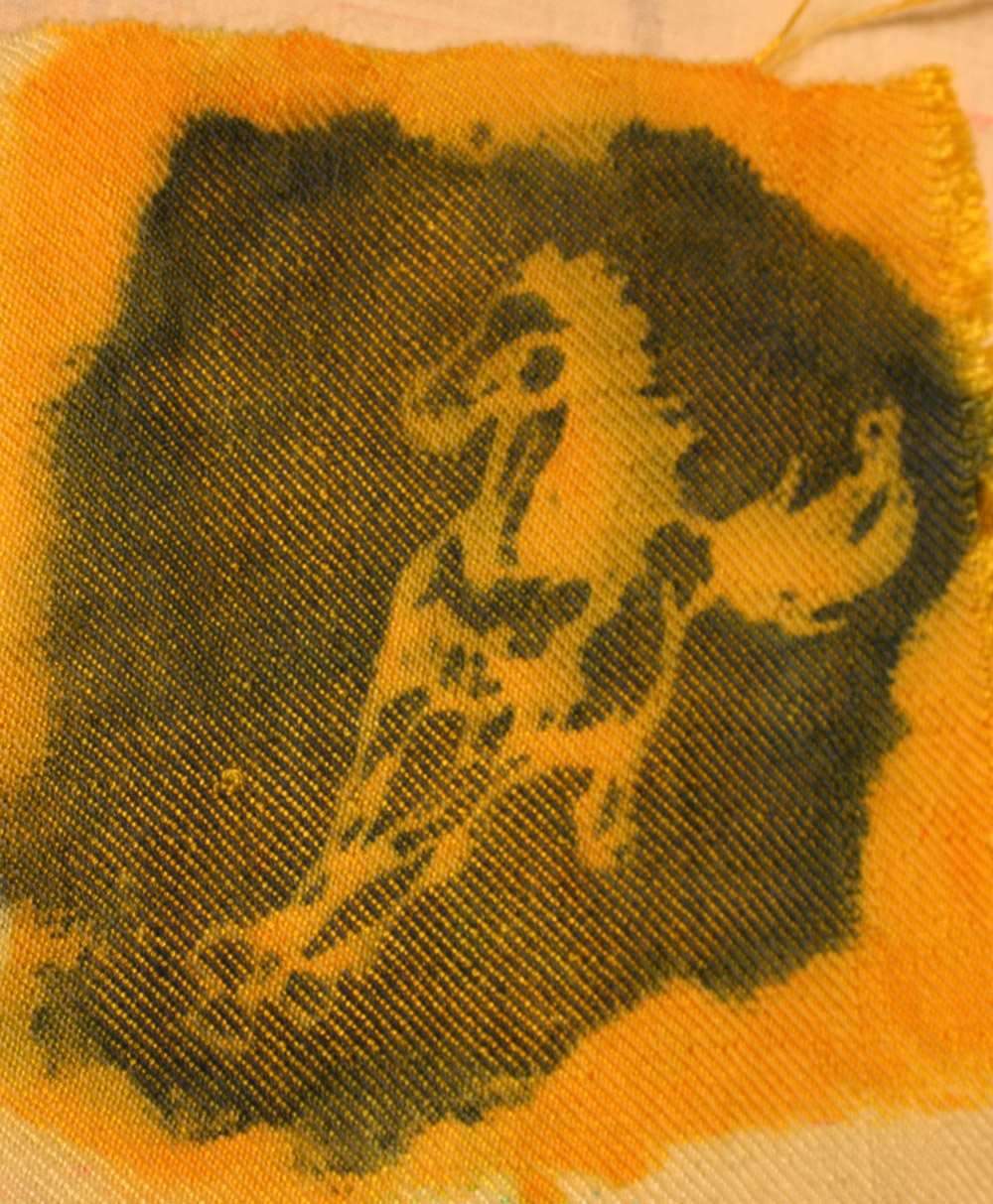
running horse, stenciled in blue acid dye over yellow fiber-reactive

I like this one; the yellow-and-blue sections provide some nice texture to the background, without distracting from the main image.  This weave pattern seems suitable for doing detailed images with lots of lines; it’s interesting enough to provide texture while not distracting from the primary image.  I don’t think this would be successful with a more dramatic weave pattern.

(The stencil actually came out just fine; the image blurred because of poor treatment afterwards – I was impatient so ironed it dry, and some areas got contaminated).

This, on the other hand, fails to excite me:
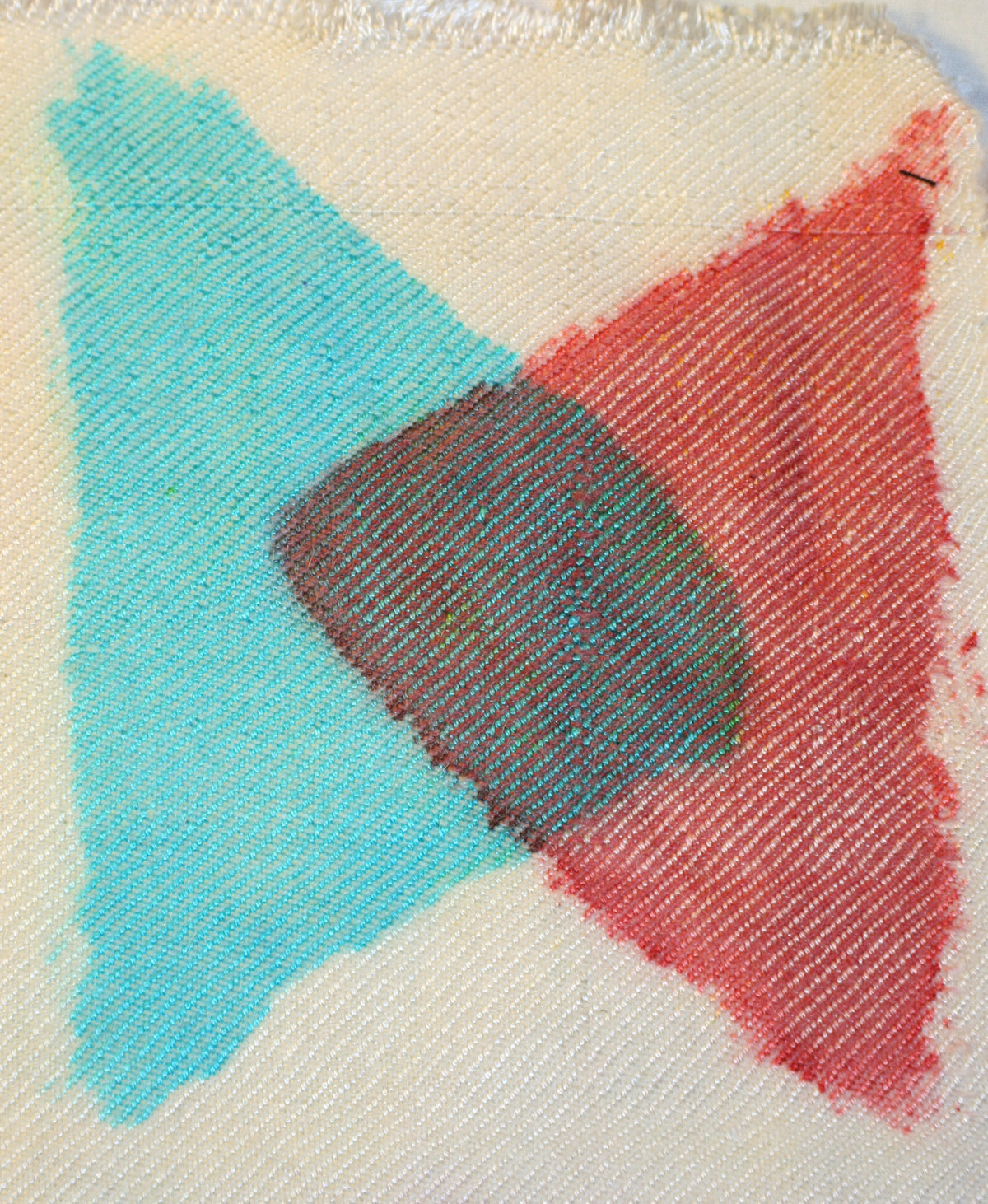
triangle in turquoise fiber-reactive dye, overlapped by triangle in red acid dye

It demonstrates that my technique works – you do indeed get turquoise stripes against a red background where the two dyes have dyed the fibers differently – but it’s essentially boring.  (Especially since, at arms’-length or further, the two colors optically blend into a single duller color.)  This is because the dots of different colors aren’t big enough to provide interest to the eye; the weave structure that worked fine for the horse doesn’t play well here.  Yes, you get blocks of color, but you could do that with a single type of dye on a “normal” fabric.  About the only thing you do get is a bit of texture.

This, on the other hand, is more dramatic, and I like it a lot better:
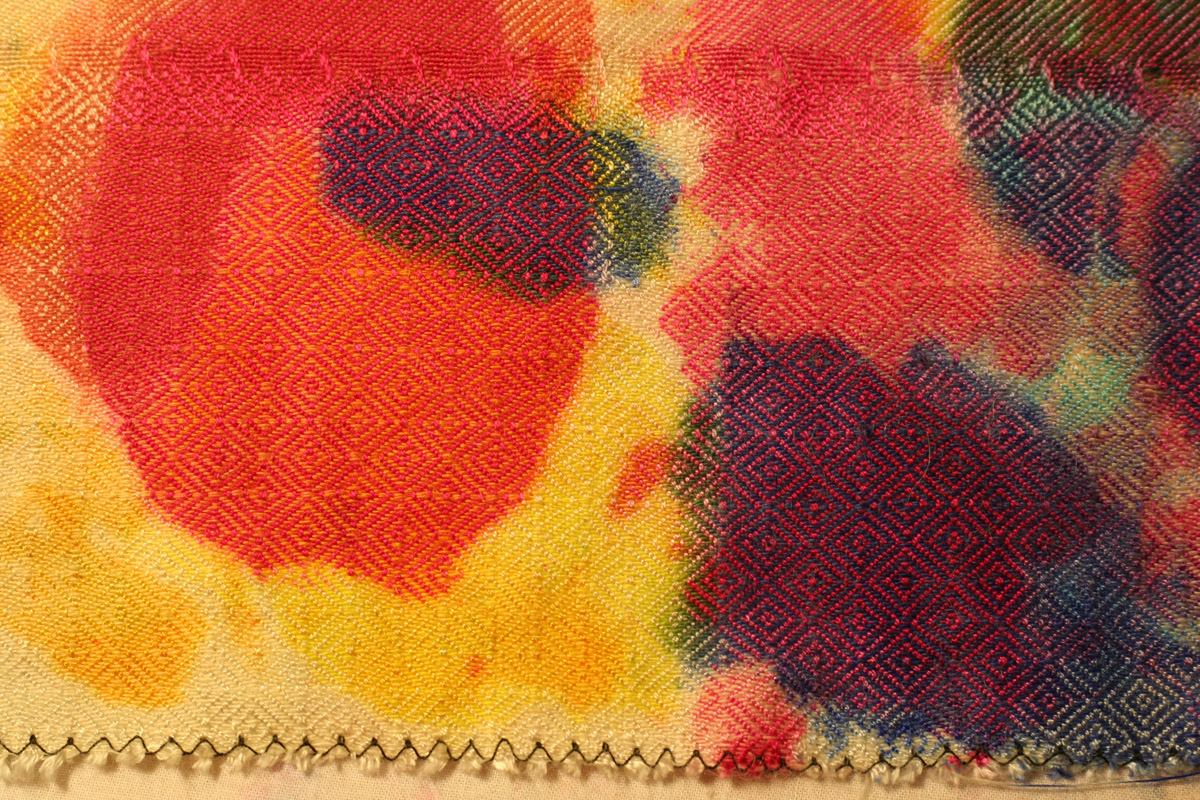
differential dyeing on a patterned weave

You may need to click through for the larger photo, but the pattern stands out well, especially in the blotch at top middle and lower right.  This would be suitable for large swaths of color, as the pattern adds interest to what would otherwise be a fairly boring blob.

Here is a photo that shows the contrast between twill (texture) and pattern (image):
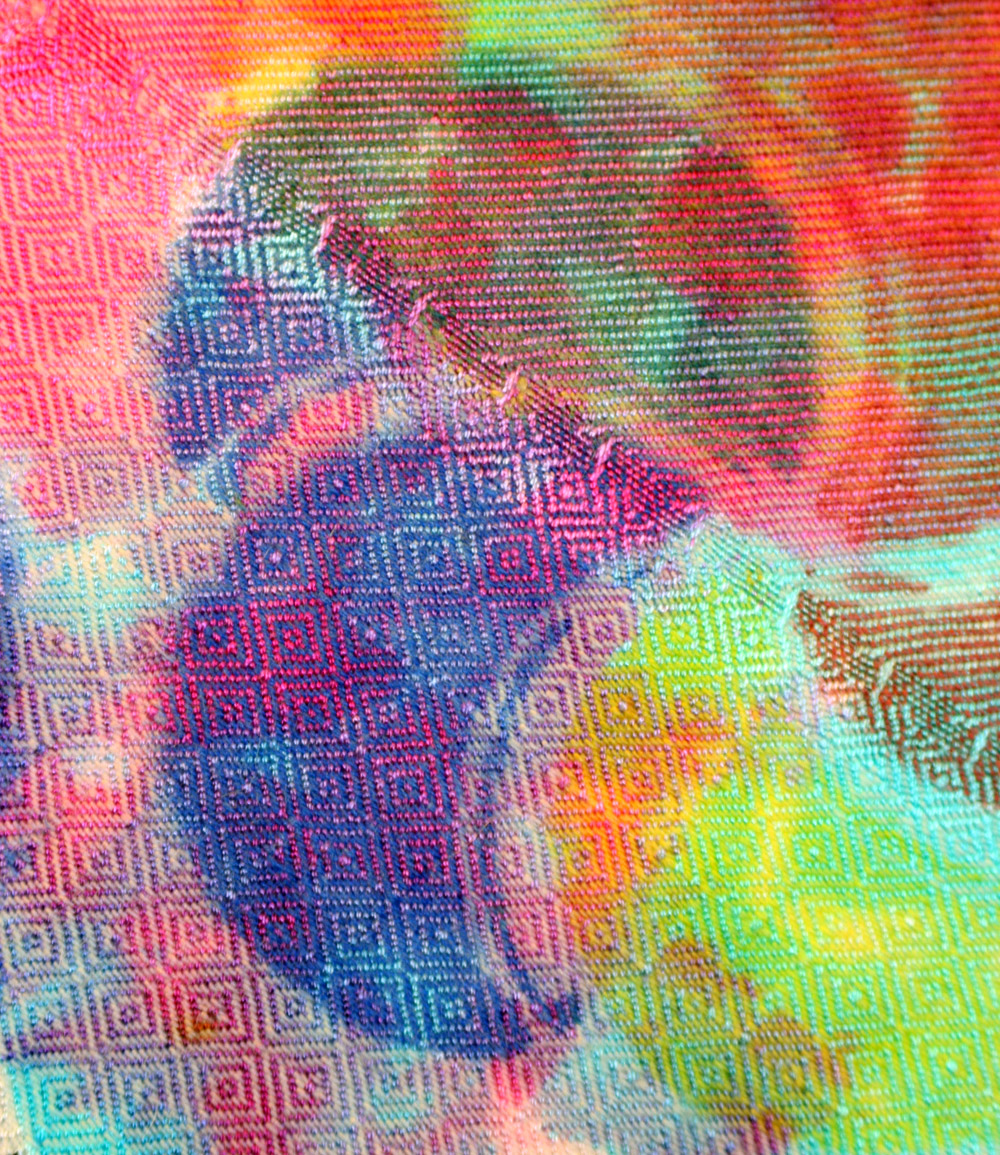
differential dyeing - pattern vs twill

The dye job is slightly different between the two (and I think only the bottom left blue moon is really successful), but you can see that there is a totally different “mood” between the twill and the pattern sections.  The twill feels more calm (of course, it is also lower-contrast) while the diamond pattern “feels” jazzier.

What next?  Well, I have a small quantity of what I think will be a very interesting fabric to experiment with:
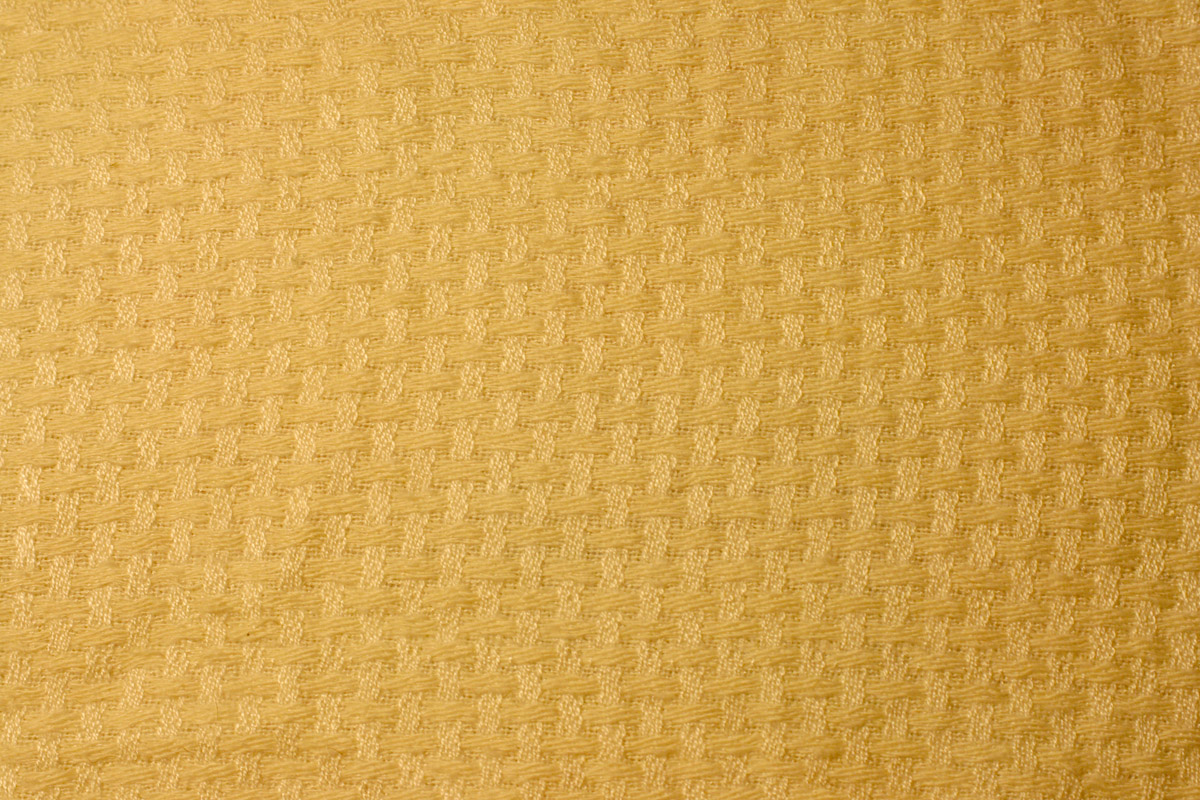
basketlike weave, undyed

The diamonds were a relatively subtle pattern.  This one is not subtle: it’s bands of five-end satin “woven” with bands of five-end sateen, and should produce a strong contrast between alpaca and tencel once dyed.  I’m guessing that the weave structure will be dominant here, visually speaking, but it will be interesting to dye it and find out!

I am almost done weaving up the fabric that I intend to use as samples for the Fine Threads group (I’ll dye it once I’ve figured out what I’m doing), and after that will play with woven imagery + differential dyeing.  I created a draft of paw prints that I think will make for interesting results.  Again, I expect the woven pattern to be dominant, but some interesting things can be done in the background!

I have actually created a matrix of things I want to try, which is too detailed to include here, but basically there are five variables:

  • amount of contrast between the colors used in fiber-reactive dye;
  • amount of contrast between the colors used in acid dye;
  • amount of contrast in the woven pattern (well blended, or areas of mostly tencel and areas of mostly alpaca)
  • pattern scale for dyed patterns (small and intricate vs. big blobs)
  • pattern scale for woven patterns

So I will be playing with those over the next week or so.

My ultimate goal is creating interesting autumn-leaf designs that I can use in my next project, but that will take considerably more experimentation.  Rather than plunge straight into it and try designing it via trial and error, I’m trying to decipher the underlying “rules” that will allow me to design effectively.

And, finally, I am doing some additional stitched shibori work for my workshop.  I’m using the twill weave (because I’ve got miles of it) and will be double-dyeing that as well.
Filed Under: All blog posts, dyeing, textiles, weaving Tagged With: cross dyeing

March 22, 2011 by Tien Chiu 3 Comments

Differential dyeing, part I

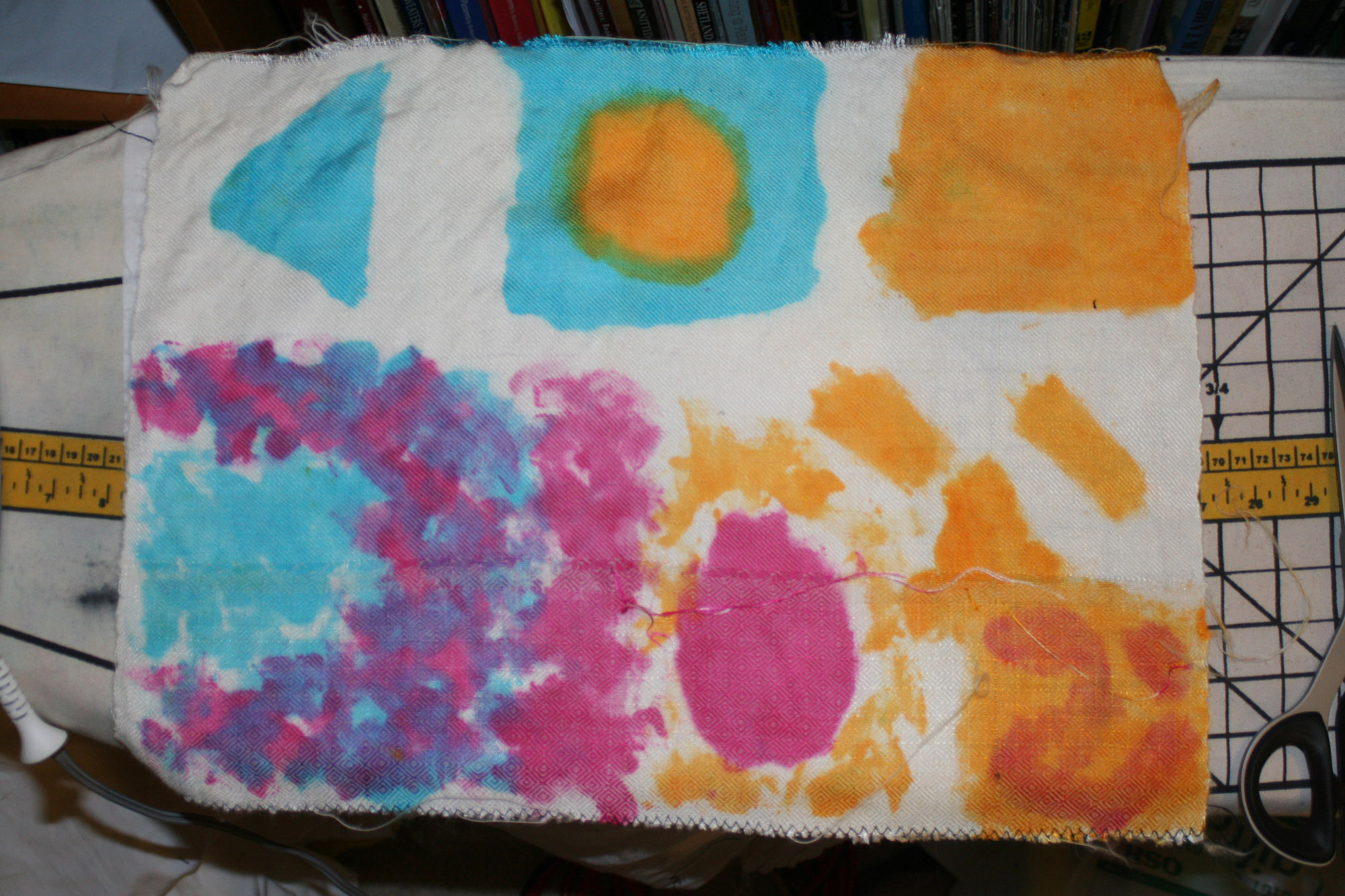
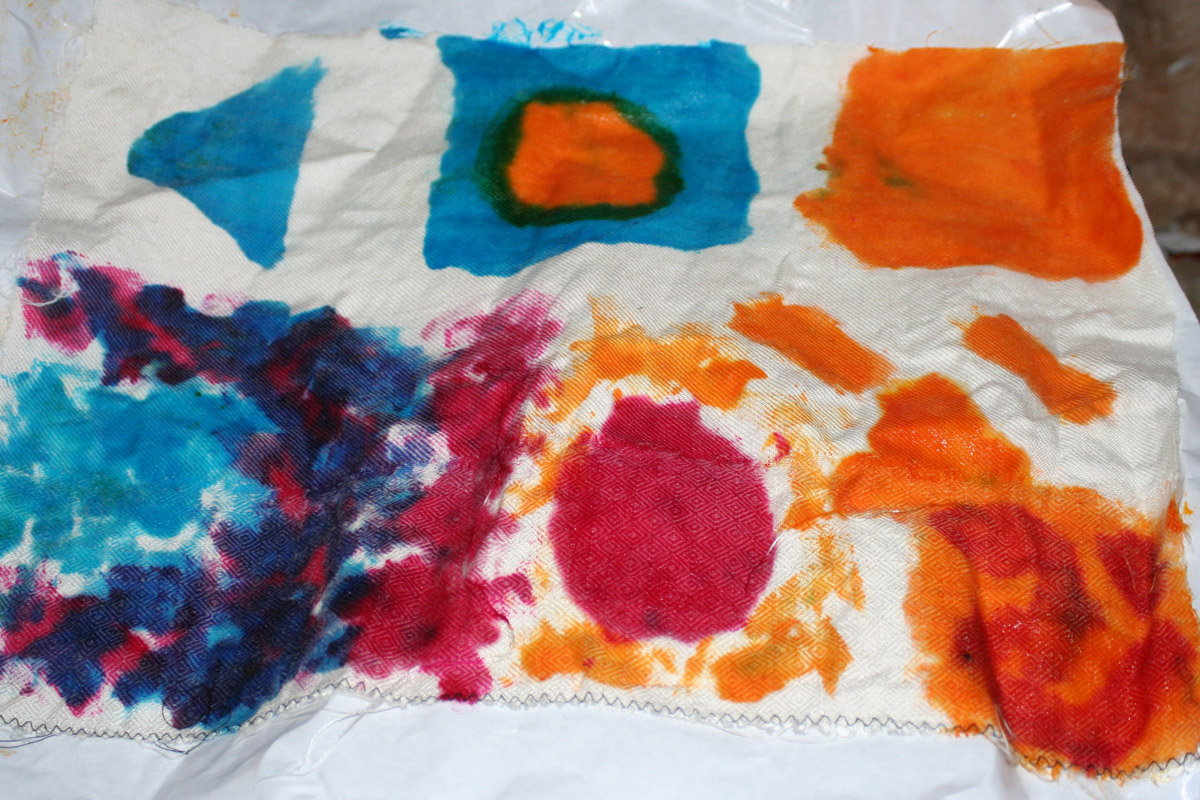
Yesterday I cut some of my precious alpaca/tencel fabric off the loom, rushed it outside, and started the differential dyeing process.  I was in a bit of a hurry because I was dyeing in one of the few dry moments in a week-long deluge of rain, and I wasn’t sure how long it would last.  So instead of carefully planning out my experiments, I rapidly painted on a set of shapes and figures:

differential dyeing, fiber-reactive dyes, freshly painted

I let that react overnight, and rinsed it out this morning.  Please click and zoom in on the photo to see how the patterns came out:

differential dyeing, fiber-reactive dye - after rinse-out

Happily, the tencel dyed beautifully while the alpaca stayed (mostly) white, so I am fairly confident that after applying the acid dyes I’ll get at least some interesting effects.

What next?  I’m going to paint the fabric with acid dyes (thickened with sodium alginate, as I did with the fiber-reactive dyes), fix the dyes, and see what happens.  Since I have (finally!) finished my stencils, I  plan to try stenciling a running horse in the yellow section:

stencil, hand-cut, of a running horse


The stencils, by the way, are made according to Jane Dunnewold’s recommendation in Art Cloth: cut from two layers of fusible interfacing (fusible sides facing), which are then sandwiched with a piece of netting, fused together, coated with latex house paint, and gently ironed with a warm iron to set the paint.  This renders it waterproof, at least in theory.  We’ll see how well it actually works.

I am also hoping to get the silkscreens started this week, but that may take longer – the emulsion needs to be applied wet, then dried out in the dark – and as there are no dark spots inside the house and the garage is cold and damp (rain = high humidity), that may have to wait until the skies dry out.  At least this weekend looks promising, weather-wise.

By and large I expect differential dyeing to be laborious, as many of the dye techniques I want to use involve dyeing twice – once for background and once for pattern.  Multiplied by two different dye types, that comes out to four dye sessions for a single piece of fabric!  But I am hoping it will be worth it in the end.

I am currently making a more organized list of dye techniques I plan to try, and will be tackling them this weekend.  If it EVER stops raining!

Filed Under: All blog posts, dyeing, textiles Tagged With: cross dyeing

March 20, 2011 by Tien Chiu 2 Comments

Success!

After a very frustrating week of trying to rub my belly and pat my head  in multiple syncopated rhythms, I have succeeded in changing my weaving “style” to work with the CompuDobby IV.  I can now weave at full speed and treadle slowly enough that the CD IV doesn’t miss a beat.  We’ll see in time whether it is more reliable than the CD III.

Which means I have stopped weaving miles and miles of 2/2 twill (boring, but easy to spot errors) and have moved on to something more interesting.  This is draft #8317 from Handweaving.net:

handwoven plaited twill, with pinwheel insets

(The color balance is off, unfortunately, and I couldn’t figure out how to correct it.  In real life, it’s a beautiful cream/white color – so pretty that it seems a shame to dye it, though I intend to use it for dye experiments anyway!)

So far I’ve woven 15″ or so of the plaited twill pattern.  I plan to weave about 60″ – enough for a full set of samples for the Complex Weavers Fine Threads Study Group, plus some additional to experiment with – and then play around with dyeing both the plaited pattern and the 2/2 twill that I wove while getting to know the new CompuDobby.  The latter is too flawed to use in anything but samples, but I imagine I will also churn out lots and lots of awful-looking samples in the process of finding what works, so I think that will work out perfectly.

And the official photo session for Kodachrome is this afternoon!  I can’t wait to see the results.  My good friend and world-class nature photographer Joe Decker (aka Rockslide Photography), who also photographed my wedding dress, will be shooting Kodachrome as well as two shawls – the doubleweave shawl I made for the Complex Weavers Fashion Show and the goose-eye color gradient shawl I made quite awhile ago.  Which means I need to come up with names for them, and create their “official” entries into the Finished-Works section of my website.  I may muck around with the display template for that page as well – I think it needs revamping.

Stay tuned for stunning photos later today!  Joe is a positively amazing photographer – do check out his site.  (If I may be allowed to brag on his behalf, his work has been collected by the Smithsonian, among other places – yes, it’s that good.)  I trust he’ll do justice to Kodachrome – and more.

Filed Under: All blog posts, textiles, weaving Tagged With: cross dyeing

February 10, 2011 by Tien Chiu 2 Comments

Next up

I’m pretty close to the end of the warp, and expect to finish up today.  Which leaves the question of what to put on the loom next.  The only constraint is that the warp must be 20″ wide, and has to be fully threaded by Sunday morning, when the loom goes to AVL for the upgrade.  Since today is Thursday, that gives me Friday, Saturday, and Sunday morning to wind, beam, thread, and sley the warp!  So it needs to be a fairly simple threading, one I won’t have to treadle.

The trouble is that I haven’t really thought about what to do next.  It needs to be something that I can get on and off the loom relatively quickly, because I do have another project in mind, but it also has to be interesting enough to be worthwhile.  It also has to be a warp that’s good for checking floating shafts – that is the point of this particular warp, to see if the Compudobby woes have been fixed!  So any errors need to be easily visible.

So I am leaning (for the moment anyway) towards warping up with 20/2 tencel and trying it out with an alpaca weft.  The idea here is to play around with what I think of as “differential dyeing” – using a cellulose fiber as warp and an animal fiber as weft, then dyeing them different colors afterward.  This takes advantage of the fact that a fiber-reactive soda ash dyebath dyes cellulose but not protein (animal) yarns, while an acid dyebath dyes protein but not cellulose.  So, using two separate dyebaths, I can get two different colors out of the warp and weft.

So far, not terribly interesting – you could get the same effect by dyeing warp and weft solid colors before weaving.  However, if you don’t do a solid color dyebath, you could get some really interesting effects.  For example, you could paint dye on the fabric, or do woven shibori, or low-water immersion scrunch-dyeing.  Would this be interesting, or would it produce mud?  Hard to say, and impossible to simulate.  I have to try it to find out.  This is intriguing enough to keep me occupied through a very long warp.  It would also, mostly, be quick and easy to weave up.

So I am leaning towards beaming on some 20/2 tencel at a twill sett (40 or 45 epi I think), using a straight or point threading.  Then I can weave a good length of yardage in basketweave (similar to plain weave but which uses a twill sett), and use that to test the loom.  Later, I can dye it using traditional shibori techniques.

Then, I can switch to woven shibori (once I get back home) and see how that works.  I can also weave more complex designs and see how the design plays out in conjunction with the dye job.  There is a very good chance of getting mud, but I suspect it could also come out spectacular – again, must weave it to know!

Filed Under: All blog posts, dyeing, textiles, weaving Tagged With: cross dyeing

  • « Previous Page
  • 1
  • 2
  • 3

Archives

Tags

aids lifecycle outfits autumn splendor book cashmere coat cats celtic braid coat color study cross dyeing design design class devore doubleweave doubleweave shawls drawing dye samples dye study group gradient colors house infinite warp jacquard loom katazome knitted blanks kodachrome jacket ma's memorial mohair coat network drafted jacket/shawl project network drafting painted warp phoenix rising phoenix rising dress phoenix rising kimono phoenix rising reloaded pre-weavolution project sea turtles taquete tie-dye tied weaves tomatoes velvet weaving drafts web design website redesign wedding wedding dress woven shibori

Categories

  • Africa
  • aids lifecycle
  • All blog posts
  • All travel posts
  • Asia
  • Bangkok
  • Belize
  • Cambodia
  • Central America
  • Chai Ya (Wat Suon Mok)
  • Chiang Mai
  • Chiang Rai (Akha)
  • China
  • chocolate
  • computer stuff
  • creating craft
  • Creative works
  • cycling
  • Delhi
  • Dharamsala
  • drawing
  • dyeing
  • Fiber Arts
  • finished
  • food
  • garden
  • Ghana
  • Guatemala
  • Hanoi
  • Ho Chi Minh City
  • Hoi An
  • India
  • Khao Lak
  • Knitting
  • knitting
  • Ko Chang
  • Laos
  • Luang Namtha
  • Luang Prabang
  • markleeville death ride
  • meditations on craft
  • mental illness
  • musings
  • Phnom Penh
  • powerlifting
  • Rewalsar (Tso Pema)
  • sewing
  • Siem Reap (Angkor Wat)
  • Southeast Asia
  • surface design
  • textiles
  • Thailand
  • travel
  • Vangvieng
  • Vientiane
  • Vietnam
  • Warp & Weave
  • weaving
  • Weaving
  • weavolution
  • writing

© Copyright 2025 Tien Chiu · All Rights Reserved ·


Loading Comments...