Tien Chiu

  • Home
  • About Tien
  • C.V.
  • Online Teaching
  • Works
  • Essays
  • Travels
  • Book
  • Blog
  • Dye samples
You are here: Home / Archives for color study

February 12, 2014 by Tien Chiu Leave a Comment

Preparing the warp for the color study

I’ve spent the last few days preparing the warp for the color study – winding the bouts and tying them off every 24 inches to get the synchronized color changes necessary for the study. I thought my process of synchronizing the ties might be useful to others, so here it is.

I started by stretching the four bouts out on a table. I aligned them, tugged a little bit to make sure they were straight, and then tied the group of four tightly together before and after the beginning of the 24″ section, to make sure they didn’t shift. At this point, the warp looked like this:
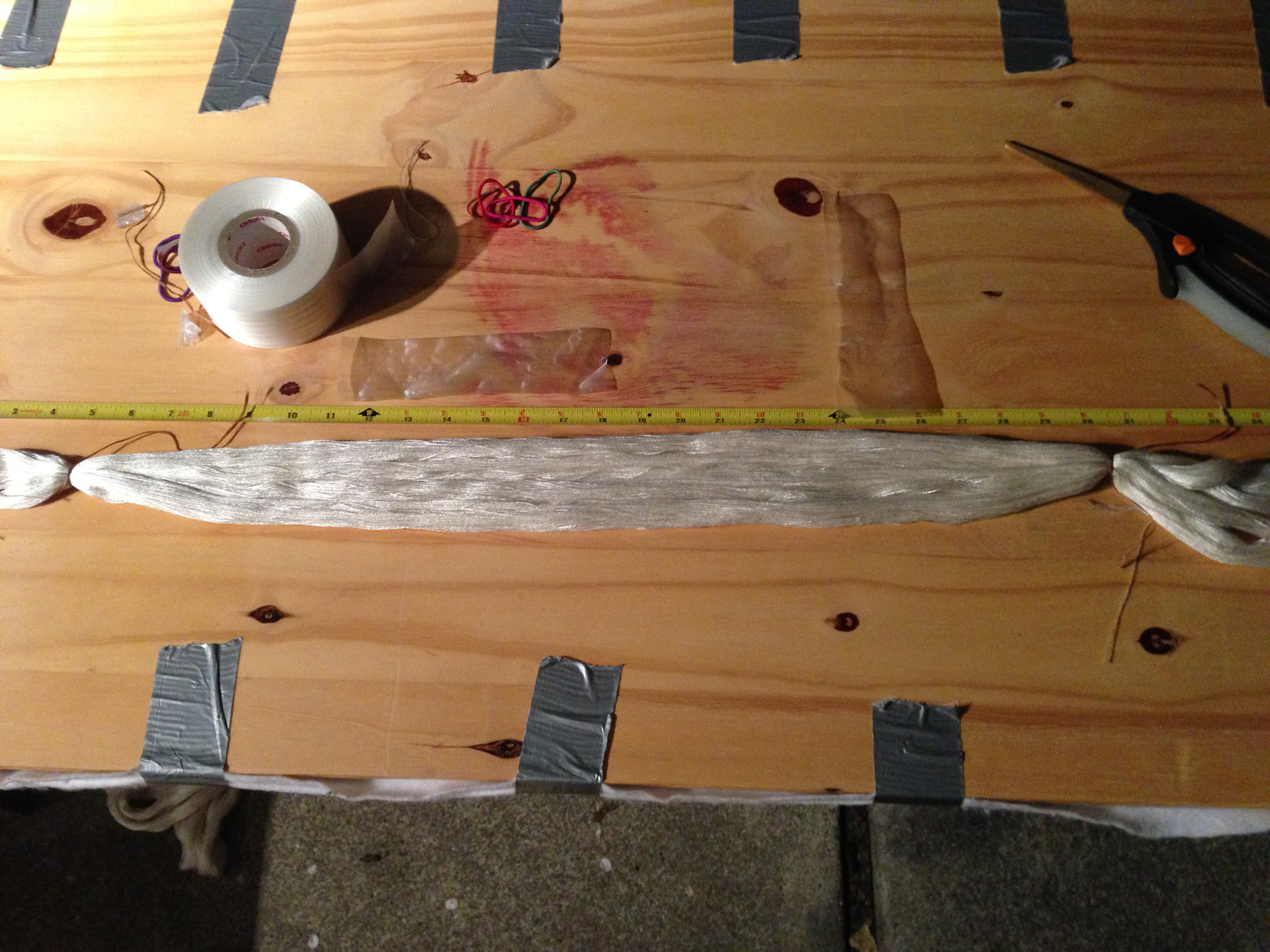
Aligned warp chains, tied together

The roll of plastic and the thin strips of plastic are ikat tape, intended for tying off warps for ikat weaving. I acquired it by way of a fellow weaver who had had it in her stash for ages, but got it from another weaver who…you get the idea. But I believe Maiwa Handprints in Vancouver sells it. I’m using it experimentally, to see if it works better than the artificial sinew (available from Dharma Trading Company) I was using before.

Anyway, the next step was to start tying off the individual bouts with the ikat tape. Three loops around the bout, pull to tighten, tie in a half-knot. The plastic seems to hold to itself well enough that a full knot isn’t necessary.
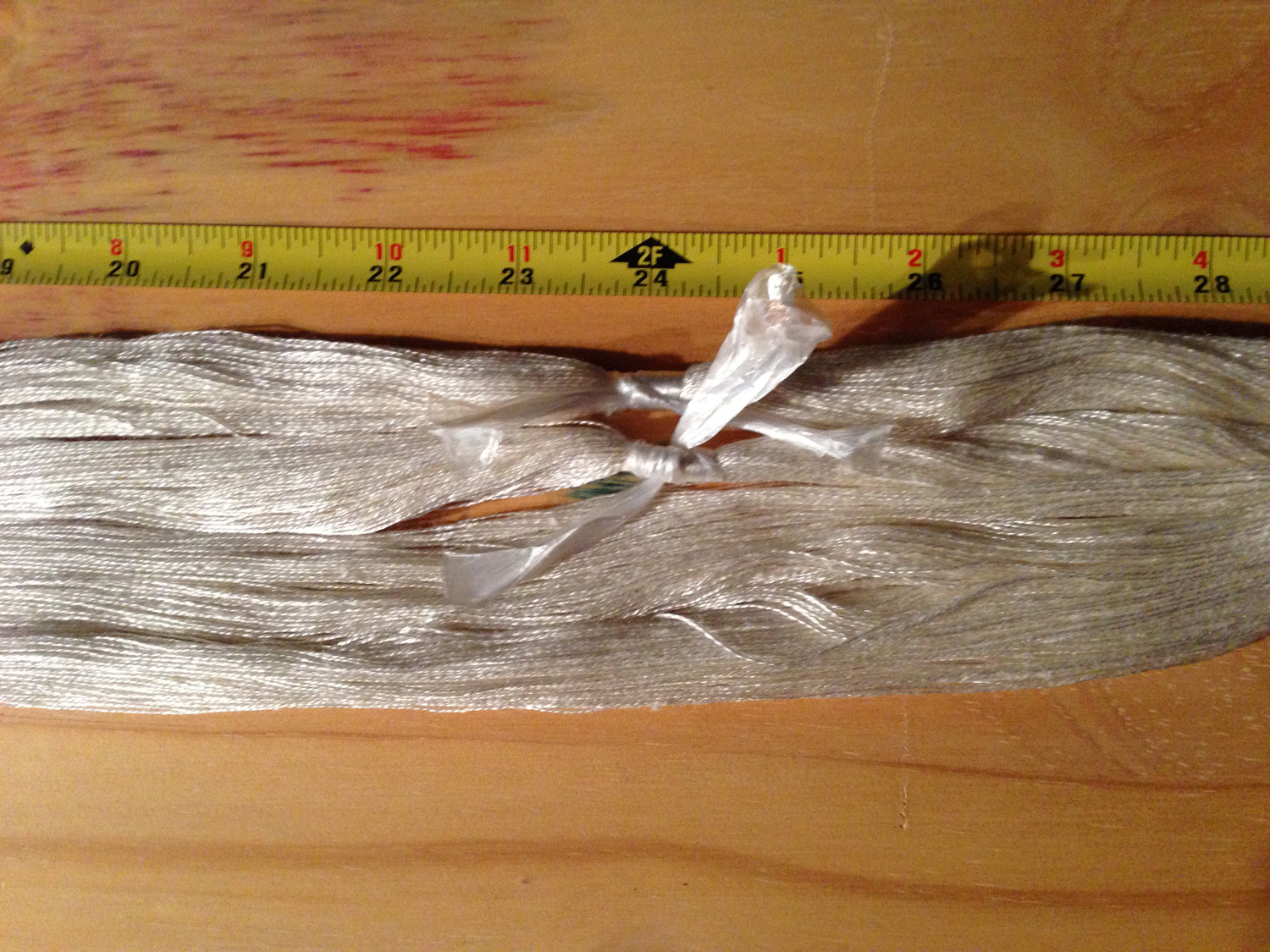
Tying individual chains with the ikat tape

I didn’t pay too much attention to placement when tying the individual ties – just tried to get them within an inch or so of each other. So of course they were misaligned when I was done:
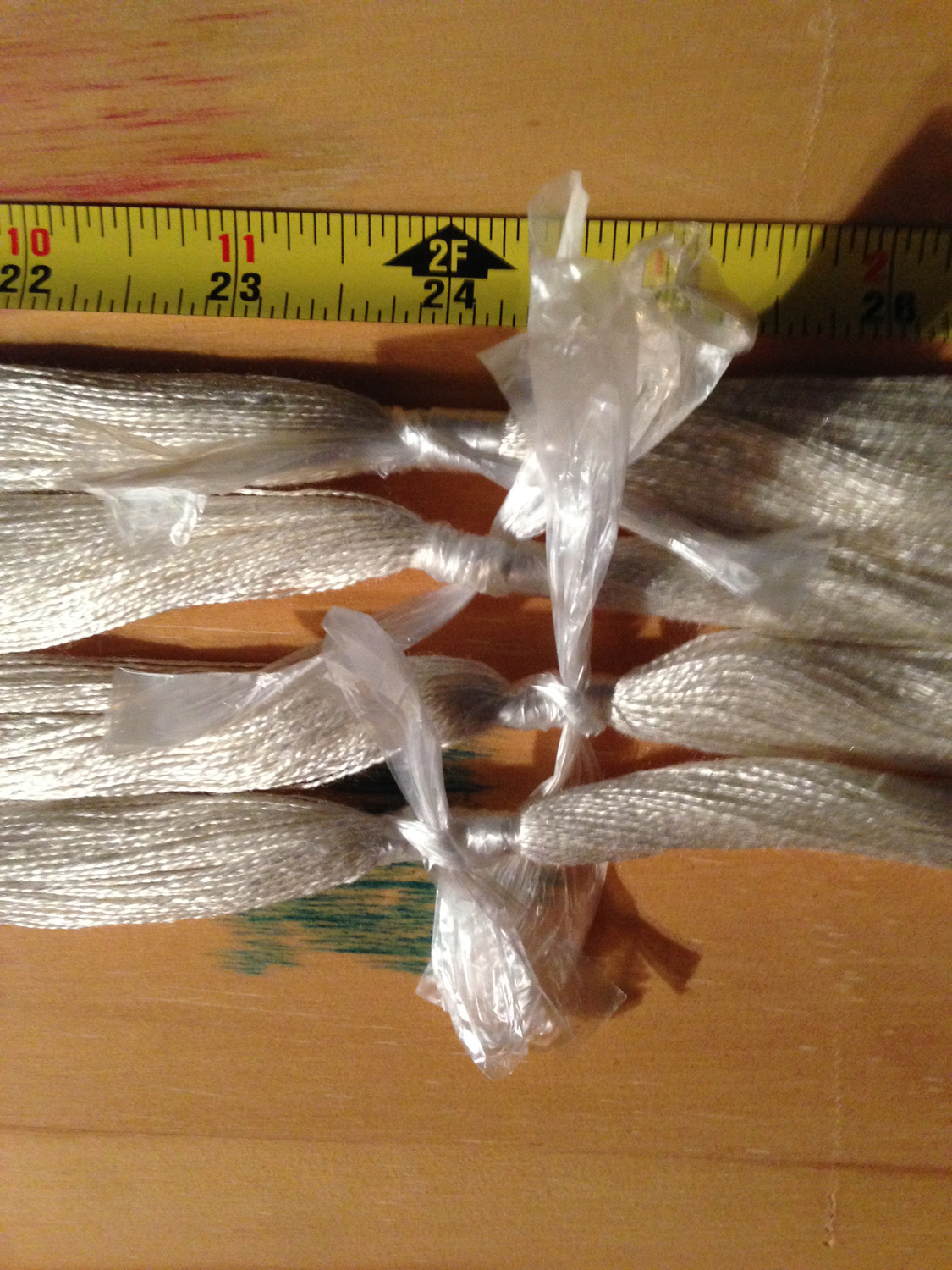
Misaligned ties
Misaligned ties

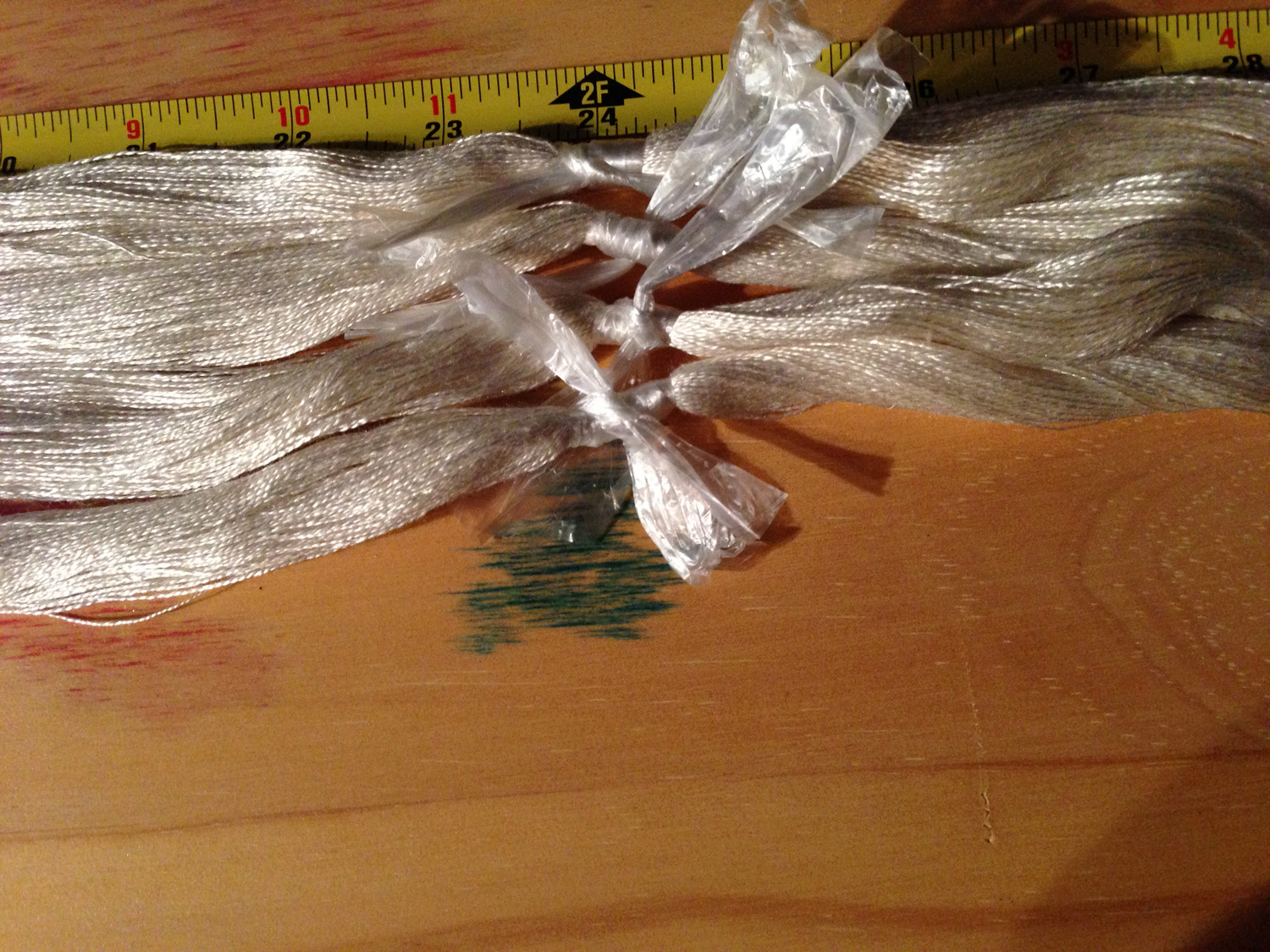
But no worries – the plastic ties can be shifted a bit without loosening:
Nicely aligned ties
Nicely aligned ties

Presto! Nicely aligned ties, placed exactly 24″ away from the previous ties.

I then stretched and bound the next section, keeping the ties that align the bouts tight until the next section was aligned and tied.

Using this method, I’ve synchronized color changes across a 13-yard warp with no more than an inch or two of shifting at the end. Of course there is some waste at the changeover between colors – but much less waste than if I had wound 17 separate warps to test the color combinations!

Having finished tying off the warp, I’m now working on winding the skeins for the weft. I decided on winding skeins rather than knitting blanks, as I’m using 25 grams of yarn per weft color. For smaller skeins it makes sense to use a knitted blank instead, but for larger amounts, skeinwinding is faster. In this particular case, I timed knitted-blank production at six minutes/blank and skeinwinding at three minutes/skein, so it would take twice as long to knit the blanks as to wind the skeins. Plus extra wear and tear on my body from knitting 300 rows per blank, for forty-five blanks!

So I’m winding skeins instead. So far I’ve wound fifteen of the forty-five skeins, so am well on my way.

On the slate for the rest of the week is more prosaic stuff, like finishing the project for Handwoven and writing the accompanying articles. Also revising my lesson plan for the workshop I’ll be teaching in March, and writing up handouts to go with the workshop. I’ve taught it twice before, improving it each time. Hopefully this time will be the best yet!

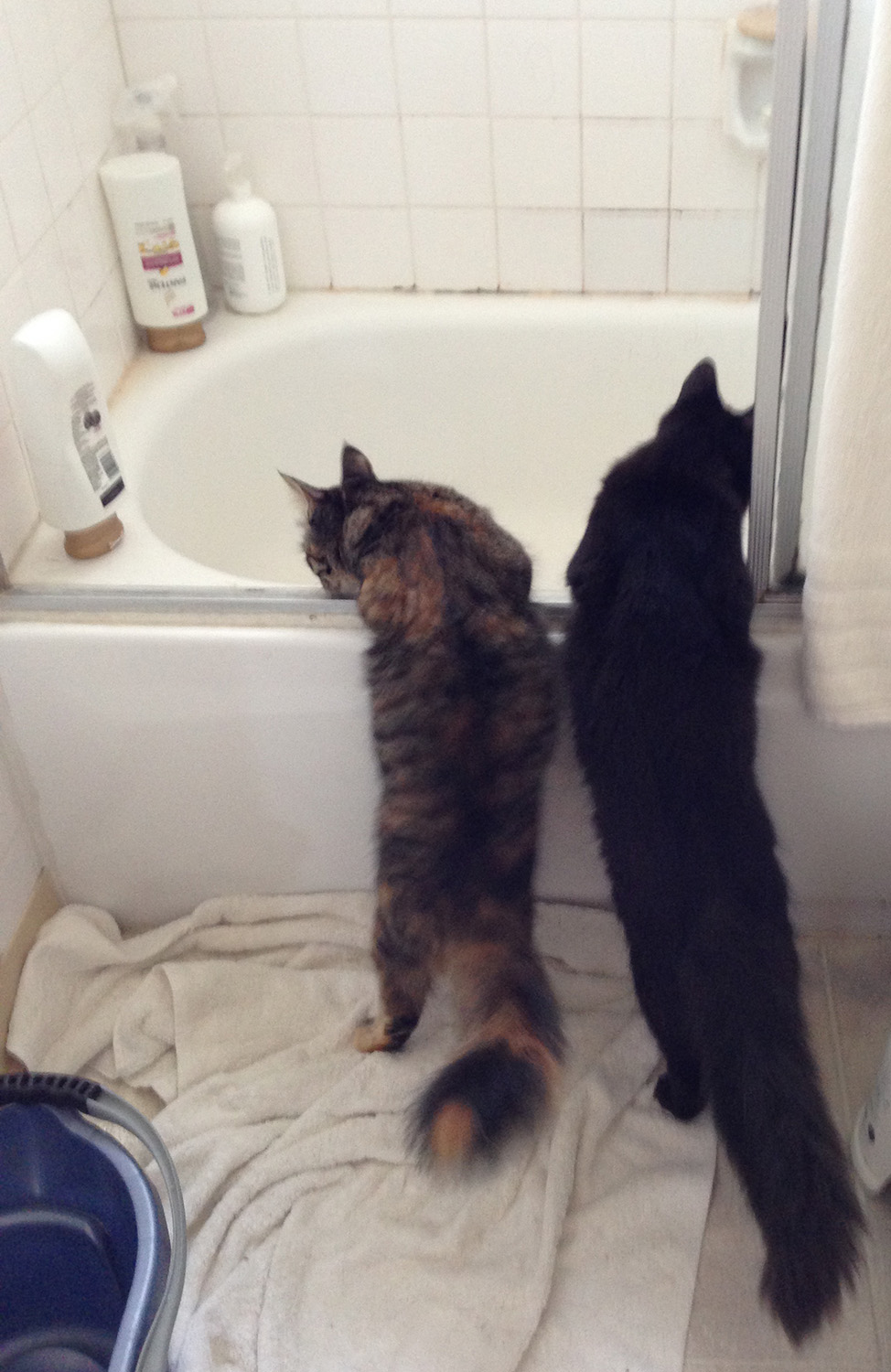
And, the kittens you’ve been waiting for! Here are Fritz and Tigress, getting their first glimpse of the bathtub. We had been keeping them out of it, but after Superkitten (aka Fritz) took a flying leap to land atop the glass door to the shower (only two inches wide – holy wow, he’s one amazing jumper), we decided it was safer just to let them in. So the moment we opened the door, two curious kittens rushed over to investigate. Because, you know, the bathtub is the most interesting place ever!
Fritz and Tigress exploring the bathtub

Filed Under: All blog posts, textiles, weaving Tagged With: color study

February 9, 2014 by Tien Chiu 3 Comments

Moving ahead with the color study

The cold is finally tapering down and my energy and enthusiasm is increasing, at least to the point where I can do other things than blow my nose, have another cough drop, and drink tea. My IQ has also returned to a measurable level, enabling me to plan the color study in more detail.

I’ve concluded that, for this particular color study (and perhaps for color more generally), there are six knobs to fiddle with:

  • Hue schemes. This basically amounts to “what color-wheel colors are in this piece?” There are a huge number of hue schemes, such as monochromatic (one color), analogous (colors from a 1/3 wedge of the color wheel), complementary (two colors from opposite sides of the color wheel), split complementary, triadic, tetradic, hexad, and probably a couple others that I’ve forgotten.
  • Value schemes, i.e. how much light color vs. how much dark color and how wide a range of values is used. Deb Menz covers this in pretty good detail in her excellent book Color Works.
  • Chroma schemes, i.e. how much saturation there is in each color, and how much contrast in saturation there is through the entire piece
  • Proportion of color – how much of each color is used
  • Placement of color – which colors are next to each other
  • Color mixing – how the colors blend in the weave structure, since weaving rarely has patches of truly solid color

Towards this, I’ve wound a 13-yard warp which will be painted in a different set of three colors every 24 inches (for a total of 17-18 color combinations). I’ve selected the warp colors to cover as many hue, value, and chroma schemes as possible. Obviously it’s impossible to touch on more than a tiny number of the possibilities! so I’m trying to get a small sampler. If I find a color scheme that speaks to me, I’ll probably do a follow-up study to investigate it in more detail.

I’m not going to bore you with the entire matrix I’ve put together, but here are a few rows from the table:

Overall color scheme Dominant warp color Secondary warp color Accent warp color Weft colors
Complementary, middle major value scheme, high saturation red-orange medium turquoise light turquoise light turquoise, medium turquoise, peachy orange
Complementary, medium minor value scheme, saturation mix Dark navy turquoise Terra cotta bright orange, turquoise, terra cotta
Split complementary, low minor value scheme, low saturation (blue-green, red, orange) dull, dark blue-green maroon terra cotta dull, dark blue green, terra cotta, maroon
Split complementary, high minor key (blue-green, red, orange) peachy orange pale red pale blue-green light blue-green, peachy orange, light red
Split complementary, middle minor key medium spruce medium orange medium red medium spruce, medium orange, light red
Split complementary, low major key dull, dark blue-green maroon peach dark maroon, pale blue-green, peach
Triad, medium major key (turquoise, yellow-orange, red-purple (fuchsia)) dark dull turquoise fuchsia gold Gold accent, red-purple, medium dull turquoise
Triad, low minor key, low saturation (red, yellow, blue) Olive navy maroon Navy, olive, maroon
Triad, medium major key, high saturation (red, yellow, blue) Cerulean blue Chinese red lemon yellow Cerulean blue, lemon yellow, Chinese red
Triad, medium major key, low saturation with high saturation contrast Navy Maroon lemon yellow Maroon, navy, golden yellow

The weft colors are purely tentative, and I expect I’ll change them on the fly as I actually start weaving. However, I do intend to dye all those colors, so I can use them according to whim.

The warp will be threaded in four groups of warp stripes:

  • Stripes of precisely equal width, in a 1-2-3 color sequence
  • Stripes of irregular width, in a random color sequence
  • Stripes with rhythmic width (like a regular plaid), in a symmetric color sequence
  • Fibonacci stripes (stripes where the width is a Fibonacci number)

A quarter-inch section of white will separate the groups.

Weft-wise, the default plan is to weave the stripes “as drawn in”, to produce the proportion gamp I talked about in my previous post. However, I’m sure that plan will last about eighteen inches into the weaving, and that’s fine. I just need something to start with!

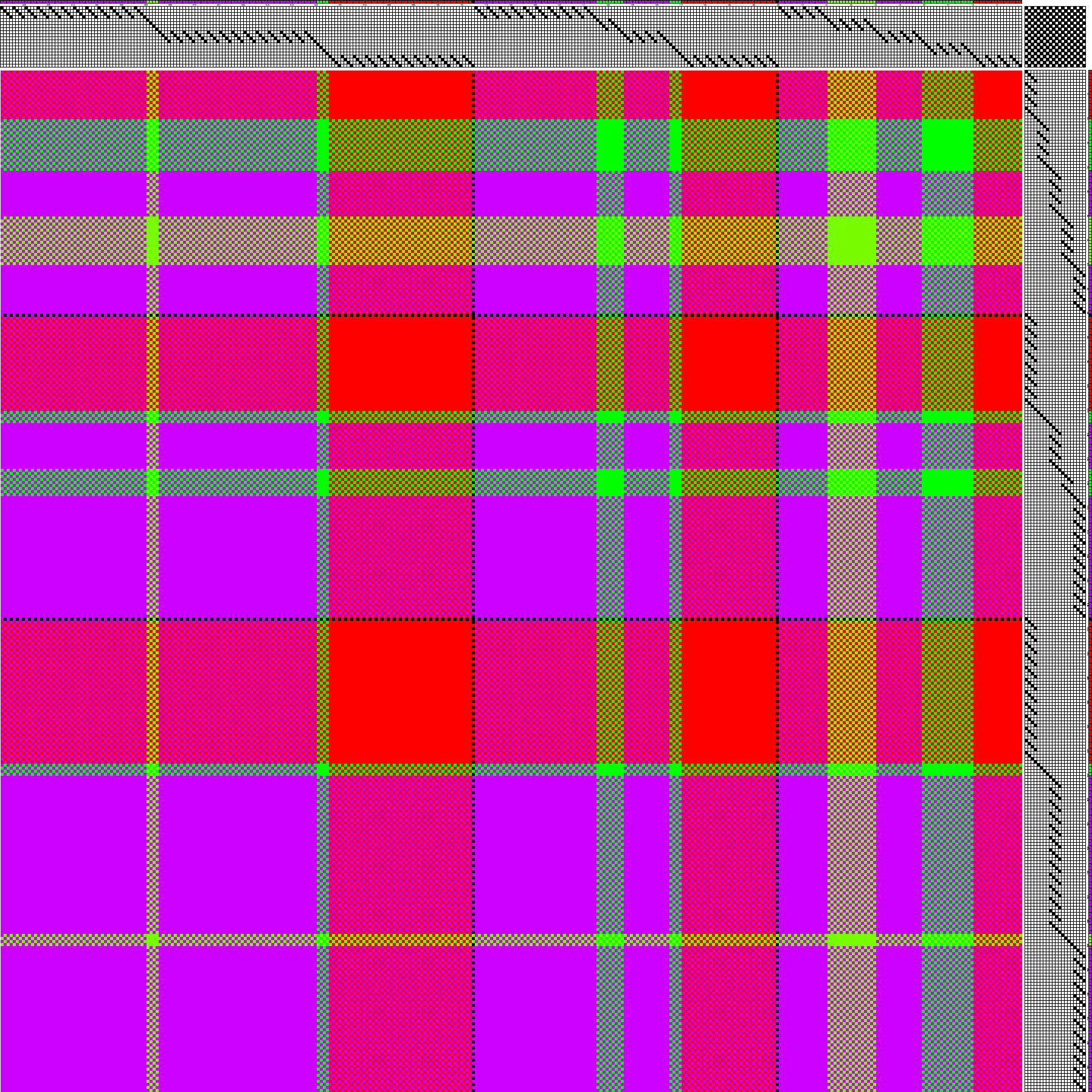
Here is the starting drawdown, showing what would happen if woven “as drawn in” with the same set of colors. The actual cloth will have very different colors, of course, but you can get some idea of the warp striping and its effects.

color study drawdown

Structure? Good question. I have a LOT of options, because I’ve put each stripe within a group on an independent set of shafts. Stripe #1 is threaded on shafts 1-4, stripe #2 is on shafts 5-8, and so on. There are a total of 8 stripes (32 shafts) in each group. The white separator stripes and the selvages are each on their own set of shafts as well. (Ah, the luxury of 40 shafts!) So…I could weave every stripe in a different structure. Is your mind reeling yet? Mine is.

All that said, for simplicity’s sake, I plan to start with a 2/2 broken twill structure. There are a ton of things to explore without going down the rabbit hole of structure! But I’m keeping my structure options open in case I get the urge to fiddle.

There will be a total of 33 colors – not sure how many shades in the warp, but I counted 28 different weft colors. To avoid having to wind, tie, dye, and unwind 28 skeins of yarn, I’m going to make a whole bunch of knitted blanks using my knitting machine, then dye the blanks. (Less prone to tangling than dyed skeins, and easier to unravel later. The results may not be as level as dyeing in skeins, but for this purpose it really doesn’t matter.)

I do have a plan for getting the warp painted, but I’ll leave it for later as this blog post is already reaching heroic lengths. This week I’ll be working on tying off sections of the warp and prepping the warp for painting – the actual painting will likely take place next weekend, as it’s complicated, fussy, and time-consuming.

It is so nice to have energy again!

Finally, your kitten for the day! You may recall a previous photo of Fritz with his head stuffed completely into my shoe. Well, kittens grow, and his head is now too large to fit into my shoe. Which is why he was so ecstatic a week or two ago, when my friend Alfred (who has much bigger feet) came over. I don’t know where he got his shoe fetish, but it’s pretty funny.

Fritz exposing his secret shoe fetish!
Fritz exposing his secret fetish!

Filed Under: All blog posts, textiles, weaving Tagged With: color study

February 6, 2014 by Tien Chiu Leave a Comment

Designing the color study

Since my last post had no kittens, I begin by offering you a bonus kitten! And a rare one at that – a picture of me and Fritz, taken by my friend Carla while she was visiting:

Tien and Fritz
Tien and Fritz

The kittens have picked up their growth – I had been thinking they were just about full-grown, but Fritz has gained over half a pound in the last eight days! I’m impressed, and a little terrified about where we might be heading.

Anyway, I’ve started thinking about my color study. It’s difficult to plan it when my head still feels incredibly stuffy, but I feel like I’m making some progress, so I thought I’d share what I’m up to.

First I went through Deb Menz’s book “Color Works”, which I think is one of the best books I’ve seen on color and its use in fiber arts. I wrote down all the different knobs-and-dials she discusses. There were four of them: proportion of color, value scheme, hue scheme, and contrast in saturation (bright/dull). (Obviously there is a lot more to color than that, but that’s what she started with.) Then I started thinking of all the different ways to express those in fabric. Around then my head exploded.

I decided to simplify, and just try examining one of them. I picked proportions of color, and came up with this draft:

color proportions gamp

It’s what I would describe as a proportion gamp. There are three groups of five stripes each in the warp (separated by black threads). The color order is the same – red, green, purple, green, purple. The only different thing about each group of stripes is the proportions of the stripes. In the right-hand group, all the stripes are exactly equal in width. In the middle group, the stripes are of random size. In the far left group they are different sizes, but with a regular pattern.

The gamp shows the results of weaving “as drawn in” – the first group of stripes produces squares when woven as drawn in, the second group produces an irregular plaid, and the third one produces a regular plaid. Even though they use the exact same colors in the exact same color order, the look and feel of the three groups is quite different.

This is more of a conceptual sketch than a finished concept. But I think the idea is sound. I’m going to wind two or three warp chains, paint them in carefully chosen color combinations, and use them for the warp stripes. So I might have one section painted in black (warp chain #1), gray (warp chain #2), and pearl gray (warp chain #3). That section might be testing out monochrome designs with lots of contrast. The next section might be pastel purple, sky blue, and sea green, to play with light-valued analogous color schemes. And so on. The wefts will be chosen from a broad palette of colors, not in any planned way, but more as a way of experimenting with “What if…?”

For the wefts, I plan to make a lot of small knitted blanks and dye each blank a different color. I think that will be quicker and easier than winding a lot of skeins, dyeing each skein separately, and then re-winding the skeins onto pirns. Also, it makes storing the dyed yarn really easy – no tangles!

Finally, structure. The gamp above is plain weave, meaning you could do it on two shafts. And plain weave may be plenty to keep me busy. But just in case…I plan to thread up using five blocks of eight shafts – one block for each stripe – so I can also use structure to change the color of a block. Plain weave is 50% warp and 50% weft, but if I go to a 3-1 twill, it will be 75% warp, 25% weft, making the warp color dominant. With eight shafts threaded straight draw I could go as high as 88% warp or weft, which would be enough for dramatic changes, if I decide to start improvising.

This is an unusual color study in that I don’t have my plans drawn up well in advance. There are simply too many variables to do that. Instead, I’m going to start with a few warp color schemes, a bunch of weft colors, and just play around. It will be interesting to see where this leads!

And, finally, your kitten for today: a dramatic shot of Superkitten (aka Fritz) in action.


Filed Under: All blog posts, textiles, weaving Tagged With: color study

  • « Previous Page
  • 1
  • 2
  • 3

Archives

Tags

aids lifecycle outfits autumn splendor book cashmere coat cats celtic braid coat color study cross dyeing design design class devore doubleweave doubleweave shawls drawing dye samples dye study group gradient colors house infinite warp jacquard loom katazome knitted blanks kodachrome jacket ma's memorial mohair coat network drafted jacket/shawl project network drafting painted warp phoenix rising phoenix rising dress phoenix rising kimono phoenix rising reloaded pre-weavolution project sea turtles taquete tie-dye tied weaves tomatoes velvet weaving drafts web design website redesign wedding wedding dress woven shibori

Categories

  • Africa
  • aids lifecycle
  • All blog posts
  • All travel posts
  • Asia
  • Bangkok
  • Belize
  • Cambodia
  • Central America
  • Chai Ya (Wat Suon Mok)
  • Chiang Mai
  • Chiang Rai (Akha)
  • China
  • chocolate
  • computer stuff
  • creating craft
  • Creative works
  • cycling
  • Delhi
  • Dharamsala
  • drawing
  • dyeing
  • Fiber Arts
  • finished
  • food
  • garden
  • Ghana
  • Guatemala
  • Hanoi
  • Ho Chi Minh City
  • Hoi An
  • India
  • Khao Lak
  • knitting
  • Knitting
  • Ko Chang
  • Laos
  • Luang Namtha
  • Luang Prabang
  • markleeville death ride
  • meditations on craft
  • mental illness
  • musings
  • Phnom Penh
  • powerlifting
  • Rewalsar (Tso Pema)
  • sewing
  • Siem Reap (Angkor Wat)
  • Southeast Asia
  • surface design
  • textiles
  • Thailand
  • travel
  • Vangvieng
  • Vientiane
  • Vietnam
  • Warp & Weave
  • weaving
  • Weaving
  • weavolution
  • writing

© Copyright 2025 Tien Chiu · All Rights Reserved ·

Loading Comments...