Tien Chiu

  • Home
  • About Tien
    • Honors, Awards, and Publications
  • Online Teaching
  • Gallery
  • Essays
  • Travels
  • Book
  • Blog
  • Dye samples
You are here: Home / Archives for phoenix rising kimono

August 19, 2013 by Tien Chiu 1 Comment

Visiting with John Marshall

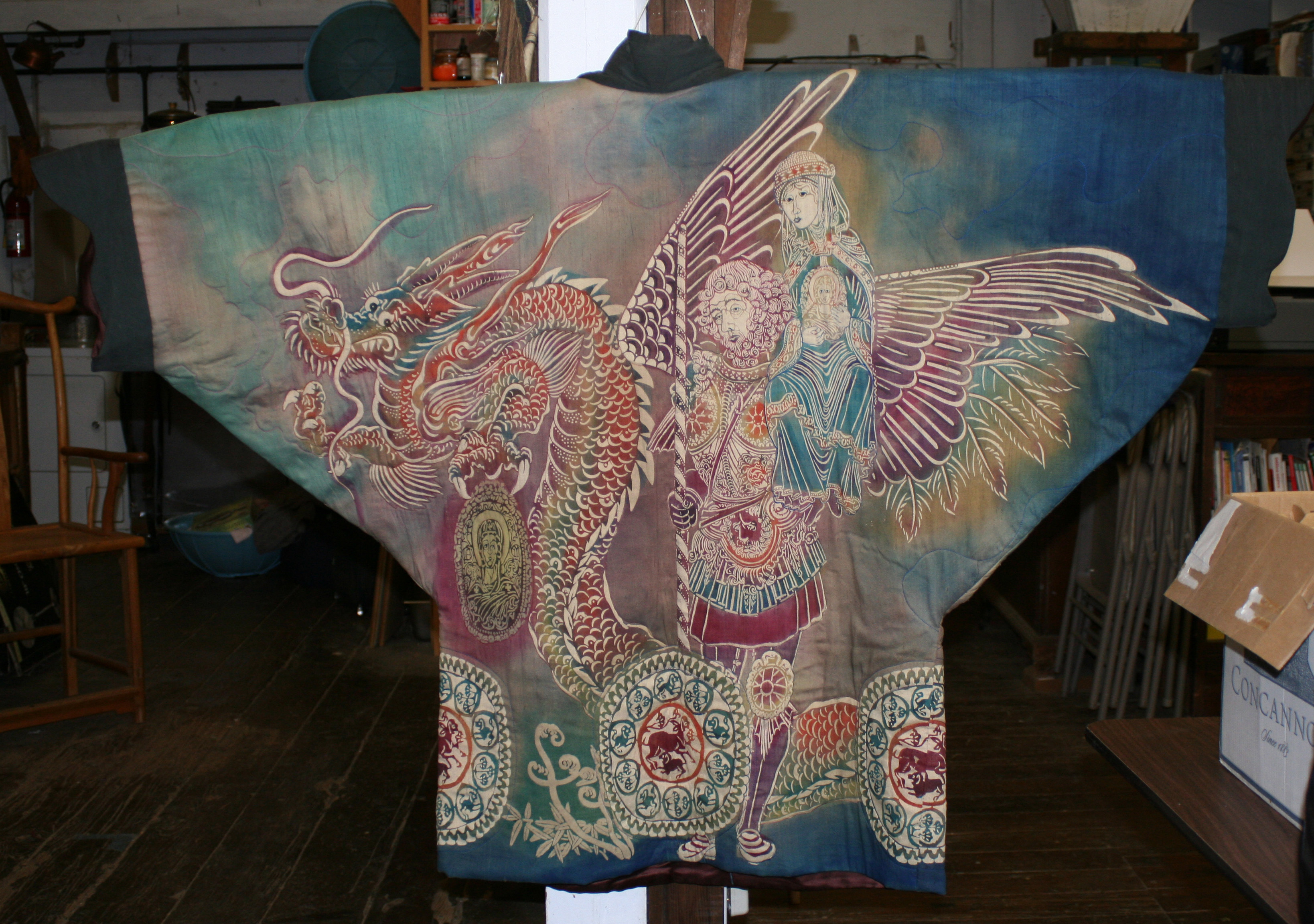
B. and I drove up to rural Northern California over the weekend to visit John Marshall, a well-known katazome artist, at his home/studio in Covelo. We had a wonderful dinner with John and his other guests, and Sunday morning I got some time to chat with John, tour his studio, and see his work.

Here’s one of his amazing katazome pieces (photo taken with permission, of course):
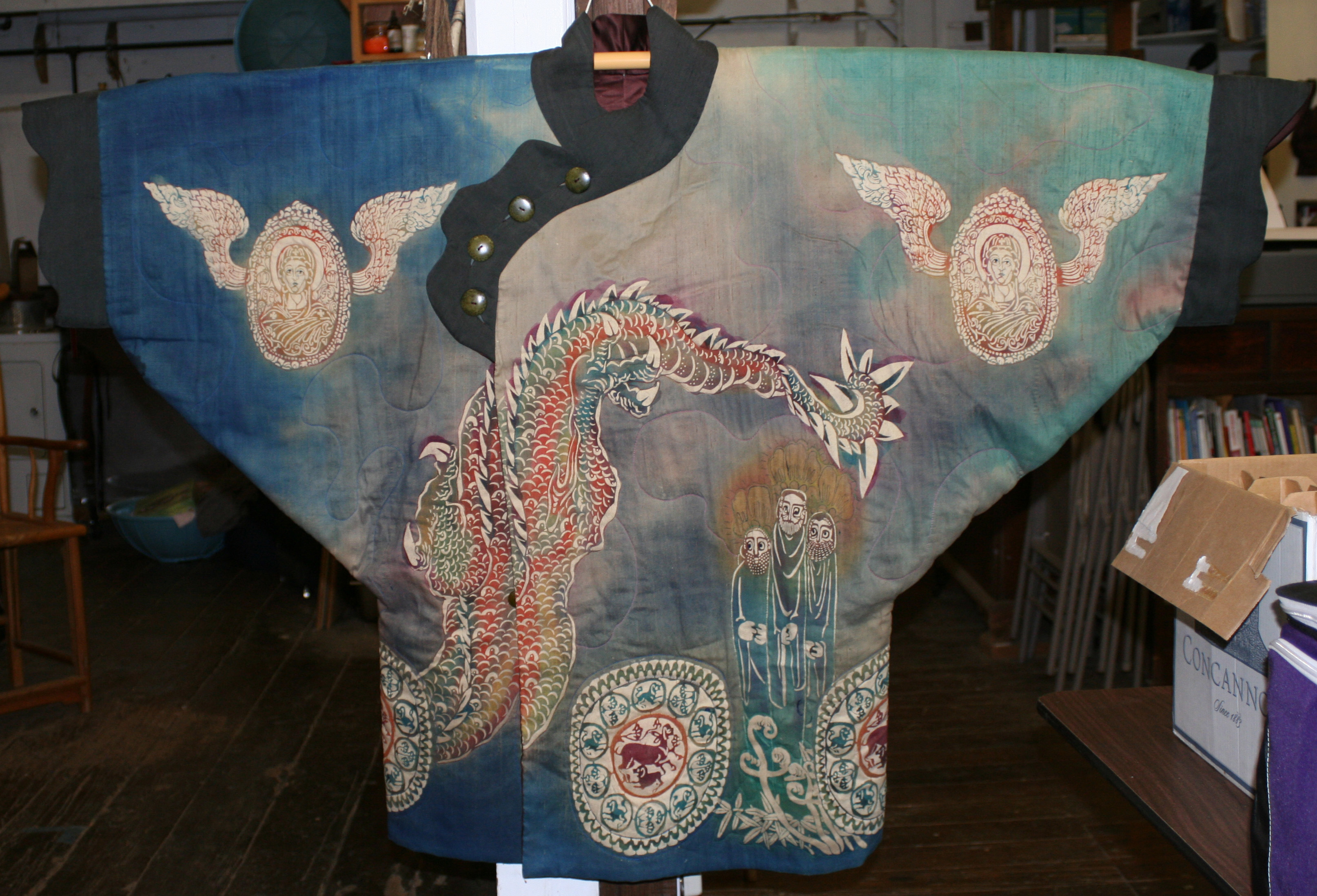
"St. George and the Dragon" - front view
“St. George and the Dragon” – front view
"St. George and the Dragon" - back view
“St. George and the Dragon” – back view

I’ve deliberately left both of the larger photos (click on the image to get to the full size version) at the original size, so you can zoom in and admire his work – the smaller photos really don’t do justice either to the power of the design or the subtlety of the colors. John is truly an amazing artist.

But what, you ask, is katazome? It’s the art of Japanese paste-resist dyeing. I took a katazome class from Karen Miller awhile back, and posted about the class here and here. (My finished pieces from the class are here.) Basically, you start by carving a stencil, like so:
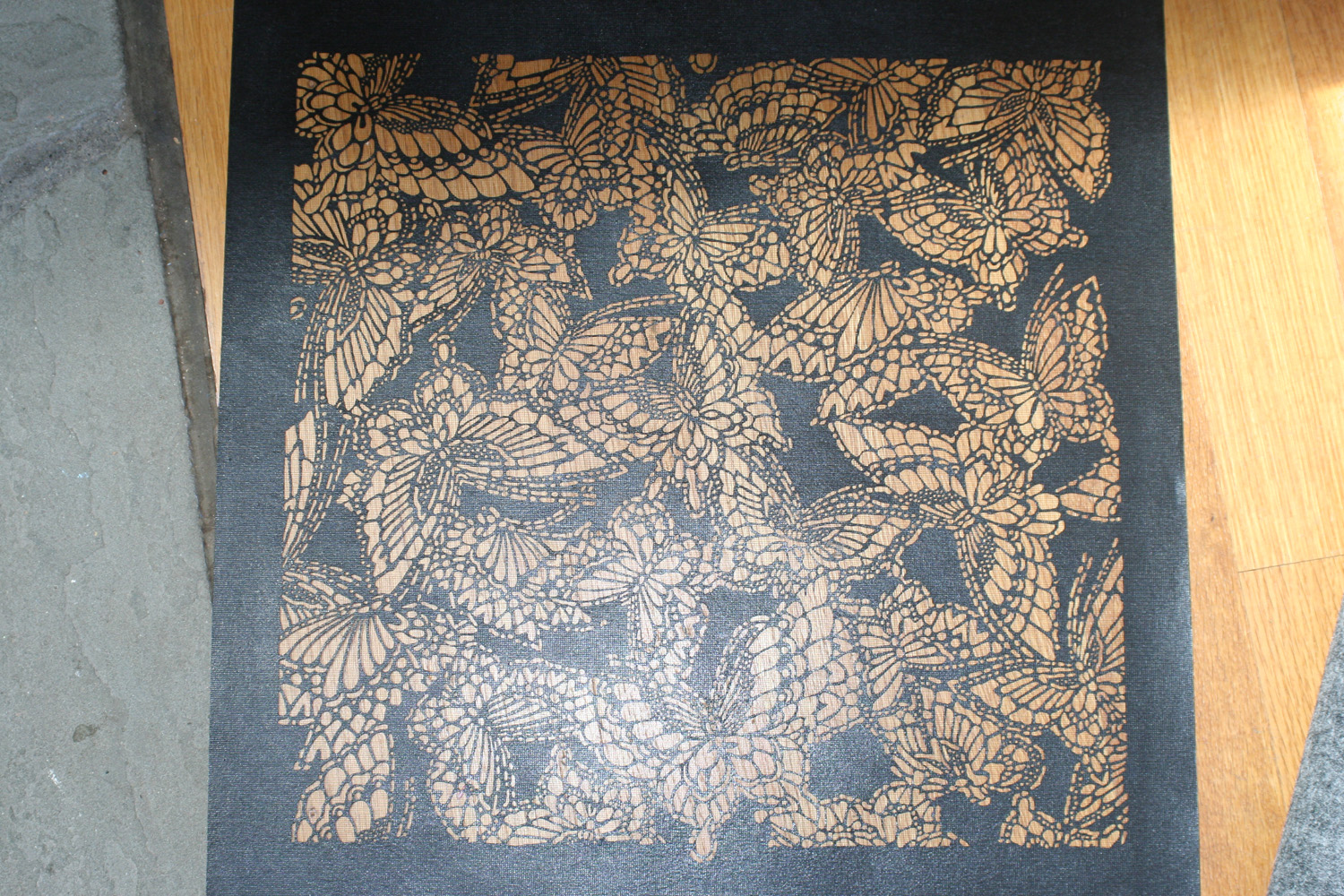
pre-cut butterfly stencil

(This is one of Karen’s stencils, not mine – I unfortunately did not take photos of the process using my own stencils.)

Then you use the stencil to “print” on the fabric using rice paste resist, like so:
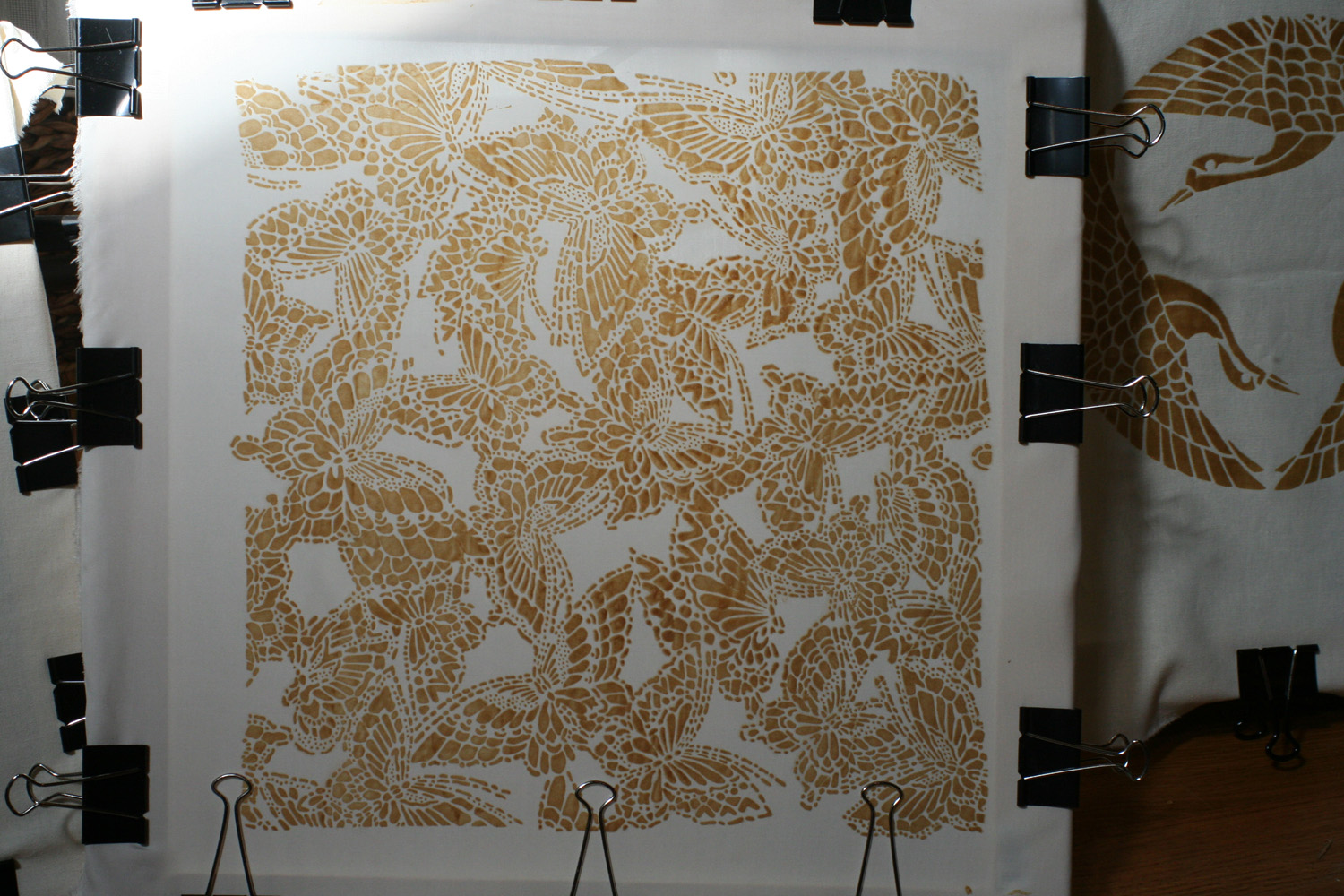
butterfly stencil paste

And then you apply the pigments or dyes over the resist:

butterfly stencil, painted with watercolor pigments

And then you wait for the dye/paint to set, then rinse out the resist:
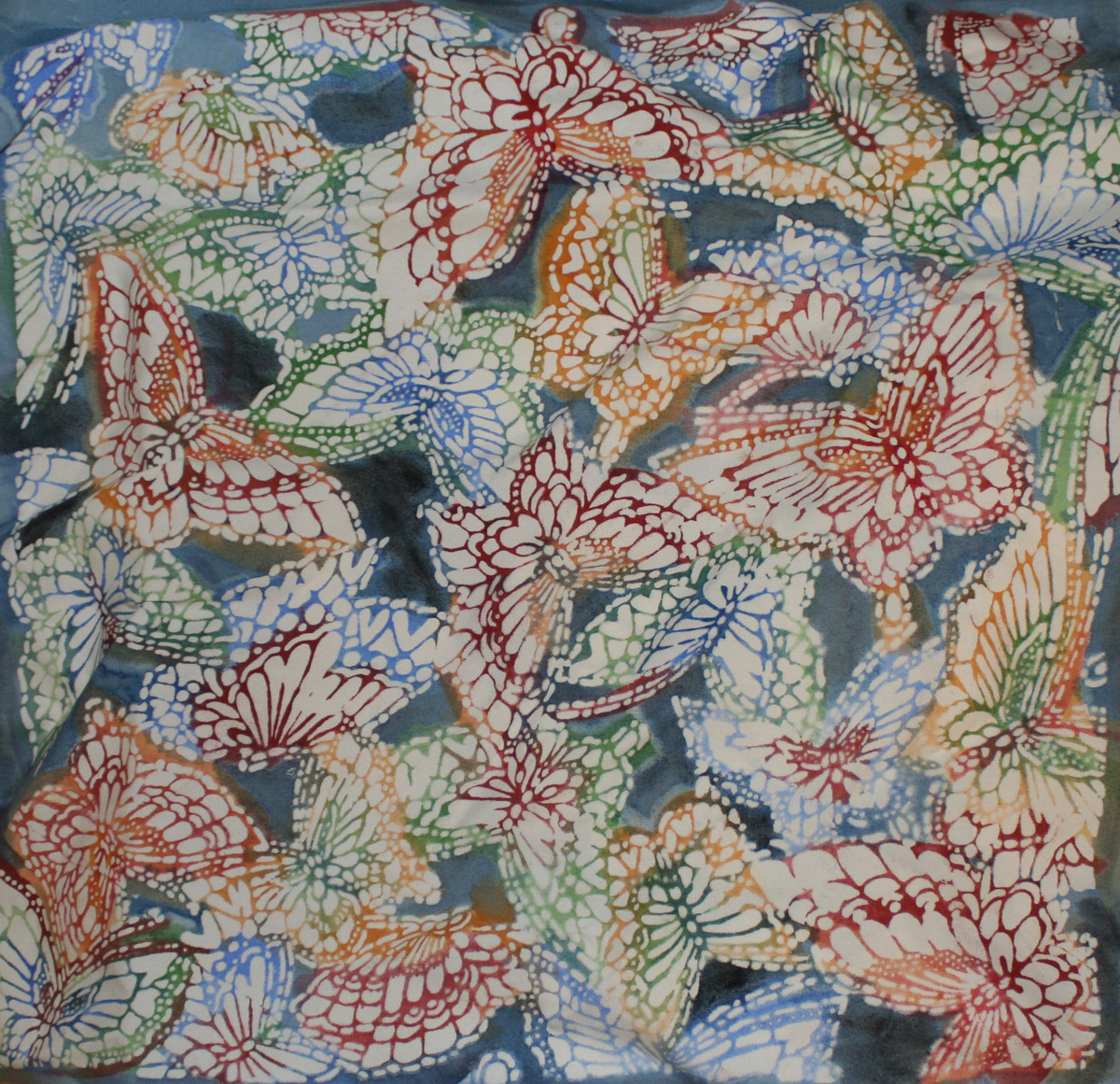
butterfly katazome, finished

Obviously this piece is not a Work of Art (as usual, I was trying to do too much in a single design), but hopefully it gives you some idea of the possibilities.

I was somewhat interested in katazome earlier, but after seeing John’s work, it’s definitely something I want to explore further. I’m hoping that next year I can go up to his place and study katazome with him – he offers a week-long class in his studio/home that sounds really enticing. I never managed to find the time for it before, but maybe next year…?

John was also kind enough to gift me with some uchikake padding (used for making uchikake, the Japanese ceremonial kimono), and loaned me a uchikake so I could reference a real garment when making my phoenix uchikake! That will be super helpful. He also gave me a copy of his book “Make Your Own Japanese Clothes”, which has instructions for making uchikake. In addition to being an amazing artist, he’s also a really generous guy.

I also discovered that, alas, my “kinshi” thread is not kinshi. Apparently the label (which is in Japanese) says “synthetic gold thread”. What I get for not reading Japanese, I guess. Well, I didn’t pay too much for it, so I’ll just chalk it up to experience. If I want to use the real stuff, I’ll order it from John, who has actually had his thread assayed to ensure it is real gold.

John also showed me some beautiful Japanese textiles that have subtle embroidery in gold and rayon threads to enhance a woven or dyed pattern. I hadn’t thought about doing surface design on the phoenix kimono, but now I see that it might make a great way to add depth and interest to the kimono. There are two ways I could go with this: embroidering “real” phoenixes flying up the kimono against the woven phoenixes in the background, or subtle embroidery to add just a bit of glitter to the woven phoenixes. Either would be a valid approach – I’ll have to think about it some more.

I’m glad to say that I’m on the back end of the asthma flare-up, too. Friday I went back to the doc and got a prescription for codeine cough medicine, which has been letting me get more sleep at night, which has helped my lungs heal up a bit. I’m almost back in the swing of things!

My project over the next few days will be the fabric for my Handwoven article. I haven’t started it yet mostly because I’m reluctant to cut that 10-yard warp in fine threads off the loom – it was such a pain to get on the loom and to debug that some part of me wants to keep it going, even though it’s served its purpose and is only tying up the loom now. In another day or two, maybe I’ll get up the nerve.
Filed Under: All blog posts, dyeing, textiles Tagged With: katazome, phoenix rising, phoenix rising kimono

August 9, 2013 by Tien Chiu 1 Comment

Bleaching silk

I’ve been doing some experiments in bleaching silk. I need to dye some silk bright lemon yellow for my next project. In the past, I’ve had trouble getting bright lemon yellow because natural/unbleached silk is actually a very pale brown. This makes (essentially) no difference for dark or dull shades, but for pale colors, and especially pale bright colors, it dulls out the color.

I posted to WeaveTech (I think it was WeaveTech) a few weeks ago in an effort to find a good recipe for bleaching silk. I got referred to two recipes. One was Treenway Silks’ proprietary recipe, which they were generous enough to share with me (but, of course, requested that I not share with others). The other was ProChem’s recipe for bleaching wool and silk. The ProChem recipe involves heating a solution of hydrogen peroxide, water, Synthrapol (a detergent) and soda ash to 130 degrees and then soaking the fabric/yarn in it for 16-24 hours.

I tested both methods, and since I had seven skeins to dye, I used one as a control (unbleached) and used three each to test each recipe – leaving the silk in the bleaching bath for 2 hours, 8 hours, and 24 hours.

Results? Both methods bleached the yarn without noticeable loss of luster (haven’t tested strength yet). Treenway’s method worked faster and more completely than ProChem’s, although after 24 hours in the bath the difference was barely detectable.

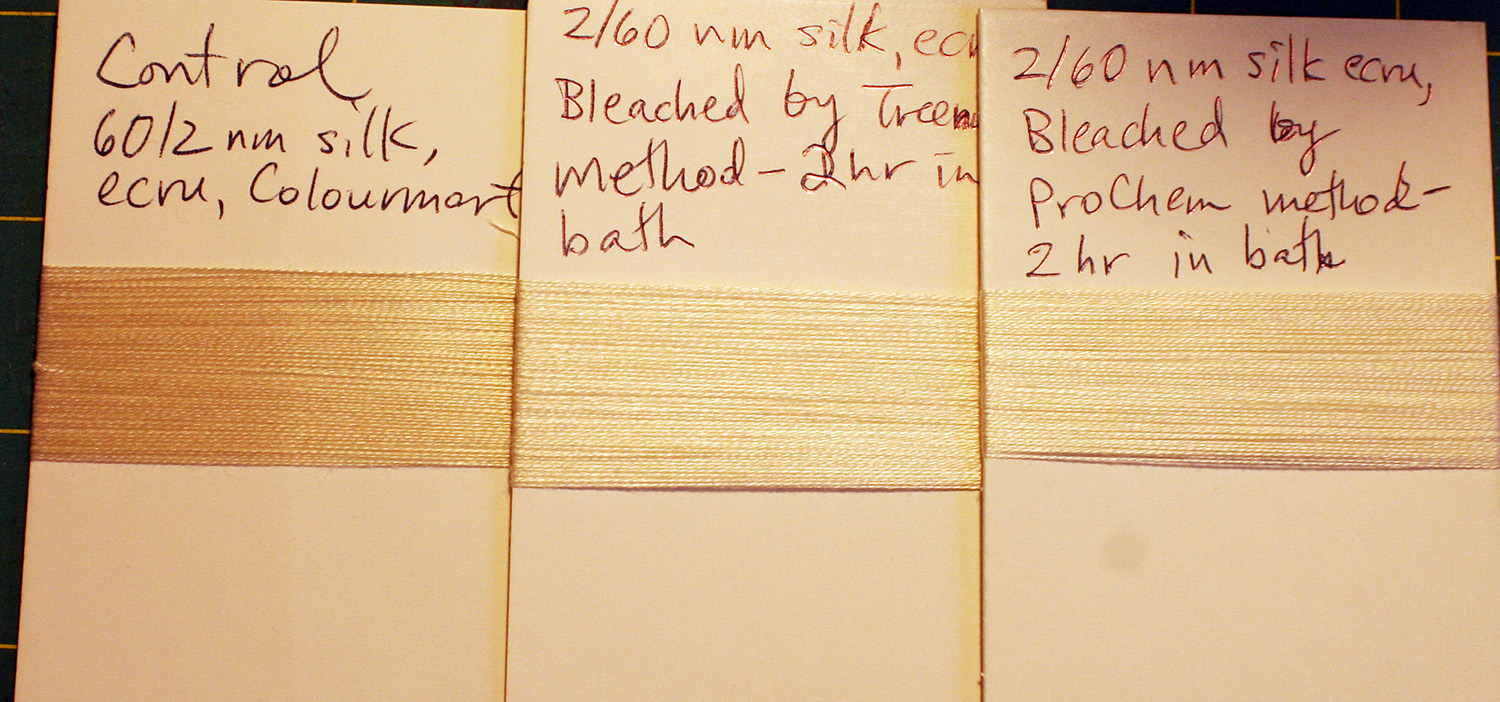
Here are sample cards from the first skeins to emerge (the others are still drying):

results of bleach baths, after two hours of soaking

I had a really hard time capturing the color differences, since they are quite subtle. In this photo, the differences are exaggerated – the “real life” color of the ecru yarn is closer to the color of the cardboard in the center card, and the Treenway method sample is a bit paler as well. However, there is a noticeable difference between the three cards, with the unbleached skein looking a bit more dingy. The ProChem method sample is also noticeably darker than the Treenway method sample.

It’s hard for me to report definitively on the later baths because the yarn is not fully dry yet, and colors will shift as a yarn dries. However, it looks like the ProChem method continues to bleach after the first two hours, while the Treenway method is fully bleached after two hours (or possibly less). Once 24 hours have gone by, there is still a difference between the two skeins (Treenway’s method is whiter) but it is barely perceptible. (As in, I can pick it out if I look really hard, but I’m not sure most people could tell the difference – I have a pretty sensitive eye for color.)

My next step, after the yarns are fully dry and I have wound sample cards from the later baths, will be to dye three skeins bright lemon yellow. (I need three skeins of yellow for my project!) Those will be the unbleached skein, the Treenway method 2 hour dyebath skein, and the ProChem 24 hour dyebath skein. I am guessing that there will be a perceptible difference between the unbleached skein and the two bleached skeins, but the difference between the bleached skeins will be imperceptible. Primarily what I’m trying to see is whether either bleaching process impacts dye take-up. I am guessing that neither affects dye take-up, since Treenway developed their method with the intent of dyeing the yarn after bleaching, and ProChem (being a dyehouse) probably did the same.

In the end, if the two bleaching methods produce comparable results, I’ll use Treenway’s method, because it’s faster than the ProChem method (which really does require 24 hours to bleach fully), and I suspect it may also be easier on the yarn due to the nature of the recipe.

My intent for all of this is to find the right bleaching method so I can pre-bleach the yarn for the kimono. I want the brightest color possible, and in particular I want the lemon yellow of the top phoenixes to stand out clearly. Thus, the experiments with bleaching processes.

Filed Under: All blog posts, dyeing, textiles Tagged With: phoenix rising, phoenix rising kimono

August 5, 2013 by Tien Chiu 2 Comments

Failure, failure, failure….success!!

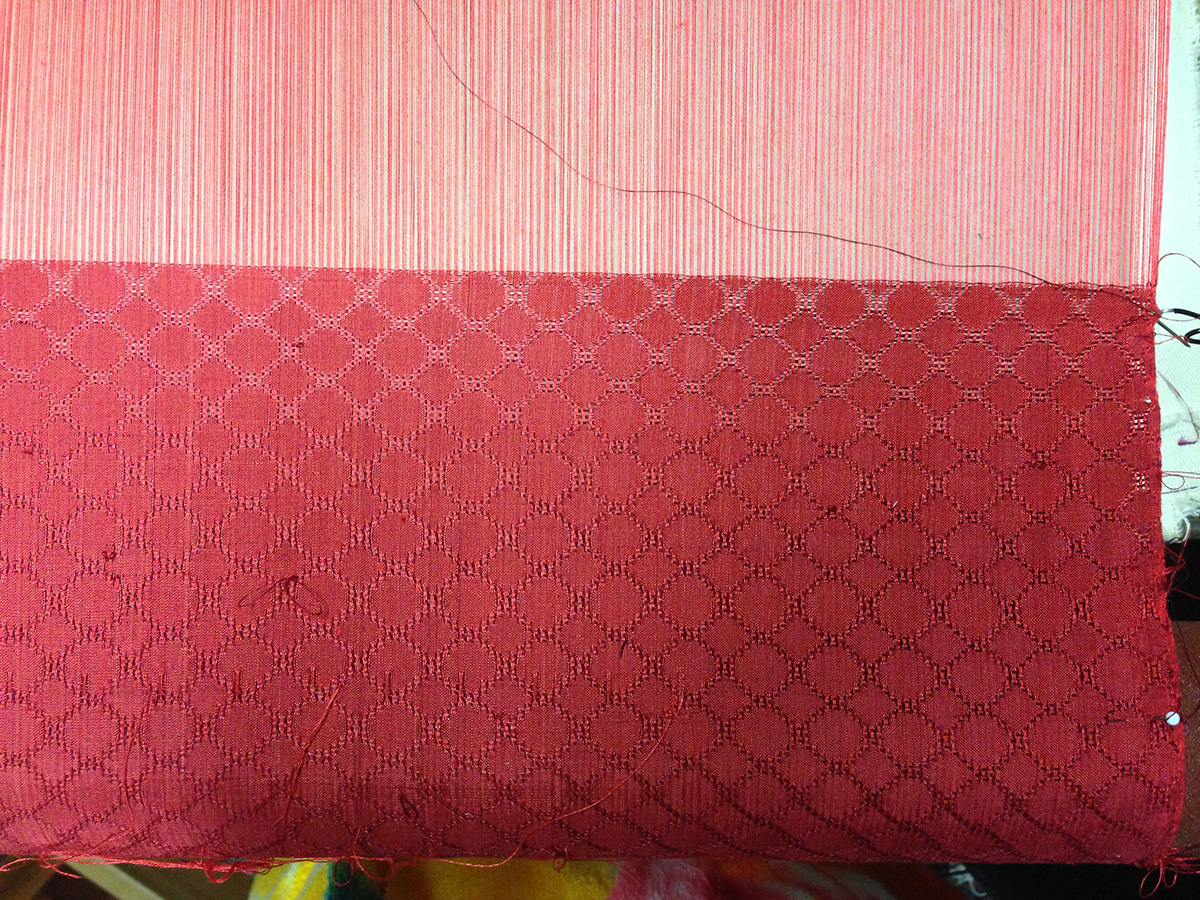
After three days of intensive troubleshooting, my fine-thread woes seem to be resolving. Here is a photo from this morning:

fine threads fabric sample - no broken threads!
fine threads fabric sample – no broken threads!

This is about four inches with no broken threads (the last broken thread is marked by the white pin on the right). My previous record was about 3/4 inch, so this is a HUGE improvement!

The only problem is that now I am breaking threads right and left – that is, on the right and left selvages. I don’t think there is any good way to fix this since I beamed on at 90 epi and have resleyed to 75 epi, meaning the warp is narrow on the beam and wide in the reed, a sure recipe for broken selvage threads. I’m just living with it for now – since this is a sample warp, I just tie knots (or pull out the thread) and keep going.

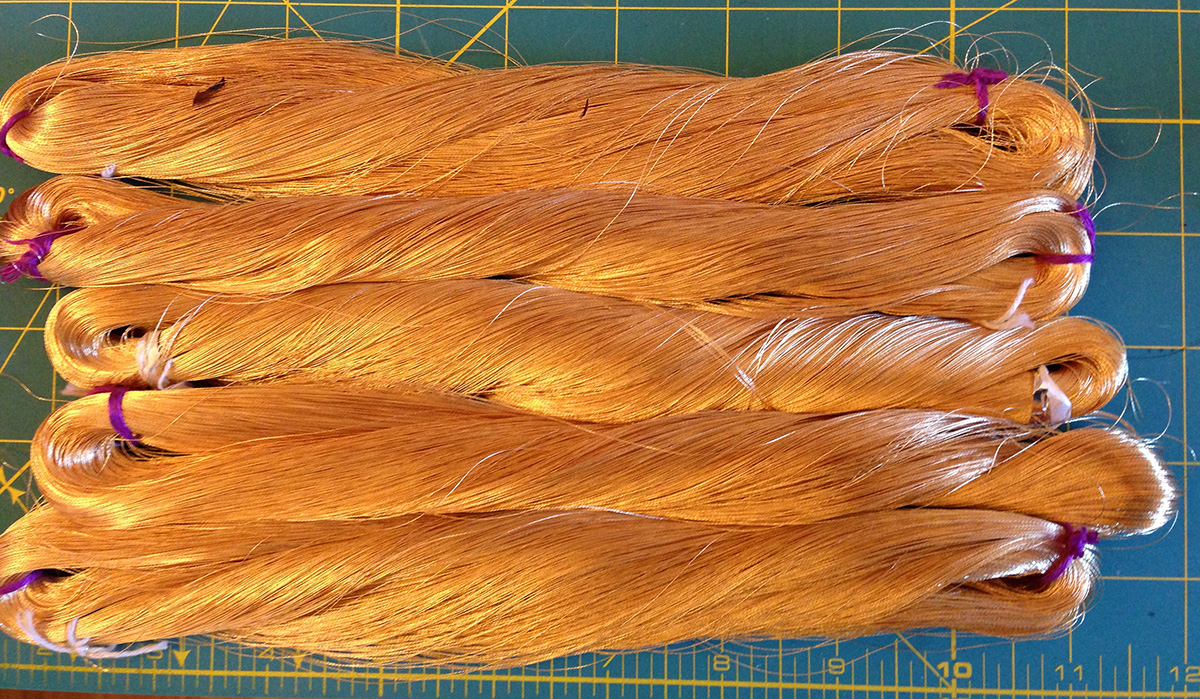
And – jump for joy! – my other batch of made-with-real-gold thread arrived from Japan! Here are five of the twenty skeins:

thread made with real gold

The photo doesn’t really do them justice – the color is deeper and richer in real life.

I have about 600 grams (20 ounces) of the yarn, so might have enough to do the phoenix.

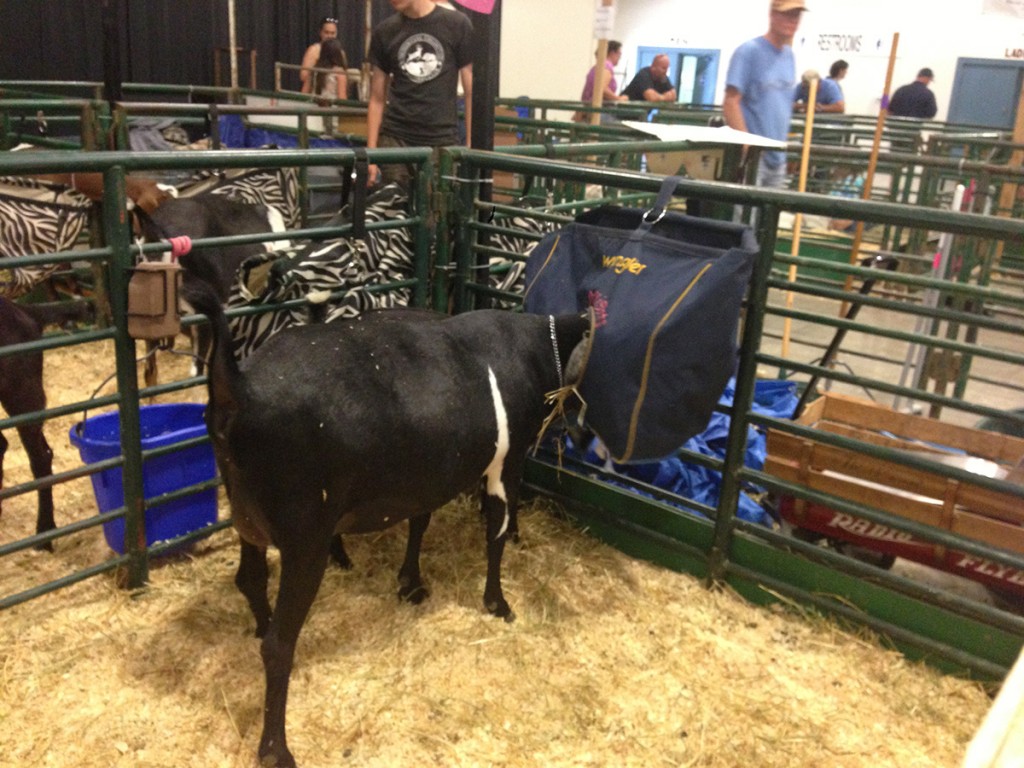
And, finally, B. and I went to the Santa Clara County Fair on Sunday, where we saw this enthusiastic goat hard at work, getting the last bits out of the feed bag:

goat eating

After three days of intense frustration, it was nice to get out of the house. Fortunately, nobody got my goat (especially good since I don’t own one!), nor did I wind up with anyone else’s goat. Good time for a stroll.

Plans for the next few days?

Well, first, I have nine pounds of wonderful Gravenstein apples just begging to be made into applesauce. Gravensteins are one of the earliest apple varieties, and are my hands-down favorite. (The only ones that compete are the Wicksons, tiny little apples the size of crabapples, which are delightfully crisp, and taste almost like sugar cane.) Gravensteins are tart and sweet, with wonderful flavor, and they make fantastic applesauce. I cook them until soft, with a bit of butter and a very tiny bit of water to keep them from burning, then put them through a food mill. The resulting applesauce is to die for – and bears no resemblance whatsoever to the watery, bland stuff they sell in supermarkets. If you haven’t made your own applesauce at least once, from full-flavored heirloom varieties, you have no idea what you’re missing. It’s heavenly.

After that? I’m working on an article for Handwoven, due September 15 or thereabouts, so I’ll need to weave up some cloth for that. Fortunately, the items I’m making for the article are fairly small, so this shouldn’t require tons of time or materials. But that will probably occupy most of this week and part of next, especially since I’m in an all-day professional development class on Saturday. (For project management, alas, not weaving!)

And there’s more to tell on the book front, too, but I think this blog post is long enough already, so I’ll save it for later. Suffice it to say that I think I’ve found myself an interesting advisor, and am eager to see how things proceed over the next month or two.

Filed Under: All blog posts, textiles, weaving Tagged With: phoenix rising, phoenix rising kimono

July 29, 2013 by Tien Chiu 4 Comments

Thread experiments

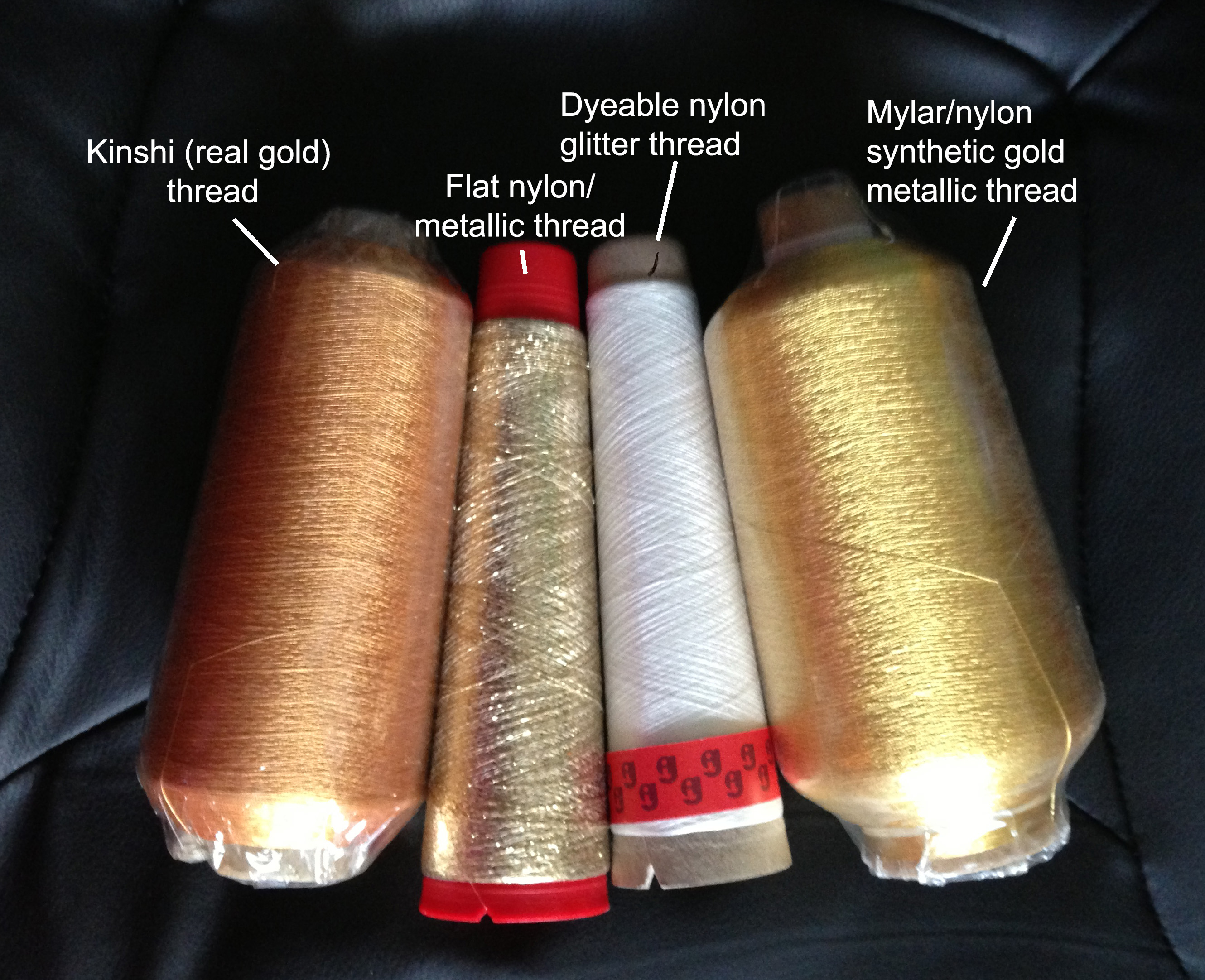
The kinshi (real gold) threads arrived today, along with some metallic gold synthetic thread (mylar wrapped around a nylon core). The dyeable nylon/metallic thread and dyeable glitter yarn had already arrived, so I decided to do a quick test to see how dyeing affected the different yarns. I made a batch of small samples, testing dyeing the thread by itself as well as the thread twisted with a strand of silk (which is how I would use it), using  fiber-reactive dyes and acid dyes.

Here’s what I started with:

metallic threads to play with

And here’s what the finished samples looked like (click to enlarge):

dyed samples of metallic yarn

The fiber-reactive dye bath didn’t seem to affect either the kinshi or the synthetic thread visibly. But the acid + heat of the acid dyebath produced some really interesting results. It stripped away all the gold on the kinshi thread, leaving a copper colored base (visible in the fourth sample from the left). And the two nylon threads shrank and crinkled considerably, resulting in a crinkly, textured thread when plied with silk. Only the mylar/nylon synthetic metallic gold thread was unaffected.

My conclusion? Work with fiber-reactive dyes (which are easier to use when painting a warp, anyway) and use either the synthetic or the real gold thread, plied with silk.

But which thread to use? In truth I could use either one, and it probably wouldn’t make a huge difference. The real gold threads will tarnish over time, and the synthetic won’t. But I love the idea of weaving with real gold thread, so I’ll likely use the kinshi threads rather than the synthetic. I found a yarn company that is willing to ply the thread with some silk for me…so I’ll be packing up the kinshi thread in the next few days and dropping it into the mail. It will probably take about three or four weeks for the plied yarn to return, which will give me just enough time to warp up and weave the yardage for my Handwoven article.

Filed Under: All blog posts, dyeing, textiles, weaving Tagged With: phoenix rising, phoenix rising kimono

July 25, 2013 by Tien Chiu Leave a Comment

Yarn design

Work has been intense the last few days, meaning I’ve been getting home too exhausted to do much. But I’ve started thinking about yarn design. I want my phoenixes to glitter as they rise up to the top of the kimono, but since they are also changing color, I need a glittery thread that can be dyed. Not easy to find! Giovanna Imperia has dyeable metallic threads (made from nylon), but they are very fine, about 30,000 yards per pound, meaning I’d need to strand together four strands to get the size I’m after. Not impossible, but likely to be a pain.

Another option is to strand a silk yarn with a non-dyeable metallic yarn (metallic gold for example). This would be nice – the silk would dye nicely, the metallic would add some glitter without being excessive. However, I’m reluctant to strand two dissimilar yarns, as I would expect different take-up between the different size yarns, producing problems eventually.

A final option would be to ply a silk yarn with a fine metallic yarn of some sort. This seems like the best option, and after considerable searching, I’ve found a vendor that is willing to do it. But now I need to decide which metallic thread to use, as I have quite a few of them:

  • bright yellow-gold polyester machine embroidery thread, which is likely impervious to chemical reactions, but also fairly stiff
  • antique gold thread, metallic filament wrapped around a rayon core
  • dyeable glitter thread from Giovanna Imperia (ordered a sample but has not arrived yet), dyeable with acid dyes
  • kinshi thread, a metallic thread made by gluing real gold dust to thread – probably won’t survive dyeing
  • metallic gold machine embroidery thread, mylar wrapped around nylon, might or might not dye

Who would have thought that there were so many types of skinny metallic threads? But before I send my yarns off to be twisted together, I need to know which ones to send. So, once the threads I’ve ordered arrive, I’m going to put all five types of thread through a peroxide bleaching dyebath, and try dyeing them both with fiber-reactive and with acid dyes, to see what happens. (The peroxide bleaching bath is because the silk I’d be blending the metallic with is ecru, not white, and I would like to whiten it before dyeing.)

So…nothing visible going on, but my brain has been running overtime, designing yarns for the kimono.

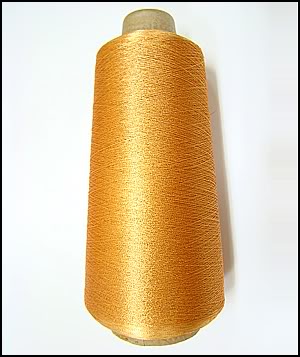
And, just because pictures are fun, here’s a pic of the kinshi thread, from the vendor’s website (the real thread hasn’t arrived yet):

kinshi thread
kinshi thread

Kinshi thread is made by coating a core thread with gold dust (yes, real gold) – very hard to find and also very expensive, so when I found three cones at an almost-reasonable price, I snapped them up. It will be interesting to try working with it!

Filed Under: All blog posts, textiles, weaving Tagged With: phoenix rising, phoenix rising kimono

  • « Previous Page
  • 1
  • 2
  • 3
  • 4
  • Next Page »

Archives

Tags

aids lifecycle outfits autumn splendor book cashmere coat cats celtic braid coat color study cross dyeing design design class devore doubleweave doubleweave shawls drawing dye samples dye study group gradient colors house infinite warp jacquard loom katazome knitted blanks kodachrome jacket ma's memorial mohair coat network drafted jacket/shawl project network drafting painted warp phoenix rising phoenix rising dress phoenix rising kimono phoenix rising reloaded pre-weavolution project sea turtles taquete tie-dye tied weaves tomatoes velvet weaving drafts web design website redesign wedding wedding dress woven shibori

Categories

  • Africa
  • aids lifecycle
  • All blog posts
  • All travel posts
  • Asia
  • Bangkok
  • Belize
  • Cambodia
  • Central America
  • Chai Ya (Wat Suon Mok)
  • Chiang Mai
  • Chiang Rai (Akha)
  • China
  • chocolate
  • computer stuff
  • creating craft
  • Creative works
  • cycling
  • Delhi
  • Dharamsala
  • drawing
  • dyeing
  • Fiber Arts
  • finished
  • food
  • garden
  • Ghana
  • Guatemala
  • Hanoi
  • Ho Chi Minh City
  • Hoi An
  • India
  • Khao Lak
  • Knitting
  • knitting
  • Ko Chang
  • Laos
  • Luang Namtha
  • Luang Prabang
  • markleeville death ride
  • meditations on craft
  • mental illness
  • musings
  • Phnom Penh
  • powerlifting
  • Rewalsar (Tso Pema)
  • sewing
  • Siem Reap (Angkor Wat)
  • Southeast Asia
  • surface design
  • textiles
  • Thailand
  • travel
  • Vangvieng
  • Vientiane
  • Vietnam
  • Warp & Weave
  • weaving
  • Weaving
  • weavolution
  • writing

© Copyright 2025 Tien Chiu · All Rights Reserved ·


Loading Comments...