Tien Chiu

  • Home
  • About Tien
  • C.V.
  • Online Teaching
  • Works
  • Essays
  • Travels
  • Book
  • Blog
  • Dye samples
You are here: Home / Archives for design

December 28, 2013 by Tien Chiu 3 Comments

Studying design

Alas, Emmy the 40 shaft loom did not arrive on Friday. I called the shipper around 2:30 and was told that the arrival date was the date the loom would arrive at the terminal and that getting it out to me would require an appointment and some additional time. (Which was contrary to the reassurances I’d gotten until then!) Aargh! I am doing my best not to stomp around the house shouting. But I must admit that it’s taking considerable effort not to pout.

(I’m not exactly why waiting for the loom is so stressful for me – perhaps because the loom has been the main focus of my life for quite some time, and swapping out to a new loom will be a huge change. Also, I’m terrible at sitting around and waiting.)

At any rate, the loom will not arrive until Monday or Tuesday, and to keep my sanity until then, I need to stay busy. So today I’m going to start a new project. I’ve been thinking I would like to start a systematic study of design, spending about half an hour a day on design exercises – both taking a critical look at others’ designs and making new designs of my own. Half an hour is enough time to do a single short exercise, and doing it consistently means that, over the course of a year, I’ll have spent 180+ hours studying design. Hopefully that will produce results!

Anyway, my plan is to work my way through design exercises from one of my many books on design. I am currently leaning toward Joen Wolfrom’s Adventures in Design (which is about two-dimensional design in the context of art quilts), but someone in my Designing Fabrics Study Group suggested a different book, which I have ordered and will examine once it arrives.

I’m also planning to start a notebook – an art journal of sorts – doing a different design every morning. I had originally planned to make the notebook 9 x 12, which is big enough to do interesting designs, but not overwhelmingly large. However, if I’m doing other design exercises on the same day, it might be better to go with a smaller format – perhaps a 3 x 5 or 4 x 6 index card. Media will be whatever strikes my fancy. I am overequipped for multimedia work – pastels, colored pencils, watercolor pencils, acrylic paints, fabric, colored papers, stamps, stencils….you get the idea. The one thing I don’t have is a broad color palette of fabric, but since Joann’s is having a 99-cent fat quarter sale starting tomorrow, I figure I can get a pretty wide range of colors relatively inexpensively.

And, I’m starting to retrospect on 2013, and put together plans for 2014. More on that later.

In honor of Boxing Day (which was last Thursday), I offer you two kittens in a box:
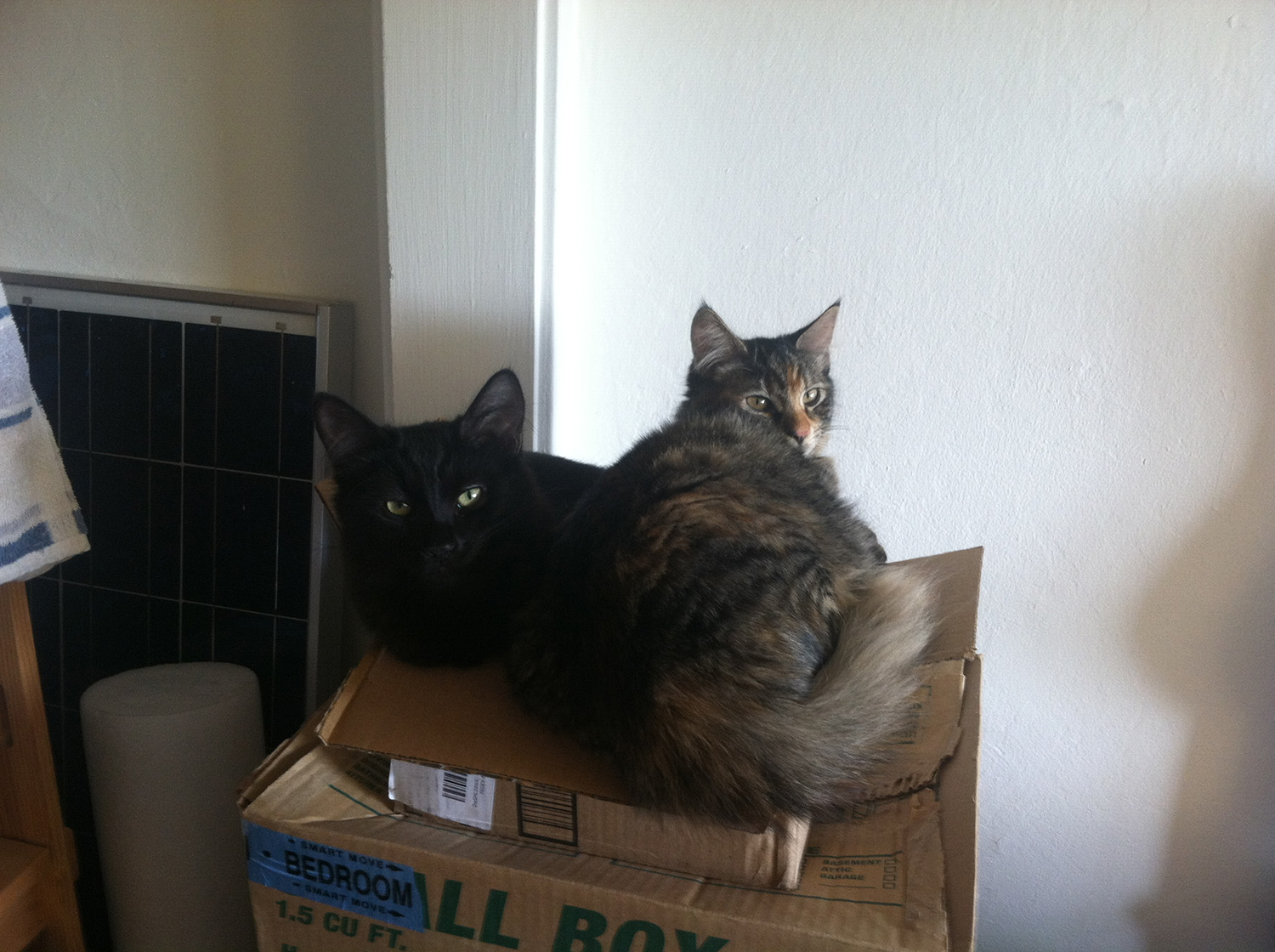
two kittens in a box!

Last month, of course, they fit in the box a lot better (yes, it’s the same box):
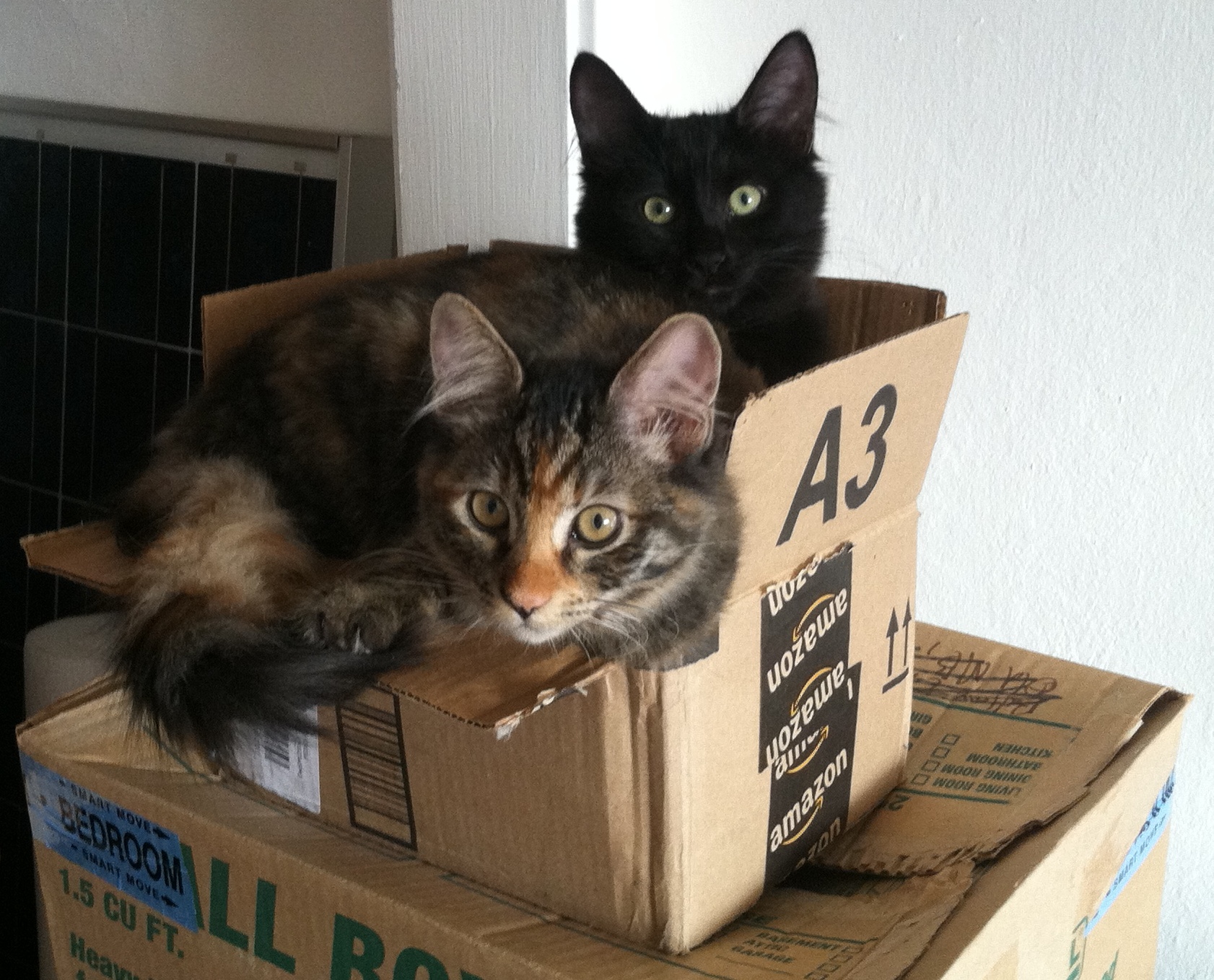
Cats in a box!
Cats in a box!

Yeah, I’d say they’re growing. ๐Ÿ™‚

Filed Under: All blog posts, textiles Tagged With: design

May 10, 2013 by Tien Chiu 2 Comments

Design analysis, Design Poker

Yesterday, after flipping through several hundred photos of couture dresses, I selected fourteen that struck my eye. They weren’t designs I would want to use, necessarily, but each of them had one or more features that drew my attention.

So this morning I went through them and did a bit of design analysis. I had two aims. The first was educate my eye about design by doing an informal analysis: where are the focal points? Where is the eye drawn, what is the balance of the piece? How does the eye move through the piece? What is the overall mood and why?

The second aim was to figure out what had caught my eye in each piece, and capture those ideas on index cards so I could play Design Poker with them.

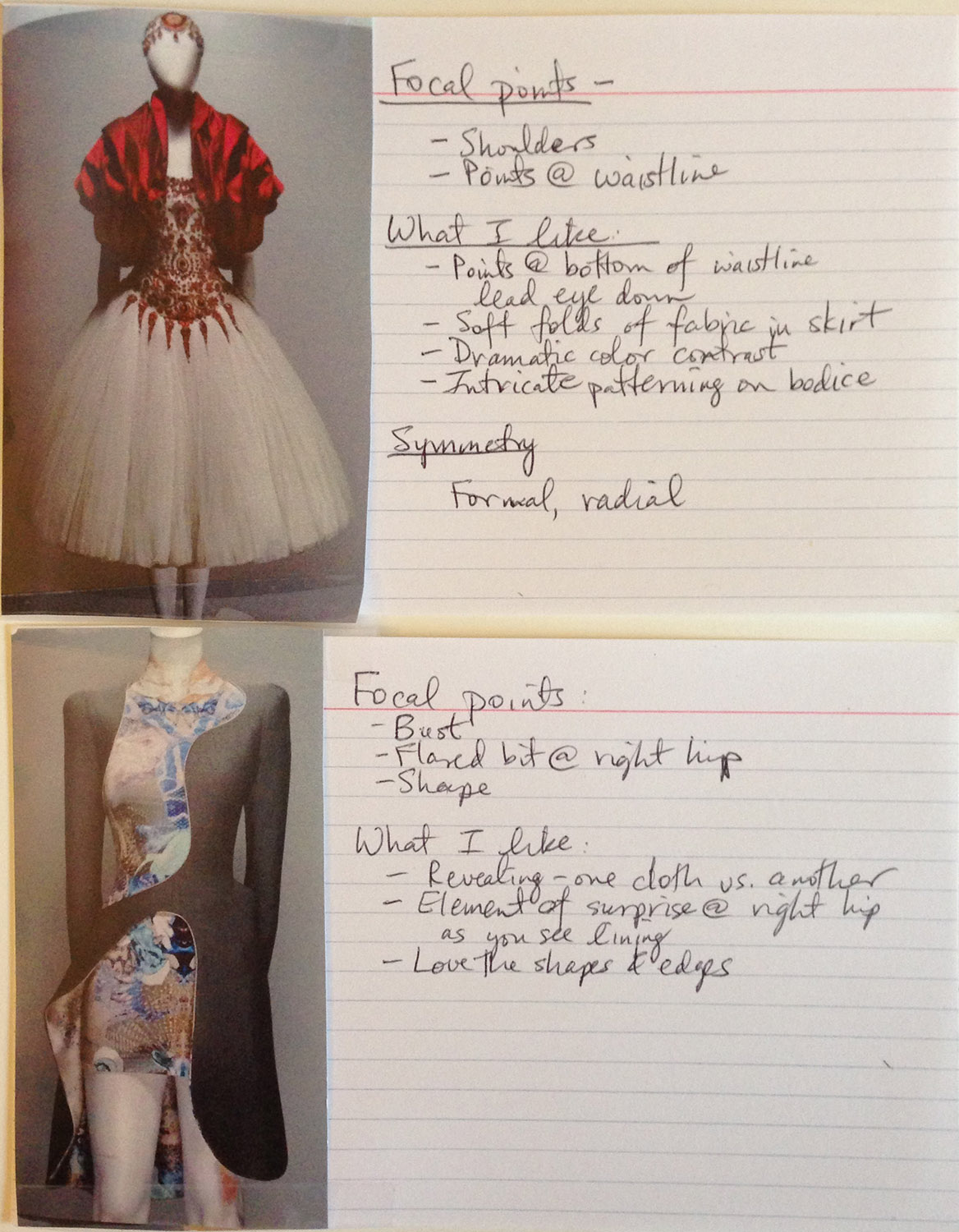
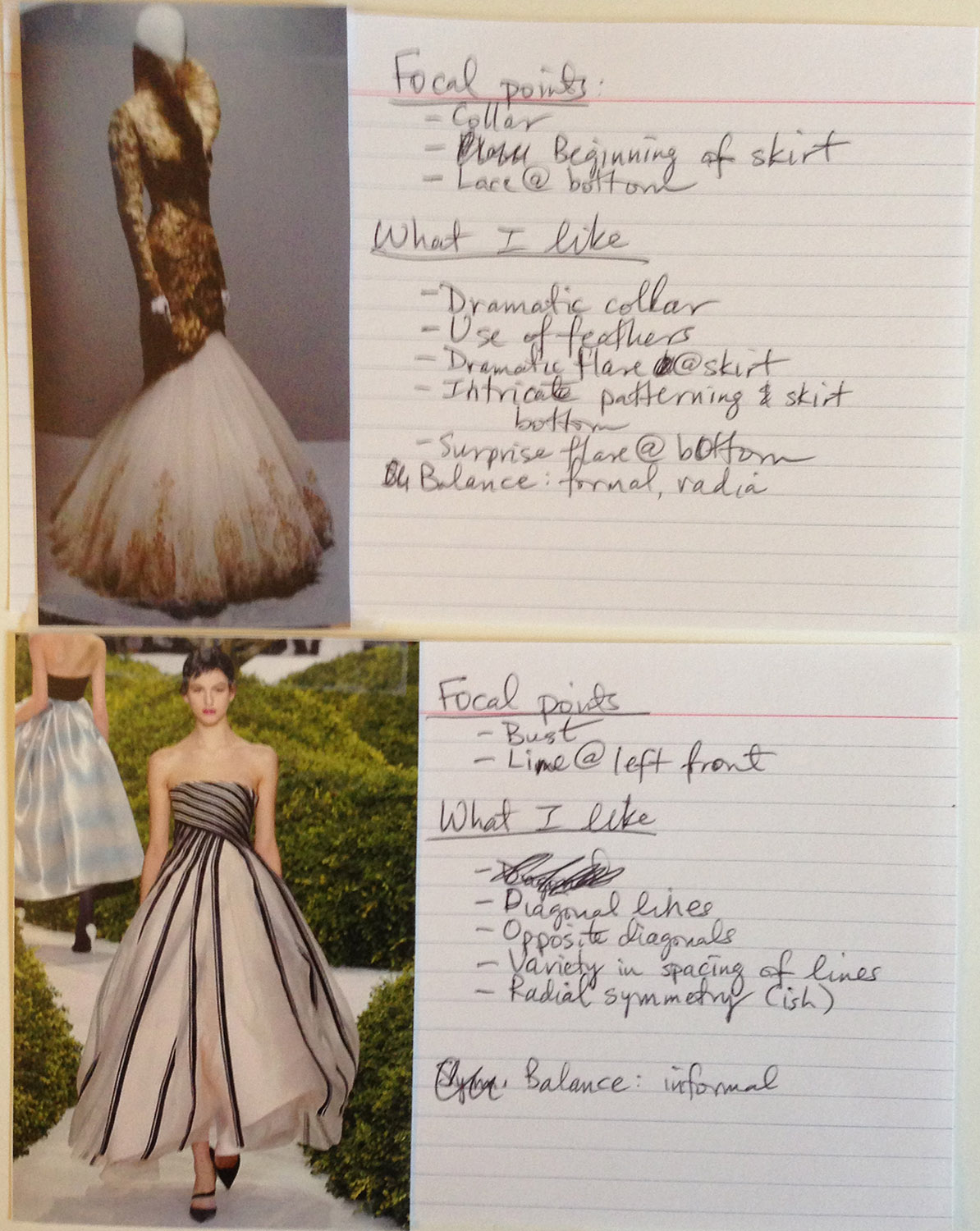
To give you an idea of what this was like, here are four of the design analysis index cards (click for a bigger version)

design analysis 2 design analysis 1

As I made each card, I captured the ideas I liked on index cards, scribbling a few words for each concept. When I was done, I had a set of sixteen cards, and was ready to play Design Poker. I “dealt” a hand of five cards, set a timer for fifteen minutes, and sketched five designs inspired by those five ideas before the timer went off.

They weren’t great designs, of course – the purpose of Design Poker is to brainstorm ideas. The timer is what keeps you moving – with an average of three minutes per design, the most you can do is scribble down ideas. This is intentional; otherwise it’s too easy to spend hours on a single design concept. In the early stages, I want lots of design ideas; later, I’ll condense and improve the best of the ideas into two or three working designs.

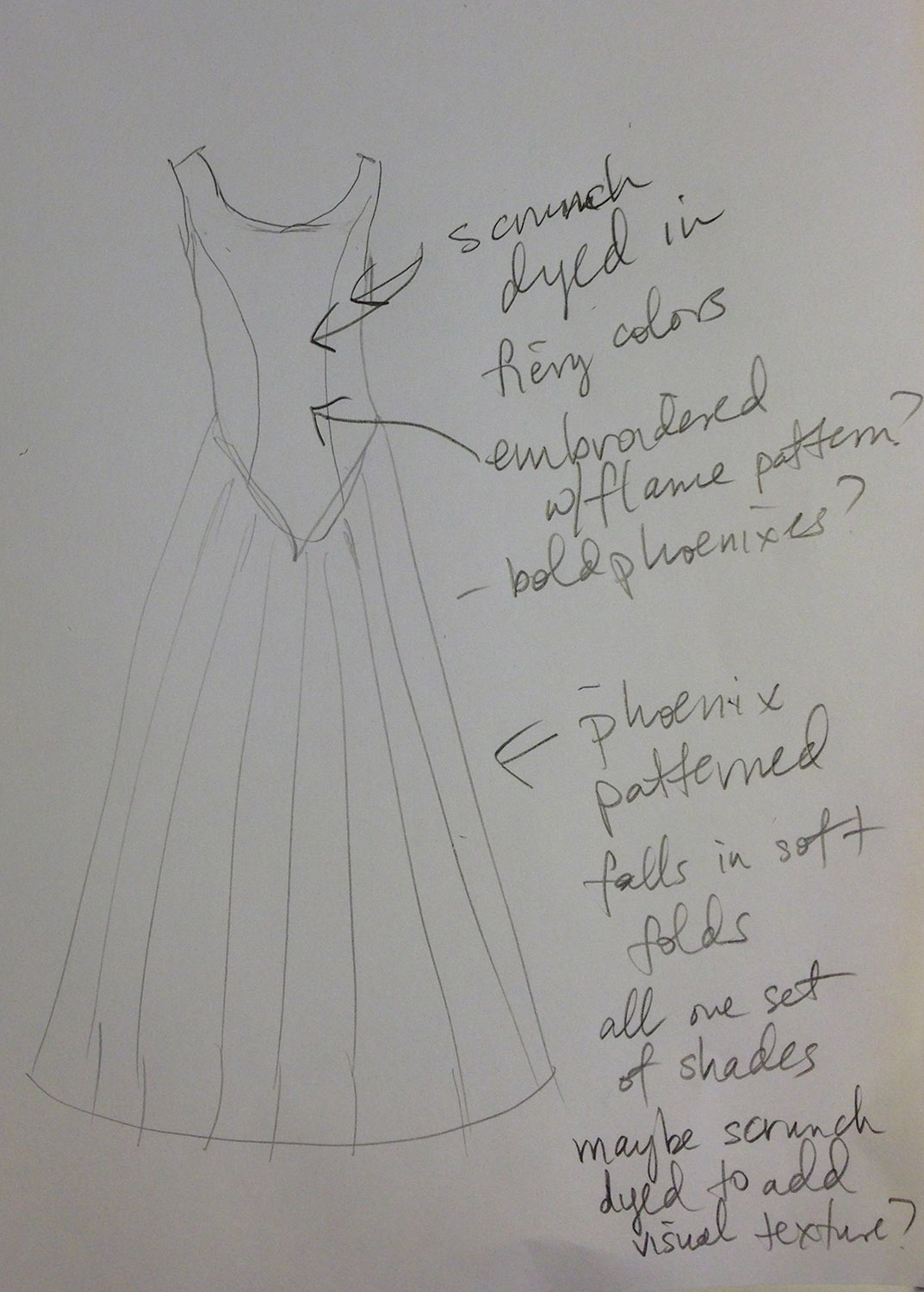
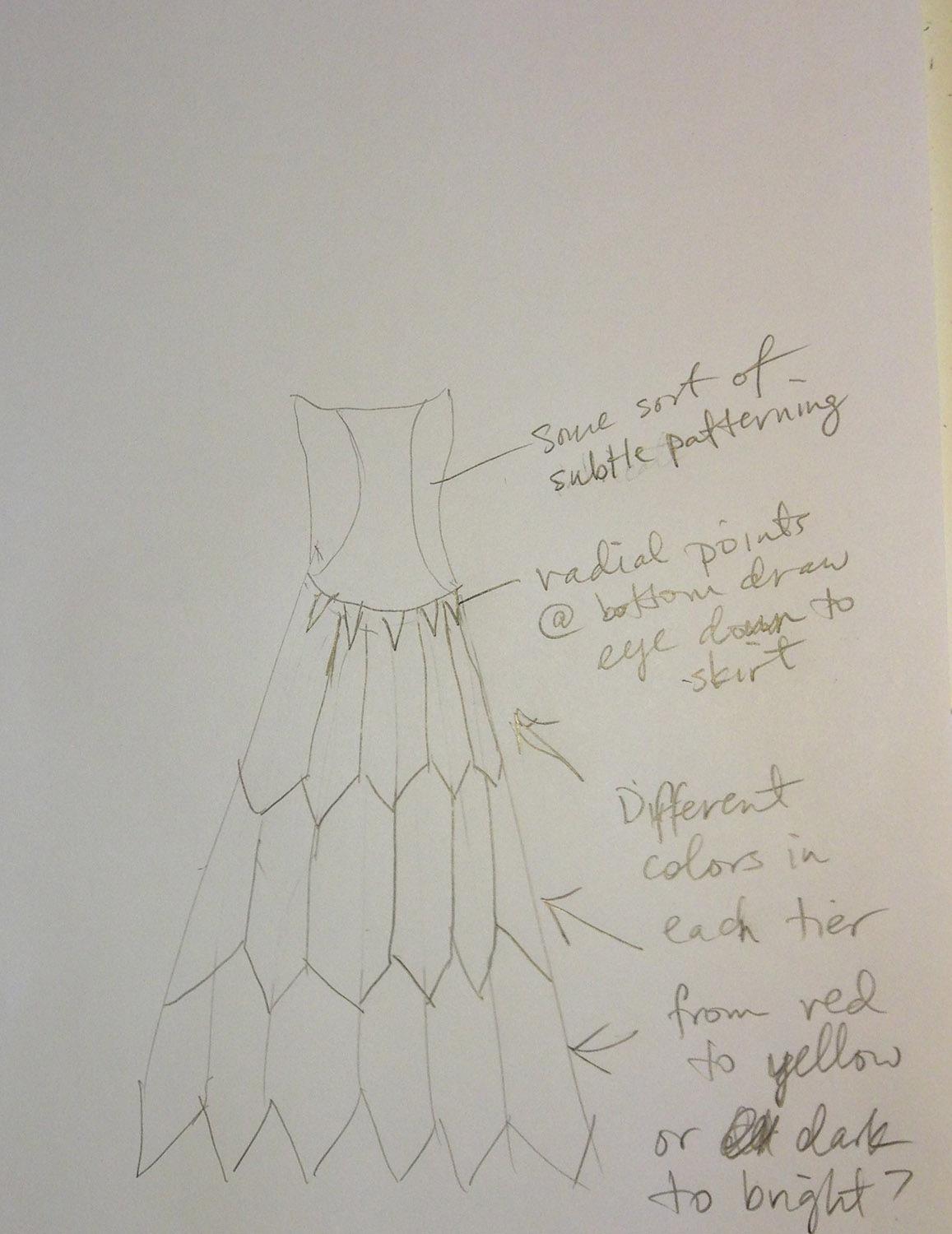
Here are some of the five designs I made:

design 1 design 2 design 3

As you can see, the designs are fairly crude and the ideas are not developed. That’s the idea for this round!

My next step is two more rounds of Design Poker with the remaining cards. After that, I’ll look at the designs, extract the better ideas from the more successful ones, and start consolidating things down to three or four working designs. I’ll develop those designs a little more fully, and then start draping and experimenting to “vet” those designs before settling on one to work with.

But first, I need to do some prep work. Some friends are coming over for a tie-dye party on Sunday, and I need to prepare! (As in, clean the work area, make sure I have all the requisite equipment, etc.) I also want to pre-tie some shirts, as some of my designs are fairly complex.

Filed Under: All blog posts, sewing, textiles, weaving Tagged With: design, design poker, fashion design, phoenix rising, phoenix rising dress

December 22, 2012 by Tien Chiu Leave a Comment

Design principles

I’m currently writing the section in my book blog on design principles, and since it would take far too long to cover two and three dimensional design in its entirety, I’m trying to pick out a few critical principles – both of how design works and how to create a good design. (Here I’m talking about visual design, not functional design.)

This feels rather like trying to summarize the physics of electromagnetism in three sentences or less, but here’s a sketch of what I’m thinking:

Design Rules:

  1. The eye is drawn to contrast – of value, color, texture, etc.
  2. Think “gravity” – our reaction to horizontal, vertical, diagonal lines, our sense of visual “balance” in a piece, etc. are all affected by gravity.
  3. Color sets mood. What do you associate with a given color? That will govern how you react to a chunk of that color.
  4. The eye is drawn to motion or the appearance of motion, both of which feel more exciting than something static.

Design Principles

  1. Know your focal points and use them consciously
  2. Give the eye a route through a piece
  3. Strive for visual balance (between unity/variety, shapes, etc.) except when you are deliberately unbalancing the figure.
  4. Consider the balance of colors that is setting your mood.

The distinction between a design rule and a design principle is that a design rule is a general rule that governs how people react to different visual designs; a principle is about ways to produce a better design.

I’m still mulling this over – so would love thoughts and comments on this – but had better start working and stop mulling soon, as I’m out of prewritten blog posts. I need to do a lot of writing this weekend!

Meanwhile, I’ve wound half the ground warp for the latest Phoenix Rising sample. Or rather, I had wound half the ground warp. Then I realized I had wound it incorrectly. Nothing to do but to cut it off the warping board, and start again. Much cursing, but at least I’ve only wasted an ounce of yarn. The advantages of weaving with fine threads!

So now I get to start again at square one. Oh well. C’est la vie, I guess.

Please do let me know what you think of the design rules/principles I’ve outlined, and if you have any to add!

Filed Under: All blog posts, textiles, weaving Tagged With: book, design

October 24, 2012 by Tien Chiu 5 Comments

How to think about design rules

While working on the book this morning, I was struck by the number of admonitions about “rules” in craft work – either laying down a list of things to do and not-do, or urging you to break all the rules and “just do it”.

I think both approaches are wrong.

There definitely are design rules, and being aware of them will lead to better design. But the rules don’t have any moral force; you’re not going to be a better or worse person (or artist) based on following or breaking the rules.

To me, design rules are more like the laws of physics. Some of them are probably biologically hard-coded, like the way the eye is drawn to movement. Others are culturally influenced, like the Western tendency to “read” two dimensional art starting at the top left. (That’s because most European languages read from left to right and top to bottom, so in Western tomes, one naturally starts by looking at the top left corner.) But put together, they describe the way the reader’s eye is likely to travel through the piece, and the emotional impact that the design will have on the viewer. That’s all.

It took me awhile to work out this understanding of “the rules”. Like everyone else, I started with a confused jumble of advice – “Don’t put blue with orange!” “Stick with one wedge of the color wheel!” and was afraid to break the rules lest I wind up with a hideous mess. I read through books on color theory and emerged only slightly less bewildered.

The trouble was that I was looking for a set of rules that said, “Do this! Do that!”, with the guarantee that as long as I did this and didn’t do that, I’d come up with a nice finished piece. I was looking for safety. But following the rules all the time is no way to live your life, and it’s also no way to create an interesting, original design.

After a long time, I realized that there really wasn’t any one magic formula for making a wonderful piece. In some ways designing a piece is like designing a bridge – you have to get from one point to another, but whether you choose a suspension bridge or a cantilevered bridge (or a blimp ferry service!) is entirely up to you, as are the choices about how to decorate it, what materials to use, etc. There are certainly tried-and-true ways to build bridges, and you might choose one of them for budget or efficiency reasons, but there are lots of different ways to achieve the same goal, getting people from one end to the other.

In the end, I realized that instead of “Thou shalts” on stone tablets, what I had was engineering guidelines – a set of rules for how the eye reacts to certain stimuli. And that was extremely empowering, because it meant I could design freely once I understood the principles. I quit asking the question, “What should I do to make good art?” and started asking, “How can I design this piece so the viewer reacts the way that I want?” The first is a child-like search for rules; the second makes it into a question of visual engineering – a question I can break down, analyze, and answer – intuitively or analytically, as I prefer.

What are these rules? Well, I’m still sorting them out – some are explicitly covered in the study of design, some are not. Here are a few:

  • The eye is drawn to contrast – in color, in shape, in size, etc. Put a small yellow block in a sea of deep purple, and the eye is instantly drawn to the contrasting color and size.
  • Horizontal lines are calming; vertical lines are more energetic; diagonal lines are most energetic.
  • The eye is drawn to movement or the appearance of movement – so put movement where you want to attract the eye.
  • Objects make more visual sense if the eye travels naturally through the piece – so connect the visually interesting spots to each other using “bridges” (a common color, a pointing finger, etc.) to let the eye travel naturally through the piece, isntead of getting “stuck” partway through.

I’m still compiling the list of design rules – obviously there are a bazillion of them, but I’m trying to sort out the most important ones to include in the book. I think the most vital thing is to explain how the eye moves and what it is attracted to, and the second most vital thing is information on how to set the “mood” of a piece using color. But tell me – what else am I missing? What other rules should I include?

Filed Under: All blog posts, musings Tagged With: design

October 23, 2012 by Tien Chiu 7 Comments

Adapting existing designs

I’m now about two weeks ahead on the book blog, and have come to the section on generating new designs from existing ones. It’s really forced me to think about how an existing design can be adapted.

I started with SCAMPER, which is a tool used by designers to create new designs from old.ย  It’s well explained here, so I’m not going to go into detail about it in this post. I didn’t feel that all of it applied to craft, however, so I devised my own list of techniques, partially based onย  SCAMPER:

  • Substitute. This is probably the most commonly used method in craft. Basically you take an existing project and swap out one aspect of the project, substituting something else: a different material, a different color, a different pattern.
  • Add a technique. Combine two techniques in a new way. Take a woven project and embroider it, or paint it.
  • Eliminate or elaborate. Either strip the design down to basics or make it completely baroque. See what you come up with. Then try something in between.
  • Use for a different purpose. Can a quilt be a baby carrier? Can it become a shawl, or a jacket?
  • Rearrange elements. Change the locations of embellishments, rotate the pattern, flip it mirror-image.

Since there are five of them, I’m trying to figure out how to name these so they fit the acronym REUSE. Wouldn’t that be cool? If you can figure out how to do it, drop me a line or leave a comment!

I’ve also decided on the examples for this series of posts. I’m going to use quilts! It’s easy to swap out colors, materials, etc. for quilt blocks (and can make quite a difference if you do!), and the simpler quilt blocks are also quick and easy to make, so I can do my examples in a day or two. This is much better than trying to work in woven examples, because setting up the loom to weave all the examples would take way longer than I’ve got. It also provides some diversity in craft examples.

So the next few days, I’ll be working on designing and making my examples using pieced quilt blocks. Since I haven’t quilted outside of my foundation piecing class a few months back, I’m going to work with a very simple design from a book titled Singular Sensations: 14 Great quilts from one simple block, by Barbara Douglas. It’s quick and easy to assemble, and can be strip-pieced, making production even faster. I’ll use my own designs instead of hers, of course, but the basic block is marvelously adaptable. Hopefully it will let me churn out enough samples in time!

A parting question: How do you approach adapting a design? What techniques or methods do you use?

Filed Under: All blog posts, sewing, textiles Tagged With: book, design

  • « Previous Page
  • 1
  • 2
  • 3
  • 4
  • 5
  • Next Page »

Archives

Tags

aids lifecycle outfits autumn splendor book cashmere coat cats celtic braid coat color study cross dyeing design design class devore doubleweave doubleweave shawls drawing dye samples dye study group gradient colors house infinite warp jacquard loom katazome knitted blanks kodachrome jacket ma's memorial mohair coat network drafted jacket/shawl project network drafting painted warp phoenix rising phoenix rising dress phoenix rising kimono phoenix rising reloaded pre-weavolution project sea turtles taquete tie-dye tied weaves tomatoes velvet weaving drafts web design website redesign wedding wedding dress woven shibori

Categories

  • Africa
  • aids lifecycle
  • All blog posts
  • All travel posts
  • Asia
  • Bangkok
  • Belize
  • Cambodia
  • Central America
  • Chai Ya (Wat Suon Mok)
  • Chiang Mai
  • Chiang Rai (Akha)
  • China
  • chocolate
  • computer stuff
  • creating craft
  • Creative works
  • cycling
  • Delhi
  • Dharamsala
  • drawing
  • dyeing
  • Fiber Arts
  • finished
  • food
  • garden
  • Ghana
  • Guatemala
  • Hanoi
  • Ho Chi Minh City
  • Hoi An
  • India
  • Khao Lak
  • knitting
  • Knitting
  • Ko Chang
  • Laos
  • Luang Namtha
  • Luang Prabang
  • markleeville death ride
  • meditations on craft
  • mental illness
  • musings
  • Phnom Penh
  • powerlifting
  • Rewalsar (Tso Pema)
  • sewing
  • Siem Reap (Angkor Wat)
  • Southeast Asia
  • surface design
  • textiles
  • Thailand
  • travel
  • Vangvieng
  • Vientiane
  • Vietnam
  • Warp & Weave
  • weaving
  • Weaving
  • weavolution
  • writing

© Copyright 2025 Tien Chiu · All Rights Reserved ·

Loading Comments...